
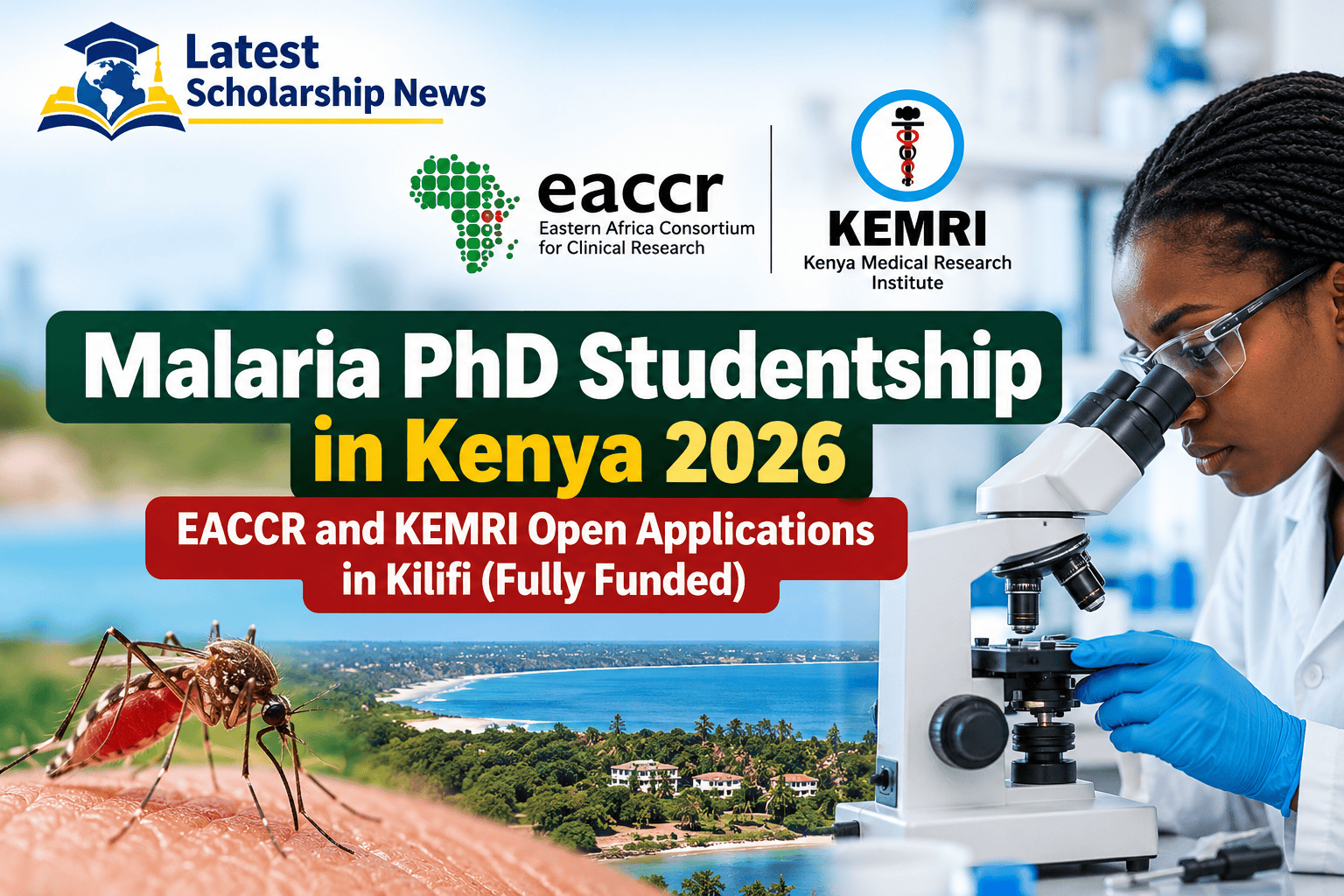
Apply for This Malaria PhD Studentship in Kenya 2026: EACCR and KEMRI Open Applications in Kilifi (Fully Funded)
Are you looking for a PhD research opportunity in malaria, immunology, molecular biology, or public health? The Eastern Africa Consortium for Clinical Research (EACCR), in partnership with the Kenya Medical Research Institute (KEMRI), has announced a Malaria PhD Studentship based in Kilifi, Kenya, for qualified researchers interested in advancing malaria research.
The opportunity is intended for candidates who want to build long-term careers in malaria research and contribute to efforts to improve malaria prevention, diagnosis, treatment, and control across Africa.
Successful applicants will have the opportunity to undertake research in an established scientific environment, with access to laboratory facilities and research activities involving molecular biology and field data collection.
Applications are open, and interested candidates should review the eligibility requirements and prepare their documents before the deadline.
Malaria PhD Studentship in Kenya 2026: Overview
Here are the key details applicants should know about this opportunity.
- Programme Name: Malaria PhD Studentship
- Host Institution: Kenya Medical Research Institute (KEMRI)
- Partner Organisation: Eastern Africa Consortium for Clinical Research (EACCR)
- Location: Kilifi County, Kenya
- Study Level: PhD
- Research Area: Malaria research and related biomedical sciences
- Eligible Applicants: Candidates with relevant master’s degrees who meet the stated requirements
- Funding: Advertised as a funded studentship; applicants should confirm the exact financial benefits with the organisers
- Application Deadline: Monday, 26 October 2026, at 5:00 p.m.
- Official Application Portal: Apply through the EACCR portal
About the EACCR and KEMRI Malaria PhD Studentship
Malaria remains a major public health challenge in many African countries, making scientific research essential to improving prevention, diagnosis, and treatment.
The Malaria PhD Studentship offered through EACCR and KEMRI is designed for researchers who want to contribute to this important field. The position is based in Kilifi, Kenya, where KEMRI conducts research into infectious diseases, disease epidemiology, immunology, and molecular biology.
The opportunity is particularly relevant to candidates with backgrounds in immunology, molecular biology, biochemistry, biotechnology, bioinformatics, public health, or related disciplines.
Applicants should be prepared to commit to doctoral research and work in Kilifi County for the duration of their studies.
Benefits of the Malaria PhD Studentship
The studentship provides an opportunity to develop advanced research skills while contributing to malaria-related scientific work.
Potential professional and academic benefits include:
1. Advanced Research Experience
Candidates can develop their research expertise in malaria and related biomedical sciences through practical scientific work.
2. Laboratory and Field Research Exposure
The advertised requirements highlight experience with molecular biology techniques and field data collection. This makes the opportunity relevant to researchers interested in combining laboratory investigations with public health research.
3. Professional Development
Working in a research environment can help candidates strengthen their analytical skills, scientific communication, research methods, and understanding of infectious diseases.
4. Contribution to Malaria Research
The opportunity offers a pathway for researchers seeking to contribute to scientific knowledge and malaria control efforts in Africa.
Important funding note: Although the opportunity is advertised as a fully funded studentship, the available announcement does not clearly specify the stipend amount, tuition coverage, accommodation, travel allowance, or other financial benefits. Applicants should contact the organisers or consult the official vacancy notice to confirm precisely what the funding covers before making financial plans.
Eligibility Requirements
Candidates must satisfy the academic, technical, and professional requirements stated in the official announcement.
1. Relevant Master’s Degree
Applicants must hold a master’s degree, or an equivalent qualification from a recognised university, in one of the following fields:
- Immunology
- Molecular Biology
- Biochemistry
- Biotechnology
- Bioinformatics
- Public Health
- A related discipline relevant to the research
Applicants should ensure that their qualifications are relevant to the advertised research position.
2. Molecular Biology Skills
Candidates should have practical experience with relevant laboratory techniques. These may include:
- Polymerase chain reaction (PCR)
- Reverse transcription PCR (RT-PCR)
- DNA sequencing
- Cell culture
- Microscopy
Applicants should clearly describe their relevant laboratory experience in their CV.
3. Research and Data Analysis Experience
Candidates must demonstrate proficiency in statistical methods and data analysis software.
Experience with field data collection, supporting research activities, and coordinating fieldwork is also important.
4. Strong Communication Skills
Applicants must have excellent written and verbal communication skills in English.
These skills are important for preparing research documents, communicating findings, working with research teams, and presenting scientific results.
5. Commitment to Malaria Research
Candidates must demonstrate an intention to pursue a long-term career in malaria research.
The motivation letter should explain why the applicant is interested in the field and how the proposed doctoral research fits into their future career plans.
6. Willingness to Work in Kilifi, Kenya
Applicants must be willing to commit to working in Kilifi County for the duration of their studies.
Candidates should consider the location and research commitment before applying.
7. Current PhD Registration
Proof of current registration in a PhD programme at a recognised local or international university, within the first year of study, is listed as an added advantage.
This is not presented as a mandatory requirement in the vacancy announcement, so prospective applicants should read the official notice carefully.
8. Research Publications and Scientific Presentations
A record of research publications in peer-reviewed journals or presentations at scientific meetings can strengthen an application.
Previous publications related to the project’s research themes are listed as an added advantage.
Required Documents
Interested candidates must prepare the documents specified in the official vacancy announcement.
1. Motivation Letter
Prepare a motivation letter of no more than two pages.
Your letter should explain:
- Your academic and professional background.
- Your relevant research and laboratory experience.
- Why you want to undertake a PhD in malaria research.
- Your research interests and learning objectives.
- Your expectations from the programme.
- Your career plans after completing the PhD.
Make your letter specific to the advertised opportunity rather than submitting a generic application.
2. Curriculum Vitae
Submit a recent CV of no more than three pages.
Your CV should include your academic qualifications, employment history, relevant research experience, laboratory skills, and a list of peer-reviewed publications, if applicable.
Ensure that your contact details are correct and that your most relevant qualifications and experience are easy to identify.
3. Academic Transcripts and Certificates
Applicants must provide certified copies of their academic transcripts and relevant certificates for both their bachelor’s and master’s degrees.
Check that the documents are legible and meet the certification requirements specified by the organisers.
4. Two Professional Reference Letters
Applicants must provide two supporting reference letters:
- One academic reference.
- One professional or social reference.
The references should include the official contact information requested in the vacancy announcement, such as institutional addresses, work telephone numbers, and official email addresses where applicable.
5. Applicant Contact Information
Provide your current email address and telephone number so the organisers can contact you regarding your application.
Before submitting, confirm that all required documents are included and follow the instructions on the official application portal.
How to Apply for the Malaria PhD Studentship in Kenya 2026
Qualified candidates can follow these steps to submit an application.
Step 1: Read the Official Announcement
Visit the official EACCR vacancy page and review the complete requirements, responsibilities, and application instructions.
Step 2: Prepare Your Motivation Letter
Write a clear motivation letter explaining your research background, interest in malaria research, relevant experience, and long-term career objectives. Keep it within the two-page limit.
Step 3: Update Your CV
Prepare a recent CV of no more than three pages. Highlight your relevant laboratory techniques, research experience, data analysis skills, publications, and academic qualifications.
Step 4: Gather Your Academic Documents
Prepare certified copies of your bachelor’s and master’s degree certificates and transcripts.
Step 5: Contact Your Referees
Arrange the two required reference letters in advance. Ensure that the referees provide the professional contact information requested in the announcement.
Step 6: Submit Your Application
Visit the official EACCR application portal below and follow the instructions provided for the Malaria PhD Studentship in Kilifi.
Official application link: https://eaccr.org/Malaria_PhD_Studentship-Kilifi
Step 7: Submit Before the Deadline
The stated deadline is Monday, 26 October 2026, at 5:00 p.m. Make sure your application is submitted before the closing time and retain any confirmation of submission.
Application Deadline
The application deadline for the EACCR and KEMRI Malaria PhD Studentship in Kilifi, Kenya, is Monday, 26 October 2026, at 5:00 p.m.
Applicants are encouraged to prepare their documents early rather than waiting until the final day.
Check the official vacancy page for any updates to the deadline or application instructions.
Can International Applicants Apply?
The vacancy announcement refers to recognised universities locally and internationally when discussing the added advantage of current PhD registration. However, this wording does not by itself establish that applicants of every nationality are eligible.
International candidates, including applicants from Nigeria and other African countries, should review the complete official announcement or contact EACCR to confirm nationality restrictions, any residency requirements, and whether international applicants can be considered.
Candidates should also clarify any requirements relating to university registration, relocation, and permission to study or work in Kenya before making arrangements.
Why Consider a PhD in Malaria Research?
A PhD in malaria research can help qualified scientists develop specialist knowledge in infectious diseases, immunology, molecular biology, and public health.
Researchers in this field may contribute to studies on malaria parasites, disease transmission, diagnostic methods, treatment effectiveness, and strategies for reducing the burden of malaria.
For candidates who enjoy scientific investigation and want to build careers in biomedical research, this opportunity may be worth considering.
However, prospective applicants should carefully evaluate the research commitment, funding arrangements, and academic requirements before accepting a position.
Frequently Asked Questions
1. Is the Malaria PhD Studentship in Kenya fully funded?
The opportunity is advertised as a fully funded studentship. However, the available announcement does not provide a detailed breakdown of the financial package. Applicants should confirm the stipend, tuition coverage, and any additional benefits directly with EACCR or KEMRI.
2. What is the deadline for the application?
The stated deadline is Monday, 26 October 2026, at 5:00 p.m.
3. What qualifications are required?
Applicants must hold a master’s degree in immunology, molecular biology, biochemistry, biotechnology, bioinformatics, public health, or a related field.
4. Is previous PhD registration compulsory?
No. The vacancy announcement lists proof of current PhD registration within the first year at a recognised university as an added advantage rather than a mandatory requirement.
5. Where is the studentship located?
The position is based in Kilifi County, Kenya.
6. Can applicants from Nigeria apply?
The available announcement does not conclusively establish eligibility for every nationality. Nigerian applicants should confirm international eligibility and any additional requirements with the organisers before submitting their applications.
7. Where can I submit my application?
Applications should be submitted through the official EACCR vacancy portal:
https://eaccr.org/Malaria_PhD_Studentship-Kilifi
Final Thoughts
The EACCR and KEMRI Malaria PhD Studentship in Kilifi, Kenya, presents a research opportunity for qualified candidates who want to advance their careers in malaria research and related biomedical sciences.
Applicants with relevant master’s degrees, practical laboratory experience, data analysis skills, and a clear commitment to malaria research should review the requirements carefully and prepare a strong application.
Before applying, confirm the exact funding benefits and international eligibility conditions with the organisers. Submit all required documents by the stated deadline of 26 October 2026, at 5:00 p.m.
Apply here: EACCR and KEMRI Malaria PhD Studentship 2026
