
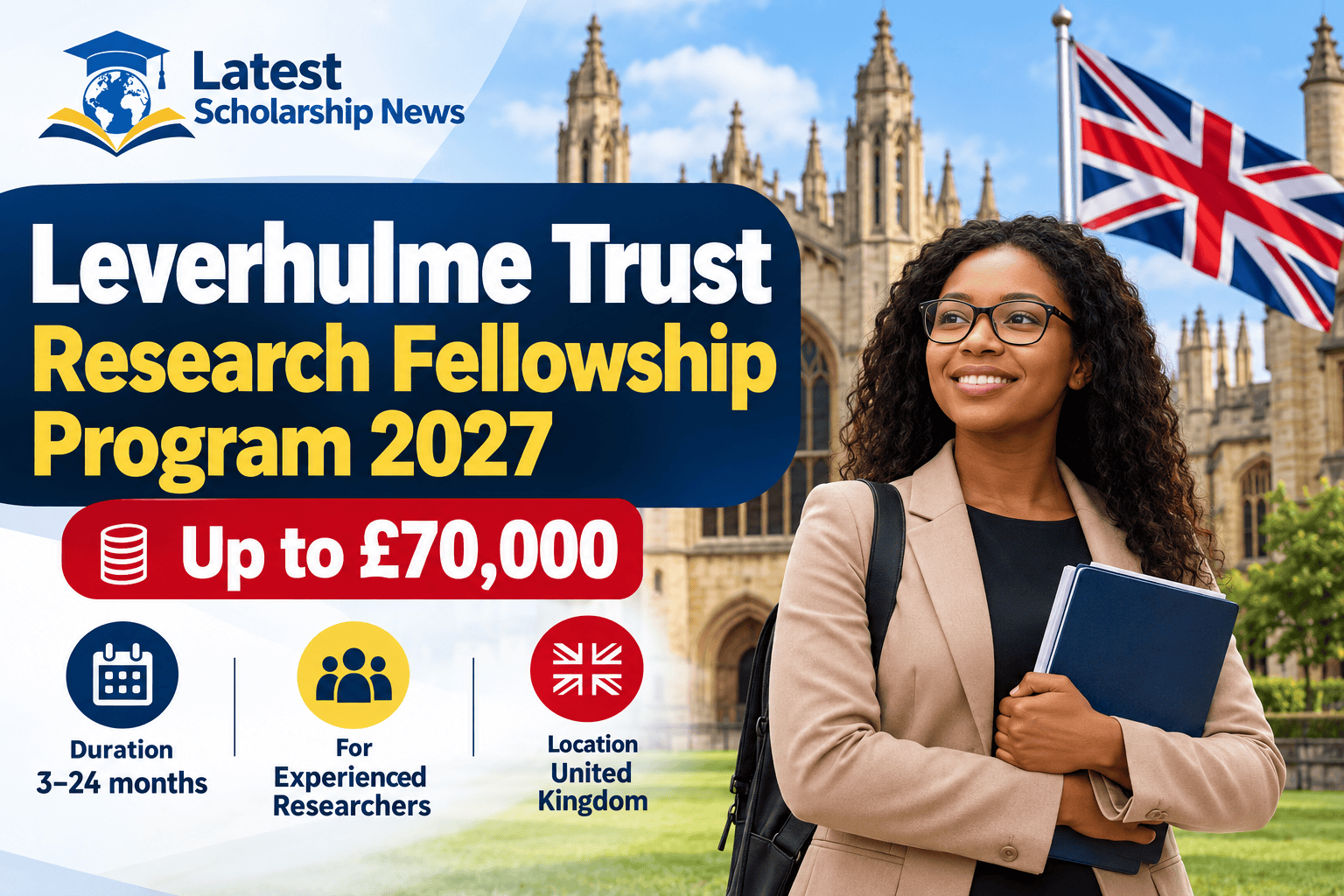
Leverhulme Trust Research Fellowships 2027: Up to £70,000 in Research Funding
Experienced researchers in the United Kingdom who need more time to focus on their academic work have an opportunity to apply for the Leverhulme Trust Research Fellowships 2027. The programme supports established researchers whose teaching and administrative responsibilities have made it difficult to complete their research projects.
The fellowship provides funding of up to £70,000 to help eligible researchers dedicate more time to an original research programme. Awards can last between three and 24 months, depending on the proposed project and the funding approved.
Unlike many scholarships designed for students, this opportunity is intended for experienced academics who already hold eligible positions at UK institutions. It may be particularly suitable for researchers who want to complete an existing research programme, develop original ideas, or make substantial progress on a project that has been delayed by routine academic responsibilities.
In this article, you will find information about the fellowship, its benefits, eligibility requirements, application deadline, and how to apply through the official programme website.
Leverhulme Trust Research Fellowships 2027: Overview
- Host organisation: The Leverhulme Trust
- Host country: United Kingdom
- Programme name: Leverhulme Trust Research Fellowships
- Fellowship year: 2027
- Funding amount: Up to £70,000
- Duration: 3–24 months
- Eligible applicants: Experienced researchers who meet the scheme’s employment and residency requirements
- Research areas: A wide range of academic disciplines, excluding medical research as defined by the Trust
- Application opening date: 7 September 2026
- Application deadline: 5 November 2026, at 4:00 p.m. UK time
- Application method: Online application through the Leverhulme Grant System
Applicants should consult the official guidance to confirm the requirements, eligible costs, and submission procedures before applying.
About the Leverhulme Trust Research Fellowships
The Leverhulme Trust Research Fellowships are designed to help experienced researchers undertake or complete research that might otherwise be delayed by their normal academic responsibilities.
University academics often balance lectures, student supervision, administrative duties, and departmental responsibilities alongside their research. These competing demands can make it difficult to dedicate sufficient time to an important research project.
The fellowship addresses this challenge by providing financial support that can help eligible researchers obtain dedicated research time.
The programme is particularly interested in applicants whose teaching and administrative responsibilities have significantly affected their ability to carry out research. Priority may be given to candidates who can demonstrate that these duties have had a substantial impact on their research activities during the preceding three years.
Researchers should note that this is a competitive research funding opportunity rather than a general scholarship for undergraduate or postgraduate students.
Benefits of the Leverhulme Trust Research Fellowships 2027
Successful applicants can receive financial support to help them concentrate on their proposed research.
1. Funding of up to £70,000
The fellowship offers a maximum award of £70,000. The amount awarded depends on the proposed research programme, its duration, and the costs permitted under the scheme.
Applicants should not assume that every successful candidate will receive the maximum amount.
2. Flexible Fellowship Duration
The fellowship can run for between three and 24 months, allowing researchers to propose a period that suits the needs of their research programme.
The proposed duration should be realistic and supported by a clear explanation of the work that needs to be completed.
3. Dedicated Research Time
A major benefit of the programme is the opportunity to devote substantially more time to research.
Eligible funding may contribute towards reasonable replacement costs, allowing an institution to arrange cover for certain teaching and administrative responsibilities while the researcher concentrates on the approved project.
4. Support for Original Research
The programme provides an opportunity to advance original research in eligible disciplines.
Applicants should explain what makes their proposed work important, how it builds on existing knowledge, and what they expect to achieve during the fellowship.
5. Opportunity to Complete an Important Research Programme
For academics whose research has been delayed by other responsibilities, the fellowship can provide valuable time to bring a project closer to completion.
The strongest applications should clearly explain why the research needs dedicated time and how the proposed fellowship would make a meaningful difference.
Important: The £70,000 figure represents the maximum award, not a guaranteed personal stipend. The funding should be understood according to the scheme’s permitted costs and approved budget.
Eligibility Requirements for the Leverhulme Trust Research Fellowships 2027
Applicants must satisfy the fellowship’s eligibility requirements before submitting an application.
1. Hold an Eligible Academic or Research Position
Applicants must hold an eligible position at a UK institution of higher education or another qualifying institution, such as a museum or art gallery.
The position must continue beyond the end of the fellowship.
Applicants should check the official guidance for the precise institutional and employment requirements applicable to their circumstances.
2. Be an Experienced Researcher
The fellowship is intended for established researchers, particularly those whose routine academic responsibilities have prevented them from undertaking or completing a research programme.
Applicants should demonstrate an established record of research in their chosen field.
3. Meet the UK Residency Requirement
Applicants must be resident in the United Kingdom at the time of application.
This requirement is particularly important for international researchers considering the opportunity.
Being a citizen of another country does not automatically establish eligibility. Applicants must satisfy the programme’s residency, employment, and other conditions.
4. Demonstrate an Established Research Track Record
Candidates must be permanent members of the UK scholarly community and demonstrate an established record in their research area.
Their application should provide evidence of relevant research experience and explain how their background prepares them to complete the proposed work.
5. Explain the Impact of Teaching and Administrative Duties
The Trust gives priority to applicants whose teaching and administrative responsibilities have significantly affected their research during the preceding three years.
Applicants should explain these challenges clearly and provide a convincing case for why the fellowship is necessary.
6. Propose Research Within the Scheme’s Scope
The proposed project must fall within the programme’s eligible research areas.
The Trust excludes medical research, so applicants should carefully review the official definition before deciding whether their proposed work qualifies.
A project should not be assumed eligible simply because it is hosted by a university or falls within a broadly recognised academic discipline.
Who Is This Fellowship Suitable For?
The Leverhulme Trust Research Fellowships may be suitable for:
- Experienced university academics with significant teaching responsibilities.
- Established researchers whose administrative duties have limited their research time.
- Eligible researchers seeking dedicated time to complete an original research programme.
- Academics working in disciplines covered by the Trust’s funding rules.
- Researchers with a clear project plan and a strong record in their chosen field.
The opportunity is not intended as a general funding route for students who want to finance an undergraduate degree, master’s programme, or PhD.
Applicants should also check the scheme’s restrictions on independent scholars, researchers in wholly or mainly research-focused positions, and other potentially ineligible categories.
Required Documents and Application Preparation
Applicants should consult the current official application guidance for the complete list of required materials.
Before starting an application, it is sensible to prepare the following information where requested:
1. Research proposal: Explain the research question, objectives, methods, and expected contribution to the field.
2. Academic CV: Provide a clear account of your research experience, relevant qualifications, and academic achievements.
3. Research track record: Identify relevant publications and other evidence of your contribution to your discipline.
4. Project timetable: Explain what you intend to accomplish during the requested fellowship period.
5. Budget and funding justification: Set out the costs for which support is requested and explain why they are necessary.
6. Institutional support: Contact your institution’s research office and department leadership early, as institutional approval is part of the application process.
This list is intended as a preparation guide. Applicants should follow the official requirements rather than assume that every item listed above is mandatory in every case.
How to Apply for the Leverhulme Trust Research Fellowships 2027
Eligible researchers should follow the official application process carefully.
Step 1: Visit the Official Programme Website
Start by visiting the Leverhulme Trust’s official website to read the Research Fellowships guidance.
Official website: https://www.leverhulme.ac.uk/
Look for the Research Fellowships programme and review the eligibility criteria, funding conditions, and application instructions.
Step 2: Confirm Your Eligibility
Check that your employment position, UK residency, research experience, and proposed project meet the scheme’s requirements.
If you are uncertain whether your research falls within the eligible scope, consult the Trust’s official guidance before proceeding.
Step 3: Contact Your Institution
Speak with your department head and research administration team as early as possible.
Your institution may need time to review your proposal, approve the application, and confirm the arrangements for your research period.
Do not wait until the final day to seek institutional support.
Step 4: Prepare Your Research Proposal
Develop a focused proposal that explains the research problem, your objectives, your methodology, and the results you hope to achieve.
Explain why the fellowship is necessary and how dedicated research time would help you complete the proposed work.
Step 5: Complete the Online Application
Applications are submitted through the Leverhulme Grant System.
Follow the current instructions, provide the required information, and upload the requested supporting documents.
Step 6: Obtain Institutional Approval and Submit Before the Deadline
Ensure that your application receives the necessary institutional approval and is submitted by the official deadline.
The application deadline for the 2027 Research Fellowships is 5 November 2026 at 4:00 p.m. UK time.
Applicants should check whether their institution has an earlier internal deadline.
Application Deadline
The deadline for the Leverhulme Trust Research Fellowships 2027 is 5 November 2026 at 4:00 p.m. UK time.
The programme opened on 7 September 2026.
As the institutional review process may take time, eligible researchers should begin preparing their applications as early as possible.
Applicants should verify the deadline and any subsequent updates on the official programme website before submitting.
Can International Applicants Apply?
International researchers should pay particular attention to the eligibility requirements.
Although the fellowship is associated with a UK-based funding organisation, applicants must meet the scheme’s UK residency requirement and hold an eligible position at a qualifying institution.
Therefore, researchers living outside the United Kingdom should not assume they are eligible simply because they have an academic position or research experience in another country.
Researchers from Nigeria and other countries should first establish whether they meet the residency, employment, and scholarly-community requirements.
If you are an international researcher currently based at an eligible UK institution, review the official rules carefully to determine whether you qualify.
Tips for Preparing a Strong Application
Because the fellowship is competitive, applicants should make a clear case for why their project deserves support.
Here are some practical steps to consider.
Explain the research problem clearly. Make it easy for reviewers to understand the question you want to answer and why it matters.
Demonstrate originality. Show how your proposed research contributes something meaningful to your field.
Explain why dedicated research time is necessary. Describe how teaching and administrative responsibilities have affected your research and why the fellowship would help.
Use a realistic timetable. Ensure that your objectives can be achieved within the requested fellowship period.
Justify the requested funding. Make sure the proposed costs are necessary, reasonable, and permitted by the scheme.
Follow the application instructions. Missing information or failure to meet eligibility requirements can undermine an otherwise promising application.
Seek institutional feedback early. Your department and research administration team may help identify weaknesses before the application is submitted.
Frequently Asked Questions
1. How much is the Leverhulme Trust Research Fellowship worth?
The maximum award is £70,000. The amount approved depends on the eligible costs and the details of the proposed research programme.
2. What is the duration of the fellowship?
Awards can last between three and 24 months, subject to approval.
3. Who can apply?
The scheme is intended for experienced researchers who meet the relevant UK residency, employment, institutional, and research-track-record requirements.
4. Can undergraduate or master’s students apply?
The fellowship is not a general undergraduate or master’s scholarship. It is designed for experienced researchers undertaking eligible research programmes.
5. Can researchers living in Nigeria apply?
Applicants must meet the UK residency requirement and hold an eligible position at a qualifying institution. Researchers living in Nigeria should not assume they qualify unless they meet these conditions.
6. Is the fellowship fully funded?
The programme provides awards of up to £70,000 towards eligible costs. However, applicants should not describe the award as a guaranteed personal stipend or assume that every research or living expense will be covered.
7. What is the application deadline?
The deadline is 5 November 2026 at 4:00 p.m. UK time. Applicants should confirm the details on the official website before applying.
8. Where can I apply?
Applications are submitted through the Leverhulme Grant System. Visit the official Leverhulme Trust website and navigate to the Research Fellowships programme for the current application instructions.
Final Thoughts
The Leverhulme Trust Research Fellowships 2027 offer a valuable opportunity for experienced researchers who need dedicated time to complete original research.
With awards of up to £70,000 and a duration of three to 24 months, the programme may be particularly useful for eligible academics whose teaching and administrative responsibilities have limited their research progress.
However, the fellowship is intended for a specific group of applicants. UK residency, an eligible institutional position, an established research record, and a suitable research proposal are important considerations.
Before applying, review the official requirements, consult your institution’s research office, and prepare your application well ahead of the deadline.
Official application and programme information: https://www.leverhulme.ac.uk/
- Applicants should rely on the Trust’s official guidance for the final confirmation of eligibility, funding conditions, and application procedures.
