
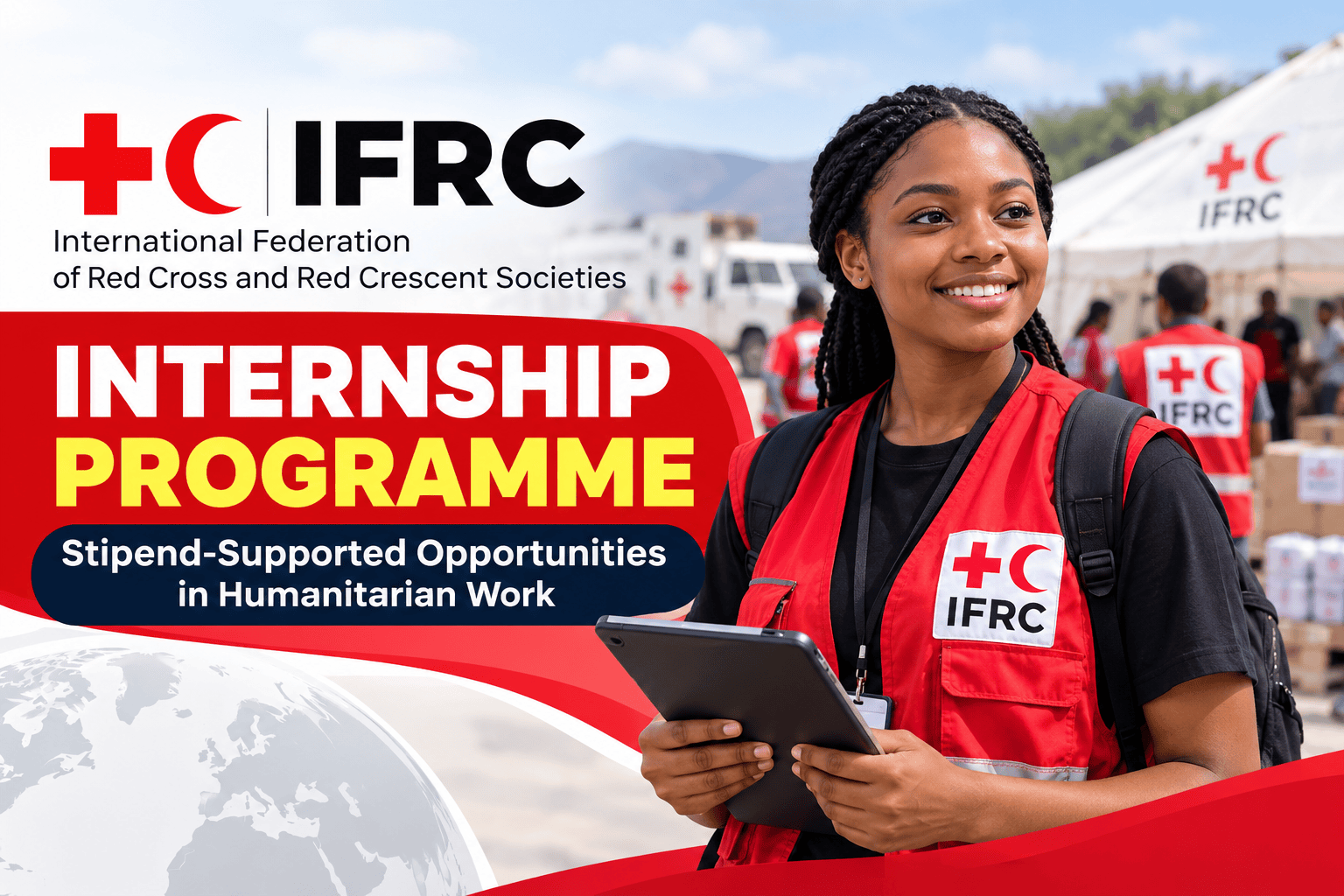
IFRC Internship Programme: Stipend-Supported Opportunities in Humanitarian Work
Are you a university student or recent graduate looking for practical experience in humanitarian work, international development or disaster response? The International Federation of Red Cross and Red Crescent Societies (IFRC) Internship Programme offers an opportunity to gain professional experience while contributing to work that supports vulnerable communities around the world.
Through its internship opportunities, the IFRC gives eligible students and recent graduates the chance to work alongside experienced professionals, develop workplace skills and learn more about humanitarian operations. Internship positions are available across different offices, with responsibilities depending on the department, location and current organizational needs.
One important benefit is that the IFRC provides a stipend to help interns cover expenses associated with their placement. However, the amount varies by office and is determined by the relevant Human Resources department.
In this guide, we explain what the IFRC Internship Programme involves, who can apply, the benefits available, the documents applicants may need and how to find and submit an application through the official recruitment portal.
Overview of the IFRC Internship Programme
The IFRC Internship Programme is designed to provide students and recent graduates with relevant work experience in a professional humanitarian environment.
The organization operates through a global network of National Red Cross and Red Crescent Societies, supporting communities affected by disasters, health emergencies, displacement and other humanitarian challenges.
Internships are generally arranged according to the organization’s staffing and operational needs. Consequently, opportunities may appear at different times of the year, and the available positions, locations, responsibilities and application deadlines can vary.
Here are the key details of the programme.
- Host organization: International Federation of Red Cross and Red Crescent Societies (IFRC)
- Programme type: Internship
- Location: Various IFRC offices worldwide, depending on available vacancies
- Eligible applicants: University students and recent graduates in relevant fields
- Financial support: A stipend to help cover internship-related expenses
- Stipend amount: Determined by the relevant IFRC office
- Language requirement: Fluency in written and spoken English
- Additional languages: French, Spanish or Arabic may be an advantage
- Work arrangement: Generally full-time, although some positions may be part-time
- Application method: Online application through the official IFRC jobs portal
- Application deadline: Varies according to the individual vacancy
Applicants should consult the official internship page and the relevant vacancy announcement for the most accurate information about a particular opportunity.
About the International Federation of Red Cross and Red Crescent Societies
The International Federation of Red Cross and Red Crescent Societies is a humanitarian organization that works with National Red Cross and Red Crescent Societies to support people affected by emergencies and other challenges.
Its work includes disaster preparedness, emergency response, community health, disaster risk reduction and strengthening the ability of communities to prepare for and recover from crises.
For students interested in humanitarian assistance, public health, communications, international relations, logistics or development work, an internship with the IFRC can provide useful exposure to the professional environment in which these activities take place.
Interns work under the supervision of relevant teams and contribute to assigned tasks according to their qualifications, skills and the requirements of the position.
Benefits of the IFRC Internship Programme
An internship can be an important step for graduates who want to understand how international humanitarian organizations operate. The IFRC programme offers several potential benefits beyond financial support.
1. Stipend Support
The IFRC states that interns receive a stipend to help cover expenses incurred during their internship.
The amount is determined by Human Resources in Geneva or the relevant office. Therefore, there is no single stipend figure that applies to every internship.
Applicants should check the individual vacancy announcement or request clarification from the relevant recruitment contact to understand the financial arrangements before accepting an offer.
It is also important to remember that a stipend does not necessarily cover every expense associated with living and working in another location.
2. Practical Work Experience
Interns have the opportunity to apply knowledge gained through their studies to real workplace assignments.
Depending on the position, tasks may involve research, preparing documents, supporting projects, organizing information, assisting with communications or contributing to administrative activities.
This experience can help participants understand professional expectations and develop skills that are useful when applying for future jobs.
3. Professional Development
The IFRC provides interns with opportunities to learn from experienced professionals and access learning resources, including workshops and online courses through its learning platform.
These opportunities may help participants strengthen their communication, research, organization and problem-solving skills.
The specific learning opportunities available will depend on the internship and the office in which the successful applicant works.
4. International Work Environment
The IFRC operates across different countries and brings together professionals from diverse academic, cultural and professional backgrounds.
Working in such an environment can help interns improve their ability to collaborate with colleagues, communicate across teams and understand different approaches to humanitarian work.
These experiences may be especially valuable for candidates interested in international development and humanitarian careers.
5. Networking Opportunities
During an internship, participants may interact with colleagues, supervisors and other young professionals working in related fields.
Building professional relationships can help interns learn about different career paths and understand the skills required for future opportunities.
However, applicants should remember that completing an internship does not guarantee a permanent job with the IFRC.
6. Exposure to Humanitarian Work
For individuals who want to contribute to humanitarian causes, an internship can provide a closer understanding of the planning, coordination and professional responsibilities involved in supporting vulnerable communities.
The experience may also help participants identify the particular areas of humanitarian work they would like to pursue in the future.
Available Fields of Work
The IFRC publishes internships according to its operational needs. The responsibilities available at any particular time depend on the vacancies advertised.
Candidates may find opportunities related to areas such as the following.
Communications and Public Information
Communications-related internships may involve preparing written content, supporting digital communications, organizing information and assisting with public information activities.
These positions may be suitable for candidates studying journalism, communications, public relations, media or related disciplines.
Humanitarian Affairs and International Relations
Some roles may involve research, policy support, document preparation and administrative assistance connected with humanitarian affairs.
Students studying international relations, political science, public administration or humanitarian studies may find these opportunities relevant to their interests.
Public Health and Community Programmes
Depending on the vacancies available, candidates may find roles connected with health programmes, community resilience or humanitarian services.
Relevant academic backgrounds may include public health, health sciences, social sciences and development studies.
Logistics and Supply Chain Management
Humanitarian operations require effective planning and coordination.
Internships in related functions may provide exposure to logistics, supply chain activities, information management or administrative processes.
Students studying logistics, procurement, supply chain management or business administration may wish to monitor these vacancies.
Research, Monitoring and Evaluation
Some positions may involve collecting information, supporting research, organizing data or assisting teams with programme monitoring and reporting.
These roles may be relevant to students with backgrounds in statistics, economics, development studies, social sciences or related fields.
Human Resources and Administration
Administrative internships can provide experience with workplace coordination, document management, scheduling and other organizational activities.
Candidates interested in human resources, management or business administration may find such positions useful for their professional development.
Important: These are examples of areas relevant to the IFRC’s work, not a guarantee that vacancies are currently available in every field. Applicants must check the official careers portal for specific openings.
Eligibility Requirements for the IFRC Internship Programme
The IFRC has general eligibility requirements for internship applicants. Individual vacancies may also include additional qualifications, skills or experience requirements.
1. Educational Requirements
Applicants must generally meet one of the following conditions:
- Be currently enrolled at a university or an equivalent educational institution in a field relevant to the IFRC’s work.
- Have recently graduated in a relevant field, normally within one year of the internship hiring date.
The relevance of an applicant’s academic background will depend on the position being advertised.
For example, a communications internship may require a different academic background from an internship involving public health, logistics or research.
2. Proof of Current Enrolment
Students who are still studying must provide an endorsement letter confirming that they are currently registered at their educational institution.
The letter must also confirm that they will remain enrolled for the duration of the internship.
Applicants should arrange this document with their university or institution before applying, particularly when the application deadline is approaching.
3. Language Proficiency
Fluency in written and spoken English is a general requirement for the IFRC internship programme.
Knowledge of another IFRC working language, such as French, Spanish or Arabic, can be an advantage.
Some positions may also require familiarity with a local language, depending on the location and responsibilities.
Candidates should review the language requirements listed in each vacancy announcement.
4. Relevant Skills and Motivation
The IFRC looks for motivated candidates whose skills and values align with the organization’s work.
Depending on the position, useful skills may include:
- Written and verbal communication.
- Research and information analysis.
- Organization and time management.
- Teamwork and collaboration.
- Computer literacy and familiarity with relevant digital tools.
- Attention to detail.
- Professionalism and accountability.
- An interest in humanitarian work and community support.
Not every internship requires previous professional experience. However, applicants should demonstrate that they can perform the duties described in the vacancy announcement.
Required Documents
The exact documents required will depend on the internship position and the instructions provided through the official recruitment system.
Applicants should prepare the following where applicable.
1. Updated Curriculum Vitae
Your CV should clearly present your educational background, relevant skills, work experience, volunteering activities and academic projects.
If you have limited professional experience, include relevant coursework, research projects, student leadership activities or volunteering experience.
Keep the information accurate and organize it so that recruiters can easily identify your qualifications.
2. Cover Letter
If requested, prepare a cover letter explaining your interest in the position and how your academic background and skills relate to the advertised responsibilities.
Avoid using a generic letter for every application. Instead, refer to the particular internship and explain what you can contribute.
3. Proof of Enrolment or Graduation
Current students should be prepared to provide the required endorsement letter confirming their enrolment and continued student status.
Recent graduates may need to provide evidence of their qualification, depending on the vacancy requirements.
4. Academic Records
Some vacancies may request academic transcripts, certificates or other educational documents.
Check the application instructions carefully to determine which records must be uploaded.
5. Other Supporting Documents
Certain positions may request additional information, such as a writing sample, language details or responses to role-specific questions.
Only submit documents requested by the official application process, and ensure that all information is truthful and consistent.
How to Apply for the IFRC Internship Programme
Applications for IFRC internships are submitted online through the organization’s official recruitment portal.
The organization does not accept open applications, meaning candidates should apply for a specific advertised vacancy rather than sending an unsolicited application and expecting it to be considered for future openings.
Follow these steps to apply.
Step 1: Visit the Official IFRC Internship Page
Start by visiting the official internship page to understand the programme’s general eligibility requirements, benefits and application procedures.
Official internship information is available here:
IFRC Internship Programme: https://www.ifrc.org/get-involved/work-us/internships
Read the information carefully before proceeding.
Step 2: Open the Official Careers Portal
Visit the IFRC’s official Work With Us page and follow the link to its jobs portal.
Official IFRC Careers Information: https://www.ifrc.org/get-involved/work-us
Search for internship vacancies and review the positions currently advertised.
Because internships are often created according to organizational needs, available opportunities and deadlines can change.
Step 3: Find a Suitable Internship
Review the available vacancies and identify positions that match your educational background, skills and career interests.
Pay attention to:
- The internship title.
- The duty station and work arrangement.
- Educational qualifications.
- Required language skills.
- Main responsibilities.
- Contract duration.
- Stipend and other financial arrangements.
- Application deadline.
Do not apply solely because a position offers a stipend. Make sure you understand the requirements and can reasonably meet them.
Step 4: Prepare Your Application
Update your CV and gather the documents requested in the vacancy announcement.
If a cover letter is required, tailor it to the position and explain how your background relates to the work.
Check that your contact details are correct and that all documents are readable.
Step 5: Complete the Online Application
Select the relevant vacancy and follow the instructions provided through the official recruitment portal.
Applicants are generally asked to provide personal information, educational background, availability and details about their competencies.
Complete any questionnaires and upload the required documents.
Step 6: Review and Submit
Before submitting your application, check that all required fields are complete and the correct documents have been uploaded.
Confirm that you meet the stated requirements and submit the application before the advertised deadline.
The IFRC states that applicants receive an automatic email acknowledging receipt of a completed application.
Keep this confirmation for your records.
Step 7: Monitor Your Email
After submitting your application, check your email regularly for updates from the recruitment team.
Shortlisted applicants may be contacted for further assessment or an interview.
Recruitment is competitive, and submitting an application does not guarantee selection.
Is the IFRC Internship Programme Paid?
Yes. According to the IFRC’s official internship information, interns receive a stipend intended to help cover expenses incurred during their placement.
However, the amount is determined by Human Resources in Geneva or the relevant office. Therefore, applicants should not assume that every internship offers the same amount.
The stipend should also not be confused with a full salary or a guarantee that all living and travel expenses will be covered.
Before accepting an offer, ask for clarification about the applicable stipend, payment arrangements and any expenses that you will be responsible for paying.
Does the IFRC Cover Travel, Accommodation and Medical Insurance?
Applicants should pay particular attention to this issue when considering an internship outside their country of residence.
According to the IFRC’s published internship FAQs:
- Travel expenses: Interns are generally responsible for their own costs.
- Accommodation: The IFRC does not provide accommodation assistance, although the relevant Human Resources contact may be able to offer information.
- Medical insurance: Interns must demonstrate that they have adequate medical insurance coverage.
- Visa support: The IFRC may provide a supporting letter for a visa application where required.
- Work authorization: The IFRC states that it will make arrangements for working authorizations.
The exact arrangements should be confirmed with the relevant office before making travel plans.
Applicants should calculate their likely expenses carefully, particularly if the internship requires relocation to an expensive city.
Is the IFRC Internship Programme Open to International Applicants?
The IFRC operates internationally, and its internship programme includes opportunities in different offices around the world.
However, applicants should not assume that every vacancy is open to every nationality or that all positions have identical eligibility requirements.
Each vacancy should be reviewed individually for its location, eligibility criteria, language requirements and any other relevant conditions.
International applicants should also consider visa requirements, work authorization, medical insurance and accommodation costs before accepting a placement.
For applicants from Nigeria and other countries, the most reliable approach is to check the individual vacancy announcement and contact the relevant recruitment office if any requirement is unclear.
Can You Get a Job at the IFRC After Completing an Internship?
An IFRC internship can provide useful professional experience and help participants develop skills relevant to future employment.
However, completing an internship does not guarantee a permanent position with the organization.
The IFRC recruits for employment opportunities through a competitive process. Former interns may apply for future vacancies if they meet the eligibility requirements for those positions.
Interns can make the most of their experience by completing assigned tasks professionally, seeking constructive feedback, developing relevant skills and maintaining an accurate record of their achievements.
These steps can strengthen their future applications, although employment decisions remain competitive.
Important Tips for a Successful Application
If you are interested in an IFRC internship, the following suggestions may help you prepare a stronger application.
Tailor Your CV to the Vacancy
Highlight the experience and skills most relevant to the advertised position.
For example, a candidate applying for a communications internship should emphasize relevant writing, research, media or digital communication experience.
Demonstrate Your Interest in Humanitarian Work
Explain why the position interests you and how it connects with your academic background or career goals.
A clear and specific explanation is more useful than simply stating that you want an international opportunity.
Use Accurate Information
Ensure that your educational qualifications, employment history and other application details are truthful.
Do not exaggerate your experience or submit certificates and documents that you cannot verify.
Apply Before the Deadline
Do not wait until the final hours to prepare your application.
Starting early gives you time to arrange documents, review the requirements and resolve any technical issues with the application process.
Check the Careers Portal Regularly
Internship vacancies are published according to organizational needs rather than through a single annual application window.
Checking the official portal regularly can help you identify relevant opportunities before their deadlines.
Beware of Internship Recruitment Scams
Applicants should be cautious of individuals or websites claiming to guarantee an IFRC internship in exchange for payment.
The IFRC explicitly states that it does not charge a fee at any stage of its recruitment process. It also states that applicants will never be asked to share banking details as part of recruitment.
To protect yourself:
- Apply through the official IFRC recruitment portal.
- Do not pay anyone who promises to secure an internship for you.
- Never share banking details in response to an alleged recruitment request.
- Verify suspicious emails and vacancy announcements through official IFRC channels.
- Do not rely on social media posts alone to establish whether a vacancy is genuine.
If a third-party website advertises an opportunity, verify the position and application deadline through the official IFRC portal before submitting personal information.
Frequently Asked Questions (FAQs)
1. What is the IFRC Internship Programme?
The IFRC Internship Programme provides eligible students and recent graduates with opportunities to gain practical work experience in areas related to humanitarian operations and organizational support.
2. Does the IFRC provide a stipend to interns?
Yes. The IFRC provides a stipend to help cover internship-related expenses. The amount is determined by Human Resources in Geneva or the relevant office and may vary by location and position.
3. Who is eligible to apply?
Applicants must generally be enrolled at a university or equivalent institution in a relevant field or have graduated recently, normally within one year of the hiring date. Individual vacancies may include additional requirements.
4. Do I need work experience to apply?
Not necessarily. The general internship programme is intended for students and recent graduates seeking practical experience. However, applicants must meet the requirements of the specific vacancy.
5. Can Nigerian students and graduates apply?
Candidates from Nigeria can explore the vacancies advertised through the IFRC careers portal. Eligibility depends on the requirements of the individual position, so applicants should check each vacancy carefully.
6. Does the IFRC pay for accommodation and travel?
Interns are generally responsible for their own expenses, including travel and accommodation. The IFRC does not provide accommodation assistance. Applicants should confirm the applicable arrangements before accepting an offer.
7. Are IFRC internships available throughout the year?
Internships are advertised according to organizational needs. New vacancies may appear at different times, so applicants are encouraged to check the official careers portal regularly.
8. How do I apply for an IFRC internship?
Visit the official IFRC internship page, open the jobs portal, identify a suitable vacancy, prepare the required documents and submit your application online before the deadline.
9. Does completing an internship guarantee a job?
No. An internship does not guarantee future employment. Former interns may apply for advertised positions for which they meet the eligibility requirements.
10. Is there an application fee?
No. The IFRC states that it does not charge any fee at any stage of recruitment. Be cautious of anyone demanding payment in exchange for an internship or job offer.
Final Thoughts
The IFRC Internship Programme can be a valuable opportunity for students and recent graduates who want to gain practical experience and explore careers in humanitarian work.
With opportunities advertised across different offices and professional areas, candidates from relevant academic backgrounds may find positions that match their interests and career goals.
The stipend provides financial assistance, but applicants should understand that the amount varies and that travel, accommodation and medical insurance expenses may remain their responsibility.
The best starting point is to review the official internship information, identify vacancies that match your qualifications and prepare a careful, accurate application.
Ready to explore available opportunities?
Visit the official IFRC Internship Programme page: https://www.ifrc.org/get-involved/work-us/internships
You can also visit the official IFRC Work With Us page to access recruitment information and the jobs portal: https://www.ifrc.org/get-involved/work-us
Check the individual vacancy announcement for the latest eligibility requirements, application deadline, stipend arrangements and other conditions before applying.
