Fully Funded to Washington, D.C.: Apply for the World Bank Government Analytics Fellowship Program 2027

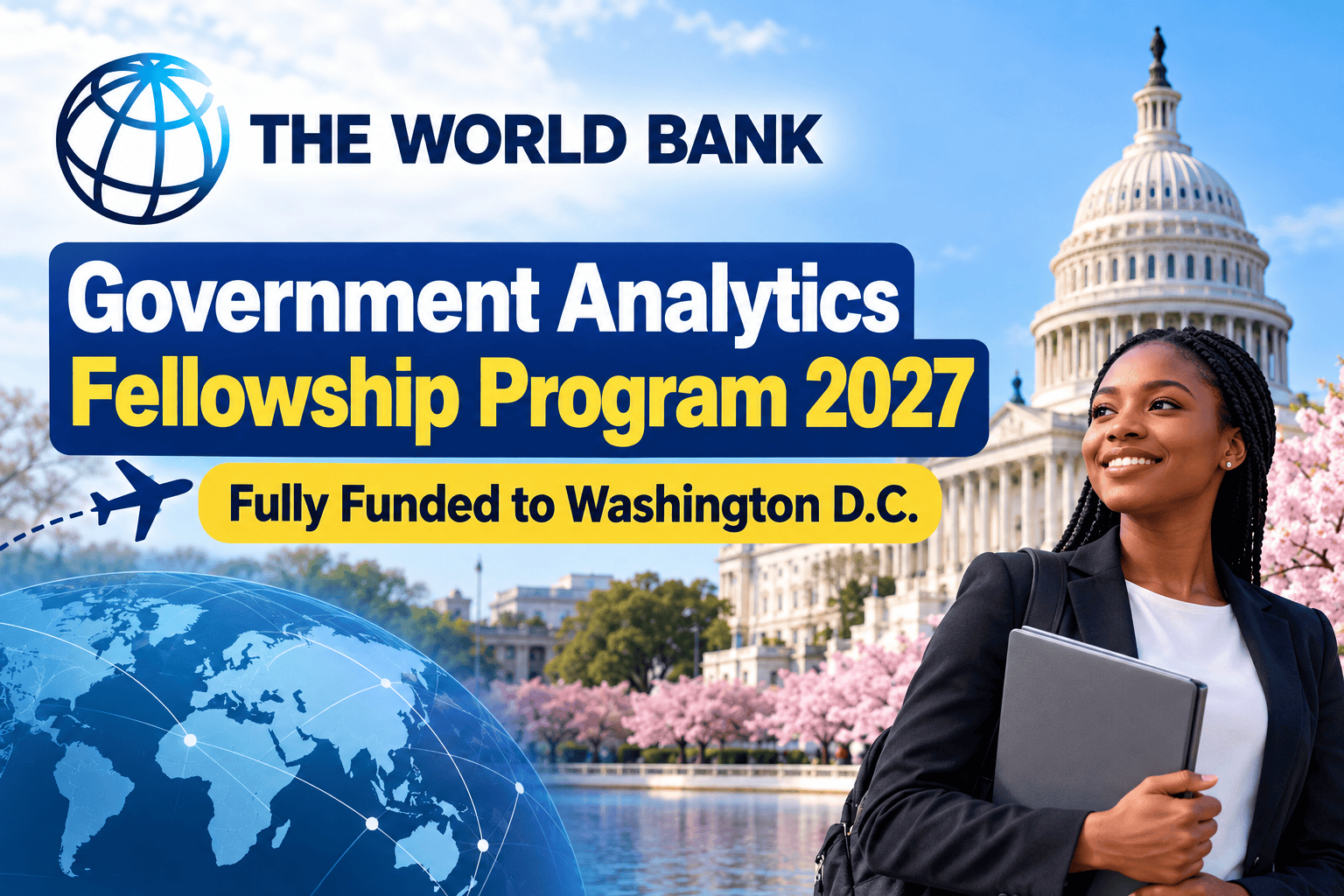
Fully Funded to Washington, D.C.: Apply for the World Bank Government Analytics Fellowship Program 2027
Government officials interested in improving public services through data and evidence-based decision-making have an opportunity to strengthen their professional skills through the World Bank Government Analytics Fellowship Program 2027.
The fellowship is designed to help public servants use government data to identify administrative challenges, improve institutional performance, and make better policy decisions. It combines learning opportunities with practical project development and support from experienced professionals.
For selected participants on the in-person track, the program includes an immersive experience in Washington, D.C., where fellows can engage with World Bank experts, researchers, and other government practitioners.
The fellowship offers different participation options, including online learning, regional hubs, and an intensive in-person experience. This makes it relevant to government professionals seeking practical ways to improve public administration within their institutions.
However, applicants should understand that this is a professional development opportunity for eligible government officials, not a general scholarship for university students or a job vacancy at the World Bank.
Here is everything prospective applicants need to know about the program, including its benefits, eligibility requirements, application documents, and how to apply.
World Bank Government Analytics Fellowship 2027: Overview
- Program Name: World Bank Government Analytics Fellowship Program 2027
- Host Organization: World Bank
- Program Location: Washington, D.C., United States, for the in-person component
- Program Duration: The immersive fellowship runs for approximately six months
- Available Formats: Online-only, immersive in-person, and regional hub opportunities
- Target Applicants: Eligible government officials and public-sector professionals
- Main Focus: Government analytics, data-informed policymaking, and public administration
- In-Person Experience: Approximately two weeks in Washington, D.C., with dates to be confirmed by the organizers
- Financial Support: Travel, hotel, and subsistence support for eligible participants from Official Development Assistance (ODA)-eligible countries attending the in-person course, subject to the program’s arrangements
- Application Deadline: November 16, 2026, as reported in the 2027 fellowship announcement
- Official Application Information: Available through the World Bank’s official fellowship webpage
Applicants should confirm the current deadline, eligibility conditions, and funding arrangements on the official website before submitting their applications.
About the World Bank Government Analytics Fellowship
Government institutions collect large amounts of information through their daily activities. This information can help public officials understand how policies perform, where resources are needed, and which administrative processes require improvement.
However, collecting data does not automatically lead to better decisions. Government officials must know how to interpret available information, identify meaningful patterns, and translate their findings into practical improvements.
The World Bank Government Analytics Fellowship seeks to address this challenge by helping public servants develop the skills and projects needed to use administrative data more effectively.
The program combines learning with practical application. Participants explore how government data can support decision-making and work toward developing a Government Analytics project relevant to their own institutions.
The fellowship also provides opportunities to learn from experts and connect with professionals working on similar public-sector challenges.
For applicants who are already involved in government administration, policy implementation, public service delivery, or institutional reform, the program may provide useful knowledge that can be applied directly to their professional responsibilities.
Fellowship Tracks Available in 2027
The 2027 program announcement describes different participation formats. Applicants should review the official application information to determine which options are available and appropriate for their circumstances.
1. Online-Only Fellowship
The online-only track is designed for government officials who want to develop their knowledge of government analytics while continuing to manage their professional responsibilities.
This format offers a more flexible way to participate in the fellowship’s learning activities.
It may be suitable for public servants who cannot travel internationally or leave their regular duties for an extended period.
Applicants should check the official program information for details about the online course, participation requirements, and project expectations.
2. Immersive In-Person Fellowship
The immersive in-person track is intended for a selected group of government officials who can commit substantial time and effort to developing a Government Analytics project.
The program runs for approximately six months and combines virtual learning, project development, expert guidance, and an intensive in-person experience.
Selected fellows are expected to work on a project that addresses a relevant challenge within their government institution.
The in-person component includes approximately two weeks in Washington, D.C. Participants have the opportunity to work with World Bank staff, academics, subject-matter experts, and other government practitioners.
The program is particularly relevant to officials who have institutional support to develop and implement practical improvements within their organizations.
3. Regional Hub Fellowship
The regional hub option is intended to bring fellowship learning opportunities closer to participants through more localized arrangements.
This format may be useful for government officials who would benefit from participating in a regional learning environment.
Interested applicants should consult the official announcement for information about available regional hubs, locations, schedules, and eligibility requirements.
Benefits of the World Bank Government Analytics Fellowship 2027
The fellowship focuses on professional development, practical problem-solving, and improved government performance.
1. Opportunity to Participate in Training in Washington, D.C.
Selected fellows on the in-person track can participate in an intensive learning experience in Washington, D.C.
During this period, participants engage with experts and other government professionals while developing their understanding of government analytics.
For eligible participants, this international learning experience also provides an opportunity to exchange ideas with professionals facing similar public administration challenges.
2. Travel and Accommodation Support for Eligible Participants
One of the important benefits of the in-person program is the financial support available to eligible participants.
According to the published fellowship information, the World Bank covers travel, hotel, and subsistence costs associated with participation in the Government Analytics course in Washington, D.C., for applicants from ODA-eligible countries.
This support is subject to the program’s applicable arrangements and eligibility conditions.
Applicants should not automatically assume that every expense is covered or that the same financial arrangements apply to all fellowship tracks. They should verify the precise terms before making travel plans.
The published information does not establish a universal cash stipend or salary for every fellow.
3. Expert Guidance and Mentorship
Developing a useful government analytics project requires more than identifying a problem. It also involves understanding available data, choosing appropriate analytical methods, and determining how the findings could inform decisions.
Selected participants receive support from experienced professionals, including dedicated mentoring for fellows covered by the in-person arrangements.
This guidance can help participants strengthen their project ideas and consider how their findings might be applied within their institutions.
4. Practical Government Analytics Skills
Participants learn how data can be used to understand government performance and improve administrative processes.
Depending on their projects and learning activities, fellows may explore questions such as:
- How can administrative data help identify delays in public service delivery?
- How can government institutions evaluate whether a policy is achieving its intended objectives?
- How can data help departments allocate resources more effectively?
- How can public agencies identify weaknesses in their internal processes?
- How can evidence support better planning and accountability?
These skills can be valuable for professionals working in policy development, public administration, monitoring and evaluation, and institutional reform.
5. Development of a Government Analytics Project
A central element of the fellowship is the development of a project that addresses a real challenge within the participant’s institution.
Rather than focusing exclusively on classroom learning, the program encourages fellows to consider how analytical methods can support practical improvements.
A well-designed project could examine service delivery performance, administrative efficiency, resource allocation, or another issue relevant to the applicant’s government organization.
The proposed project should be realistic, institutionally relevant, and supported by an appropriate plan for using available data.
6. International Professional Networking
The fellowship creates opportunities to interact with government officials, academics, data professionals, and practitioners from different backgrounds.
These interactions can help participants exchange ideas, learn from other public-sector experiences, and develop professional connections.
The value of this network will depend on how participants engage with the program and apply what they learn after the fellowship.
Who Can Apply for the World Bank Government Analytics Fellowship 2027?
The fellowship is aimed at government officials who have the professional responsibilities and institutional support needed to develop a Government Analytics project.
According to the published 2027 announcement, applicants are expected to meet the following requirements.
1. Employment in a Central Government Organization
Applicants should work in a central government organization, including an eligible government agency.
This requirement means the fellowship is not generally intended for individuals applying solely as private citizens, university students, or private-sector employees without the required government affiliation.
Prospective applicants should verify whether their particular institution qualifies under the program’s rules.
2. Appropriate Professional Responsibilities
Candidates should hold mid-level management positions, senior analyst roles, or equivalent positions.
They should have sufficient authority and institutional support to develop a government analytics project.
Applicants are therefore encouraged to demonstrate how their current responsibilities relate to government performance, policy implementation, administrative processes, or data-informed decision-making.
3. Relevant Quantitative Coursework
Applicants must have completed tertiary-level coursework in statistics or related quantitative methods.
This requirement is important because government analytics involves working with information, evaluating evidence, and drawing conclusions that can inform administrative decisions.
Candidates should highlight relevant academic coursework and practical experience in their CV.
4. English Language Proficiency
Applicants must be proficient in English to participate effectively in the fellowship’s learning activities and professional discussions.
Application documents should also be prepared in English, as required by the published application instructions.
5. A Relevant Government Analytics Project
Candidates must present a proposed project with a clear connection to their institution’s needs and a realistic possibility of implementation.
A strong proposal should identify a specific problem, explain how government data could help investigate it, and describe the practical value of the findings.
For example, an applicant working in a public service department might propose examining why certain applications take longer to process than others.
The project could use existing administrative records to identify bottlenecks and recommend improvements.
Applicants should select a problem that is relevant to their own responsibilities and can be investigated using data their institution can appropriately access.
6. Organizational Nomination and Support
Applicants must be nominated by their organizations.
The published announcement indicates that a maximum of two fellows may be nominated from each organization.
Institutional support is important because the fellowship is designed to help participants work on projects that can contribute to improvements within their government institutions.
Candidates should therefore speak with their supervisors or relevant administrative authorities early enough to obtain the required endorsement.
Additional Requirements for the In-Person Fellowship
Applicants interested in the immersive in-person track should be prepared to meet additional commitments.
These include:
- Being available to travel to Washington, D.C., for approximately two weeks in March 2027, with exact dates to be confirmed by the organizers.
- Completing the required virtual Government Analytics Fellowship course before attending the in-person training.
- Submitting their Government Analytics project before the in-person component, as required by the program.
- Having the time and institutional support necessary to participate in the intensive fellowship.
- Demonstrating that their proposed project has practical relevance to their government organization.
Successful completion of the required virtual learning and project submission is a condition of participation in the in-person component, according to the published announcement.
Applicants should review the current official application instructions for any additional requirements.
Required Documents for the Application
Preparing the application documents in advance can help candidates submit a clear and complete application.
The published 2027 announcement identifies the following documents.
1. Curriculum Vitae
Applicants should prepare a comprehensive CV of no more than three pages.
The CV should highlight relevant qualifications, professional responsibilities, analytical experience, and contributions to public-sector work.
Where appropriate, candidates should include their tertiary-level coursework in statistics or related quantitative methods.
It is helpful to describe professional achievements clearly rather than simply listing job duties.
For example, applicants might explain how they contributed to a monitoring exercise, improved an administrative process, analyzed program information, or supported policy implementation.
All information should be accurate and relevant to the fellowship.
2. A 150-Word Government Analytics Project Summary
Applicants must prepare a summary of approximately 150 words describing the government analytics project they intend to develop within their organization.
This summary should communicate the central idea in a concise and understandable way.
A useful project summary should explain:
- The government problem the project will address.
- Why the problem matters to the institution or the public.
- What administrative data or other relevant information could be examined.
- How the analysis could help identify possible improvements.
- How the findings might be used in decision-making.
Candidates should avoid proposals that are too broad or depend on data they cannot reasonably access.
A focused project with a clear purpose is easier to explain and evaluate than a general statement about improving government performance.
3. Organizational Endorsement Letter
Applicants must provide an endorsement letter from their organization.
The letter should nominate the candidate for the fellowship, confirm their position, and demonstrate institutional support for the proposed project and participation.
Candidates should contact the appropriate supervisor or administrative authority to arrange this document.
The endorsement should accurately reflect the organization’s commitment and should not make promises that the institution cannot fulfil.
4. Document Format and Language
The published application information states that the required documents should be submitted in English and in PDF format.
Applicants should check the current official application form to confirm all document specifications before submission.
How to Apply for the World Bank Government Analytics Fellowship 2027
Interested government officials can follow these steps to prepare their applications.
Step 1: Visit the Official Fellowship Website
Begin by visiting the World Bank’s official Government Analytics Fellowship webpage.
Read the current announcement carefully and review the available participation formats.
Official fellowship webpage:
https://academy.worldbank.org/en/prosperity/institutions/government-analytics-fellowship
Use the official website to verify the application deadline, eligibility conditions, and current submission instructions.
Step 2: Confirm Your Eligibility
Check that you meet the employment, professional experience, quantitative coursework, language, and project requirements.
You should also determine whether your government organization is eligible to nominate participants.
If you are interested in the in-person track, consider whether you can meet the additional time and travel commitments.
Step 3: Discuss Your Application With Your Organization
Because organizational nomination and institutional support are required, speak with your supervisor or the appropriate authority before submitting your application.
Explain why the fellowship is relevant to your work and how the proposed project could help address an existing institutional challenge.
Allow sufficient time for the endorsement letter to be prepared.
Step 4: Develop Your Project Idea
Choose a specific government administration or service delivery problem that could be examined using available data.
Think about what information your institution already collects, what the data might reveal, and how the findings could support better decisions.
Your proposed project should be practical and relevant to your institution’s priorities.
Step 5: Prepare Your Application Documents
Prepare your CV, 150-word project summary, and organizational endorsement letter.
Ensure that your documents are written in clear English, saved in the required PDF format, and consistent with the information requested by the organizers.
Proofread each document before submission.
Step 6: Submit Your Application Through the Official Channel
Follow the application procedure provided on the World Bank’s official fellowship webpage.
Complete the required application form and upload the requested documents according to the instructions.
Do not assume that sending documents by email alone constitutes a valid application unless the official instructions explicitly permit it.
Step 7: Confirm Submission and Monitor Updates
After submitting your application, retain any confirmation details provided by the application system.
Monitor your email and the official fellowship website for updates, requests for further information, and selection announcements.
Applicants should avoid making non-refundable travel arrangements before receiving the necessary confirmation from the organizers.
Application Deadline for the 2027 Fellowship
The 2027 fellowship announcement published on October 9, 2026, lists November 16, 2026, as the application deadline.
Candidates should use the official World Bank fellowship webpage and current application form to confirm the closing date and any applicable time-zone requirements.
It is advisable to prepare the required documents well before the deadline, particularly because obtaining an organizational endorsement may take time.
Late applications may not be considered, so candidates should follow the official submission instructions carefully.
Is the World Bank Government Analytics Fellowship Fully Funded?
The fellowship announcement describes travel, hotel, and subsistence support for applicants from ODA-eligible countries participating in the Government Analytics course in Washington, D.C.
This is an important benefit for eligible participants selected for the in-person experience.
However, applicants should distinguish between support for the in-person component and a general cash scholarship.
The published information does not establish that every fellowship track has identical funding arrangements, nor does it confirm a universal salary or monthly stipend.
Before accepting an offer, applicants should verify:
- Whether their country qualifies for the stated support.
- Which travel expenses are covered.
- The applicable accommodation and subsistence arrangements.
- Whether any additional expenses must be paid by the participant or their organization.
- Whether separate conditions apply to the online-only or regional hub tracks.
Applicants should rely on the official fellowship terms when making financial and travel decisions.
Can Nigerian Government Officials Apply?
Government officials working in Nigeria who are interested in improving public administration through data may wish to explore the fellowship.
However, meeting the general professional requirements does not automatically guarantee eligibility or selection.
Nigerian applicants should confirm that their government organization qualifies, obtain the required institutional nomination, and demonstrate relevant quantitative coursework and a practical project proposal.
Candidates interested in the Washington, D.C., component should also verify the applicable travel and subsistence arrangements for their country.
The strongest approach is to develop a proposal that addresses a real challenge within the applicant’s institution and explains how the analysis could support better administrative decisions.
Tips for Preparing a Strong Application
Although no applicant can guarantee selection, careful preparation can help demonstrate the relevance of their experience and project idea.
Choose a Specific Problem
Avoid proposing to improve an entire government system without identifying a manageable issue.
Instead, focus on a clearly defined challenge, such as delays in processing applications, difficulties monitoring public programs, or gaps in administrative reporting.
Explain How Data Will Help
Describe what information could be examined and how it might help answer the project’s central question.
Your proposal should show that you understand the relationship between the problem, the available evidence, and the intended outcome.
Demonstrate Institutional Relevance
Explain why the proposed project matters to your organization.
A proposal is more convincing when its findings could inform a real administrative decision or contribute to a clearly identified improvement.
Highlight Relevant Experience
Use your CV to demonstrate experience in government administration, policy implementation, data analysis, monitoring and evaluation, or related responsibilities.
Include specific examples where possible, ensuring that all claims are accurate.
Secure Organizational Support Early
Do not leave the endorsement letter until the last minute.
Discuss your proposed project with your organization and allow sufficient time for the required authorization and documentation.
Keep Your Project Realistic
A project should be achievable within the available time and resources.
Consider whether the necessary data can be accessed appropriately, whether the proposed analysis is manageable, and whether the findings could realistically inform institutional decisions.
Frequently Asked Questions
1. What is the World Bank Government Analytics Fellowship?
It is a professional development program designed to help government officials use administrative data and analytical methods to improve public administration and decision-making.
2. Is the fellowship open to all applicants?
No. The published requirements target eligible government officials working in central government organizations, including government agencies. Applicants must meet the professional, quantitative coursework, language, nomination, and project requirements.
3. Can university students apply?
The fellowship is not presented as a general university scholarship. Its published eligibility requirements focus on government officials who can develop projects within their institutions.
4. Does the fellowship include travel to Washington, D.C.?
The immersive in-person track includes approximately two weeks in Washington, D.C. The exact dates are subject to confirmation by the organizers.
5. Are travel and accommodation expenses covered?
The published announcement states that travel, hotel, and subsistence costs for the Washington, D.C., course are covered for applicants from ODA-eligible countries, subject to the applicable arrangements. Applicants should verify their eligibility and the precise coverage.
6. Is a monthly stipend available?
The published information does not establish a universal monthly stipend or salary for all participants. Applicants should consult the official terms for the financial support applicable to their selected track.
7. What documents are required?
The published announcement lists a CV of no more than three pages, a 150-word Government Analytics project summary, and an organizational endorsement letter. Applicants should confirm the current requirements before submitting.
8. What is the application deadline?
The 2027 announcement lists November 16, 2026. Applicants should verify the deadline and submission requirements on the official World Bank website.
9. Can private-sector professionals apply?
The published eligibility criteria focus on candidates working in central government organizations, including government agencies. Private-sector professionals should review the official requirements rather than assume that they qualify.
10. Where can I find the official application information?
Visit the World Bank’s official Government Analytics Fellowship webpage:
https://academy.worldbank.org/en/prosperity/institutions/government-analytics-fellowship
Final Thoughts
The World Bank Government Analytics Fellowship Program 2027 offers a professional development opportunity for eligible government officials who want to use data to improve public administration.
Through its learning activities, project development, expert support, and potential in-person experience in Washington, D.C., the fellowship encourages participants to turn government information into practical insights that can support better decisions.
For interested applicants, preparation should begin with confirming eligibility, discussing the proposed project with their organization, and gathering the required documents.
The most important step is to ensure that the application reflects a genuine government challenge and explains how data analysis could help address it.
Before applying, carefully review the official fellowship announcement to confirm the deadline, selection requirements, and funding conditions.
Official application information:
https://academy.worldbank.org/en/prosperity/institutions/government-analytics-fellowship
