Apply for the SJN/MIT Climate Journalism Fellowship 2027: $7,500 Stipend for U.S.-Based Journalists

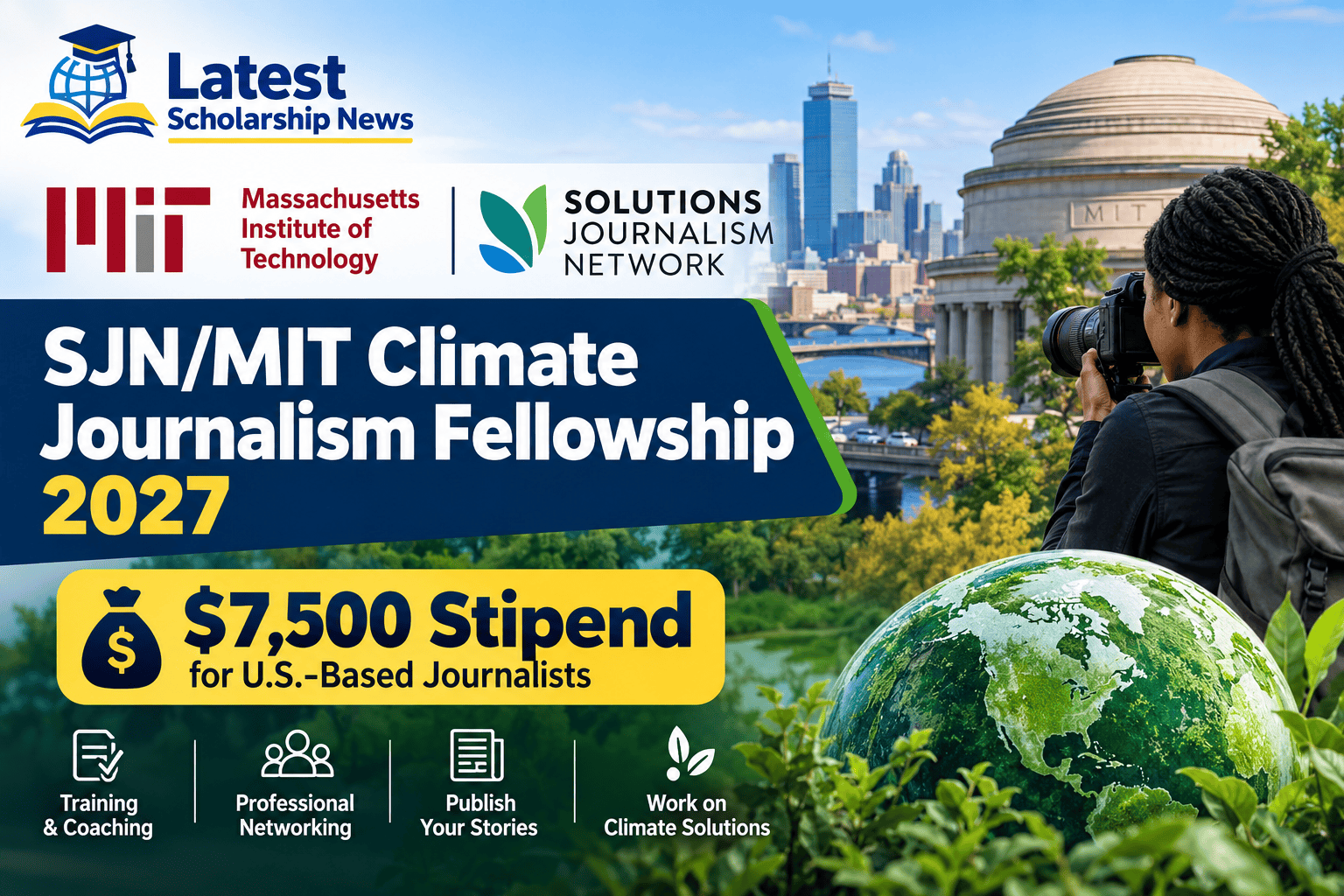
Apply for the SJN/MIT Climate Journalism Fellowship 2027: $7,500 Stipend for U.S.-Based Journalists
Journalists interested in climate change, environmental reporting, and community-focused storytelling have an exciting opportunity to advance their careers through the SJN/MIT Climate Journalism Fellowship 2027. The fellowship, jointly offered by the Solutions Journalism Network (SJN) and the Massachusetts Institute of Technology (MIT), will support 10 freelance and staff journalists working with local and regional newsrooms in the United States.
The eight-month programme will provide selected fellows with a $7,500 stipend, specialised training, professional guidance, and access to resources that can help them produce meaningful journalism about climate change and practical solutions.
Unlike programmes that focus primarily on climate science or environmental disasters, this fellowship encourages journalists to investigate how climate change affects everyday community concerns, including housing, healthcare, agriculture, energy costs, and weather resilience. Participants will explore how communities respond to these challenges and report on the effectiveness of different approaches.
Applications are currently open, and eligible journalists are encouraged to submit their applications before the October 26, 2026 deadline.
If you are a U.S.-based journalist looking to strengthen your reporting skills, develop an ambitious local climate reporting project, and connect with experienced professionals, this fellowship may be worth considering.
SJN/MIT Climate Journalism Fellowship 2027: Overview
Here are the key details applicants should know before applying.
- Fellowship Name: SJN/MIT Climate Journalism Fellowship
- Host Institutions: Solutions Journalism Network and Massachusetts Institute of Technology
- Location: United States, with an in-person gathering in Halifax, Canada
- Programme Duration: Eight months
- Fellowship Period: January–August 2027
- Number of Positions: 10
- Eligible Applicants: Freelance and staff journalists based in the United States and associated with local or regional newsrooms
- Financial Support: $7,500 stipend
- Additional Benefits: Training, coaching, research resources, workshops, and professional networking
- Application Deadline: October 26, 2026
- Expected Selection: November 2026
- Official Application: Available through the Solutions Journalism Network’s application portal
The fellowship is designed to help journalists produce well-researched reporting that connects climate change with the concerns, experiences, and priorities of local communities.
What Is the SJN/MIT Climate Journalism Fellowship?
The SJN/MIT Climate Journalism Fellowship is a professional development programme that supports journalists investigating climate change and the responses being developed to address its effects.
The programme brings together the expertise of the Solutions Journalism Network and MIT to strengthen reporting on climate solutions.
The Solutions Journalism Network promotes journalism that examines how people and institutions respond to social challenges. MIT contributes expertise in climate science, technology, energy, public policy, and science communication.
Through this partnership, selected journalists will receive guidance in researching, developing, and publishing stories that go beyond identifying problems. They will investigate potential solutions, examine available evidence, and explain what has worked, what has not worked, and what communities can learn from those experiences.
The 2027 fellowship will run from January through August and will support 10 journalists working on projects for local and regional news outlets.
Applicants do not necessarily need to specialise in environmental journalism. Journalists covering local government, business, agriculture, healthcare, housing, energy, and other beats may also be suitable candidates if they can develop a strong climate-related reporting project.
Benefits of the SJN/MIT Climate Journalism Fellowship 2027
The fellowship offers financial support, professional training, research assistance, and opportunities to collaborate with other journalists.
Here are some of the main benefits available to successful applicants.
1. $7,500 Stipend
Each selected fellow will receive a $7,500 stipend to support the development and publication of their climate journalism project.
The stipend can help cover eligible reporting-related expenses, including time devoted to the project, travel, multimedia development, and hosting an event.
Applicants should understand that this is a fellowship stipend rather than a guaranteed annual salary or a monthly payment. The official programme announcement describes the support as a $7,500 stipend for the eight-month fellowship.
2. Specialised Climate Journalism Training
Participants will take part in training designed to improve their understanding of climate-related issues and strengthen their reporting skills.
Topics will include:
- Climate science and its implications for communities.
- Climate and energy policy.
- Climate economics.
- Climate change communication.
- Public opinion and climate-related debates.
- Researching and writing stories about climate solutions.
This training can help journalists explain complex environmental issues in ways that are accurate, accessible, and relevant to their audiences.
3. Access to MIT Research Resources
Fellows will have access to MIT’s extensive library databases, socioeconomic climate analyses, and other resources as requested.
These resources can support more detailed investigations into the relationship between climate change, public policy, economic conditions, and community experiences.
Access to research resources may also help participants identify credible evidence, investigate claims, and provide stronger context for their published stories.
4. Individual Coaching and Editorial Support
Selected fellows will receive one-on-one consultations with a solutions coach and a science journalism specialist.
This guidance is intended to complement the support provided by their newsroom editors.
Participants can use these consultations to refine story ideas, strengthen research methods, assess evidence, and develop reporting that meets professional journalistic standards.
5. Professional Workshops and Peer Learning
Fellows will participate in virtual workshops led by specialists from SJN, MIT, and partner organisations.
They will also attend monthly virtual cohort meetings, where they can exchange ideas, discuss their work, and learn from the experiences of other journalists.
The fellowship includes SJN’s Train the Trainer programme, which involves approximately 15 hours of training over five days. Participants who complete the programme may become eligible for SJN training accreditation and future opportunities to deliver solutions journalism training.
6. In-Person Fellowship Gathering in Canada
The programme includes an in-person gathering at the Society of Environmental Journalists’ annual conference in Halifax, Canada, scheduled for April 15–17, 2027.
According to the official application information, the fellowship will cover conference registration, travel, and hotel rooms for this gathering.
This provides an opportunity for participants to connect with other journalists, exchange experiences, and learn more about environmental reporting.
7. Opportunities to Expand the Reach of Published Stories
The programme will collaborate with Public News Service to create audio versions of fellows’ stories for distribution through its network.
The fellowship also provides for republication of the project through MIT.
These arrangements can help participants reach audiences beyond their immediate local or regional news outlets.
8. Long-Term Professional Development
The fellowship is intended to support journalists beyond the immediate reporting project.
Participants will develop experience in climate reporting, evidence-based storytelling, research, and solutions journalism. They will also have opportunities to share their experiences through presentations, speaking engagements, and discussions with other journalists.
These skills may be useful for future reporting projects and professional opportunities.
Who Can Apply for the SJN/MIT Climate Journalism Fellowship 2027?
The fellowship is intended for freelance and staff journalists based in the United States who are associated with local or regional newsrooms.
Applicants should be prepared to develop and publish a substantial reporting project connecting climate change with issues that matter to their communities.
The programme is particularly interested in reaching communities where climate change is underreported or remains a polarising subject.
Although previous experience in environmental or climate journalism is valuable, it is not compulsory. Journalists working in other reporting specialities are welcome to apply if their proposed projects fit the fellowship’s objectives.
General Eligibility Requirements
Applicants should consider the following requirements before preparing an application:
1. Be based in the United States
The programme is intended for journalists based in the United States.
Applicants should review the official application instructions to determine whether their circumstances meet the programme’s location requirements.
2. Work as a freelance or staff journalist
Both freelance journalists and journalists employed by news organisations may be considered.
However, applicants must demonstrate support and interest from a local or regional news outlet willing to publish the proposed reporting project.
3. Have a suitable climate reporting idea
Applicants must propose a project that examines climate change impacts and potential solutions in a specific community or region.
The project should connect climate issues with local concerns rather than discussing climate change only in general terms.
4. Demonstrate strong storytelling skills
Applicants must provide two writing or reporting samples through links to previous work.
These samples should help demonstrate their ability to research, investigate, and communicate information effectively.
5. Be willing to complete the fellowship requirements
Selected fellows must participate in the programme’s training and coaching activities and produce the required stories during the fellowship period.
Applicants should be confident that they can commit the necessary time to the programme.
Important: These requirements summarise the published fellowship information. Prospective applicants should consult the official application form for the complete eligibility criteria and submission instructions.
What Kind of Reporting Projects Are Suitable?
The fellowship encourages journalists to investigate the relationship between climate change, local priorities, and practical responses.
A strong project should identify a meaningful community concern and examine how people, organisations, or public institutions are responding to it.
Potential reporting topics include the following.
Climate Change and the Cost of Living
Journalists could investigate how climate-related challenges affect household expenses, energy affordability, or the cost of maintaining safe and comfortable homes.
A project might examine programmes designed to improve energy efficiency, reduce household energy costs, or help residents manage extreme temperatures.
Climate Change and Healthcare
Another possible topic is the relationship between climate change and public health.
A journalist might investigate how local health services prepare for heatwaves, how communities respond to smoke from wildfires, or how public health programmes help vulnerable residents during extreme weather.
Climate Change and Agriculture
Agriculture is an important subject for communities affected by changing weather patterns.
A reporting project could examine how farmers are responding to drought, flooding, changing growing seasons, or water shortages.
The journalist would need to investigate the evidence behind the approaches being used and assess their practical limitations.
Climate Change and Housing
Housing provides another potential area of investigation.
Journalists could explore community programmes that help buildings withstand extreme weather, initiatives that improve energy efficiency, or policies intended to reduce the risks associated with flooding and heat.
Climate Change and Energy
A project could investigate local efforts to improve energy reliability, expand access to renewable energy, or reduce the cost of energy for households and businesses.
The reporting should examine both the benefits and limitations of the approaches being considered.
Climate Change and Weather Resilience
Journalists may also investigate how communities prepare for flooding, storms, heatwaves, or other weather-related hazards.
Possible subjects include early-warning systems, emergency planning, infrastructure improvements, and community-led resilience programmes.
These examples illustrate the kinds of topics that may fit the programme. Applicants should develop an original proposal that reflects the needs and experiences of the community they intend to cover.
What Is Solutions Journalism?
Solutions journalism is a reporting approach that investigates responses to social problems using evidence and critical analysis.
Rather than simply describing a problem or celebrating an initiative, solutions journalism examines how a response works, whether it produces meaningful results, and what its limitations may be.
The Solutions Journalism Network uses four core pillars to guide this approach.
1. Response: Explain the response to the problem and how it is intended to work.
2. Evidence: Examine available evidence showing whether the response has produced results.
3. Insights: Identify lessons that can be learned from the response, including factors that contribute to its success or failure.
4. Limitations: Explain the weaknesses, obstacles, and circumstances that may limit the effectiveness of the response.
For example, a journalist investigating a community flood-prevention programme should not simply report that the programme exists. The journalist should investigate how it operates, whether it has reduced flood risks, what evidence supports the claims being made, and what challenges remain.
This evidence-based approach is central to the SJN/MIT Climate Journalism Fellowship.
Fellowship Responsibilities and Expected Deliverables
Successful applicants will be expected to complete a reporting project during the eight-month programme.
According to the official application information, fellows must meet several important requirements.
Publish at Least Four Related Stories
Each fellow must produce and publish a minimum of four related news stories by August 2027.
At least two of these stories must apply the principles of solutions journalism.
The stories should form part of a coherent project rather than a collection of unrelated articles.
Focus on Local or Regional Priorities
Projects must focus on the home county or state of the supporting newsroom.
Reporting should connect climate change with existing community concerns, values, and priorities.
Include Local Perspectives
Fellows must incorporate lived experiences and perspectives from the communities affected by the issues being investigated.
This means gathering relevant voices, examining local experiences, and presenting the issue in a way that reflects the people directly affected.
Participate in Training and Peer Learning
Participants must take part in the fellowship’s scheduled training and monthly virtual cohort meetings.
They will also be expected to share what they learn about solutions journalism with their peers, whether through formal presentations or informal discussions.
Complete a Follow-Up Interview
The programme requires fellows to participate in a follow-up interview six to eight months after the fellowship.
This interview will help the organisers understand the fellowship’s impact and gather feedback about the participants’ experiences.
Applicants should review the full programme requirements before applying to ensure they understand the work involved.
Required Documents and Application Materials
Applicants should prepare their supporting materials before beginning the application process.
The official selection criteria identify several important components.
1. Two Samples of Previous Work
Applicants must provide links to two samples demonstrating their storytelling skills.
These may be published reporting pieces that show their ability to investigate a subject, explain complex information, and communicate with readers or audiences.
Choose samples that demonstrate strong research, clear writing, and a commitment to accuracy.
2. A Climate Journalism Project Proposal
The project pitch is an important part of the selection process.
It should explain:
- The climate impacts the applicant intends to investigate.
- The potential solutions or responses the project will examine.
- Why the subject matters to the local community.
- How the reporting will connect climate change with regional priorities.
- How the applicant intends to research and publish the stories.
- Why the proposed project can realistically be completed by August 2027.
The selection team will assess whether the proposal can incorporate solutions journalism, connect climate issues with local perspectives, and be completed successfully during the fellowship.
3. Evidence of Newsroom Support
Applicants must demonstrate interest and support from a local or regional news outlet that intends to publish the proposed project.
The programme also instructs applicants to ask their editor from the supporting newsroom to email climate@solutionsjournalism.org.
The editor should confirm that they have read the fellowship requirements and intend to submit a letter of support if the applicant is shortlisted.
Applicants should coordinate with their editors early to avoid delays during the application process.
4. Commitment to Climate and Solutions Reporting
The selection criteria also consider applicants’ commitment to using the skills and knowledge gained through the fellowship to pursue further solutions journalism and climate or environmental reporting.
A thoughtful application should therefore explain not only why the proposed project matters, but also how the experience could contribute to the applicant’s future reporting.
How to Apply for the SJN/MIT Climate Journalism Fellowship 2027
Interested journalists can follow these steps to prepare and submit an application.
Step 1: Review the Official Fellowship Information
Begin by reading the programme requirements on the official MIT Climate Project website.
Confirm that your location, professional background, and proposed reporting project meet the fellowship’s requirements.
Official information: https://climateproject.mit.edu/sjnmit-climate-journalism-fellowship
Step 2: Develop a Strong Reporting Idea
Identify a climate-related issue affecting a specific community or region.
Consider how the issue connects with concerns such as housing, healthcare, agriculture, energy costs, or weather resilience.
Your proposal should identify a clear reporting question and explain which responses you intend to investigate.
Step 3: Gather Your Work Samples
Prepare links to two examples of your published work.
Select stories that demonstrate your research skills, reporting experience, and ability to explain important issues clearly.
Step 4: Contact Your Supporting Newsroom
Discuss the proposed project with an editor at a suitable local or regional news outlet.
Explain the fellowship requirements and confirm that the newsroom is interested in publishing the resulting stories.
Ask the editor to send the required email to climate@solutionsjournalism.org.
Step 5: Complete the Online Application
Visit the official fellowship application portal and provide the information and supporting materials requested.
Official application form: https://www.tfaforms.com/5235794
Review your answers carefully before submitting the application.
Step 6: Submit Before the Deadline
The application deadline is October 26, 2026, at midnight, according to the official application information.
Do not wait until the final hours to submit your materials. Allow enough time to coordinate with your editor, check your work samples, and review your project proposal.
Step 7: Prepare for Possible Shortlisting
Shortlisted candidates will be interviewed during the final stage of the selection process.
Applicants should be prepared to discuss their reporting idea, its relevance to the community, the evidence they intend to gather, and their ability to complete the project within the fellowship period.
Final selections are expected by November 30, 2026.
Important Dates for the 2027 Fellowship
Applicants should keep the following dates in mind.
| Event | Date |
|---|---|
| Fellowship application deadline | October 26, 2026 |
| Expected fellow selection | By November 30, 2026 |
| Introductions for selected fellows | December 2026 |
| Foundational climate journalism workshops | January 2027 |
| Climate Train the Trainer programme | February 2027 |
| Ongoing coaching and training | March–August 2027 |
| In-person gathering in Halifax, Canada | April 15–17, 2027 |
| Deadline to produce and publish the required stories | August 2027 |
Dates and arrangements should be checked against the official programme information in case of updates.
Frequently Asked Questions
1. Is the SJN/MIT Climate Journalism Fellowship 2027 paid?
Yes. Selected fellows will receive a $7,500 stipend to support their reporting and participation in the programme.
The stipend is intended to support the fellowship project and should not be confused with a guaranteed monthly salary.
2. How many journalists will be selected?
The programme plans to support 10 freelance and staff journalists in 2027.
3. Can freelance journalists apply?
Yes. The fellowship is open to freelance and staff journalists based in the United States who are associated with a supporting local or regional newsroom.
Freelance applicants should confirm that they can meet the newsroom support and publication requirements.
4. Must applicants have previous climate journalism experience?
No. Previous experience in climate or environmental reporting is valued but is not a compulsory requirement.
Journalists from other beats may apply if they can propose a suitable climate reporting project.
5. Can journalists based outside the United States apply?
The fellowship is designed for journalists based in the United States.
Applicants based in other countries should not assume they are eligible. Review the official application requirements to confirm whether your circumstances qualify.
6. Is this a fully funded fellowship?
The fellowship provides a $7,500 stipend, professional training, coaching, research resources, and other programme benefits.
However, it should not automatically be described as a fully funded international fellowship covering all personal and professional expenses. Applicants should review the official terms to understand exactly what financial support is available.
7. When is the application deadline?
The deadline is October 26, 2026, at midnight, as stated in the official application information.
Applicants should check the application portal for the applicable deadline and submission instructions.
8. When will the fellowship begin?
The programme will begin in earnest in January 2027, following introductions and preparatory activities in December 2026.
9. How many stories must each fellow publish?
Each fellow must produce and publish at least four related news stories by August 2027. At least two stories must apply the principles of solutions journalism.
10. Where can I apply?
Applicants can access the official application form here:
https://www.tfaforms.com/5235794
For programme information, eligibility details, and updates, visit the MIT Climate Project’s official fellowship page.
Final Thoughts
The SJN/MIT Climate Journalism Fellowship 2027 offers an opportunity for U.S.-based journalists to develop stronger reporting skills, investigate climate-related challenges, and produce stories that help communities understand practical responses to environmental change.
With a $7,500 stipend, specialised training, individual coaching, research support, and opportunities to connect with other journalists, the programme may be valuable for reporters seeking to deepen their work on climate change and local solutions.
However, the fellowship also requires a clear reporting proposal, support from a local or regional newsroom, participation in training, and publication of at least four related stories during the programme.
Journalists who meet the requirements and have a strong idea for a community-focused reporting project should review the official application instructions and prepare their materials early.
Application deadline: October 26, 2026.
Apply through the official portal: https://www.tfaforms.com/5235794
Disclaimer: Latest Scholarship News is an independent information platform. Applicants should verify eligibility requirements, deadlines, benefits, and application instructions through the official programme website. The fellowship organisers make the final decisions regarding selection and participation.
