
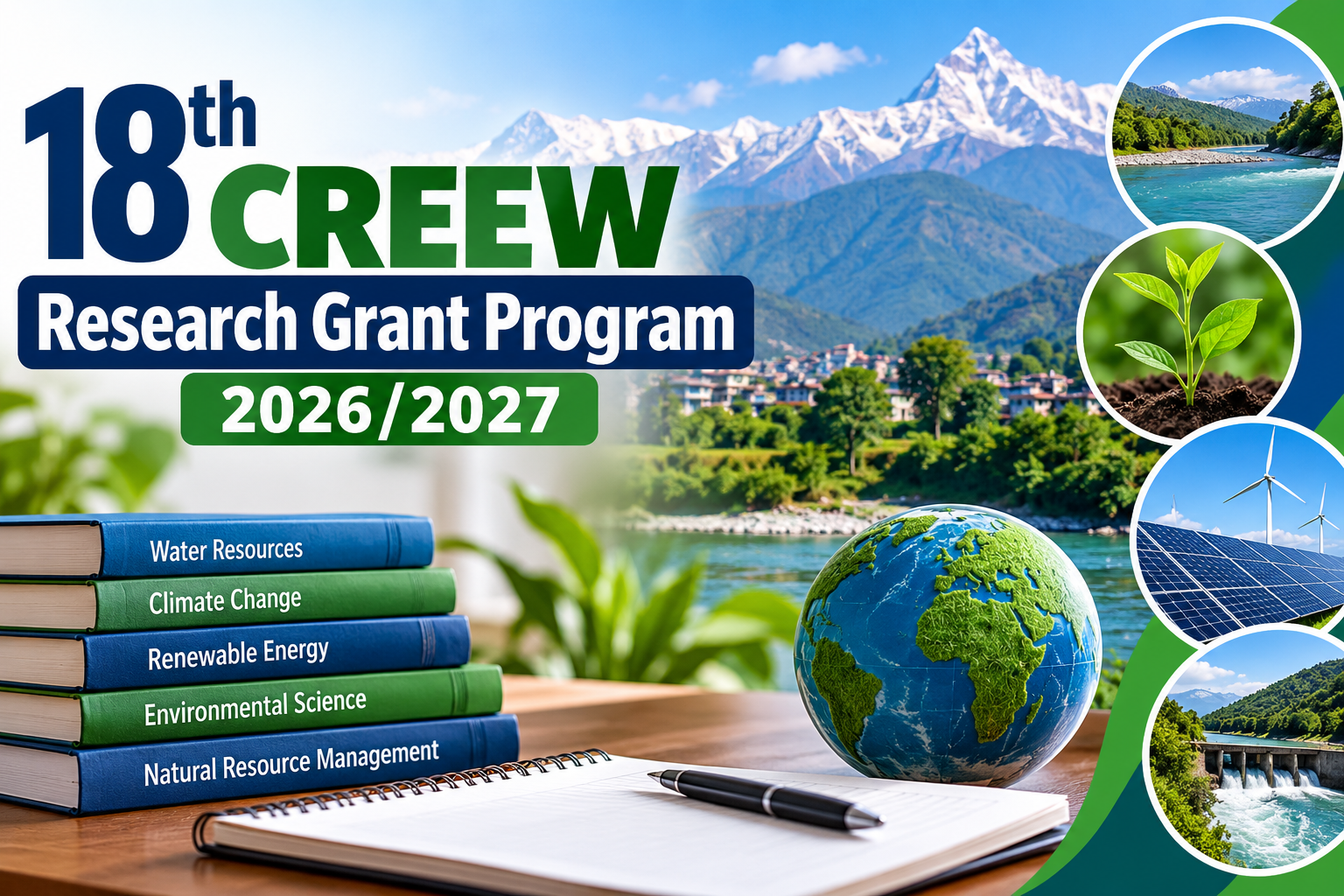
18th CREEW Research Grant Program 2026/2027: Eligibility, Research Areas and How to Apply
Are you a Master’s student in Nepal preparing a thesis on water resources, environmental science, climate change, renewable energy, or natural resource management? The 18th CREEW Research Grant Program 2026/2027 offers an opportunity to receive research support and technical guidance while developing your Master’s thesis.
Organised by the Center of Research for Environment, Energy and Water (CREEW), the programme supports students whose research addresses environmental and development challenges relevant to Nepal. In addition to financial assistance, selected students can benefit from mentorship and feedback from experienced researchers and professionals.
The 2026/2027 programme is intended for eligible Nepalese students in the second year of a Master’s degree who are actively developing their thesis proposals. Applicants should ensure their proposed research aligns with CREEW’s research priorities and addresses a relevant issue within Nepal.
Applications close on 20 November 2026, while the research period for successful applicants is scheduled to run from January to June 2027.
Below is a detailed guide to the programme, including eligibility requirements, research areas, application documents, and the steps prospective applicants should follow.
About the 18th CREEW Research Grant Program
The CREEW Research Grant Program is an initiative of the Center of Research for Environment, Energy and Water, a Nepal-based research and development organisation.
The organisation supports research that contributes to a better understanding of water, environmental, energy, and natural resource challenges. Through its research grant programme, CREEW provides opportunities for Master’s students to develop their thesis research while receiving guidance from professionals familiar with their fields.
The 18th edition of the programme continues this focus by encouraging research that responds to practical challenges affecting Nepal.
The programme also emphasises research development through presentations and feedback. Selected students and their supervisors are expected to participate in proposal, mid-term, and final research presentations during the grant period.
These activities can help students improve their research methods, communicate their findings, and strengthen the overall quality of their academic work.
18th CREEW Research Grant Program 2026/2027: Overview
Here are the key details applicants should know before preparing their applications.
- Programme Name: 18th CREEW Research Grant Program
- Academic Year: 2026/2027
- Host Organisation: Center of Research for Environment, Energy and Water (CREEW)
- Funding Support: Financial assistance for eligible Master’s thesis research
- Target Applicants: Nepalese citizens enrolled in the second year of a Master’s programme
- Eligible Research Location: Nepal
- Priority Fields: Water resources, environmental science, climate change, renewable energy, natural resources, and related areas
- Application Deadline: 20 November 2026
- Research Period: January–June 2027
- Additional Benefits: Technical mentorship, expert feedback, and research presentations
- Official Website: https://www.creew.org.np/
Important: The published information available for this edition does not confirm a specific grant amount. Applicants should consult the official call for proposals for the current funding terms rather than relying on figures from previous editions.
Benefits of the CREEW Research Grant Program
The programme offers more than an opportunity to receive financial assistance. It also provides academic support that can help students develop their research skills and improve their thesis work.
1. Financial Support for Master’s Research
Selected applicants receive research grant support to assist with eligible thesis research activities.
The precise amount and eligible expenditure categories should be confirmed in the official 2026/2027 call. Applicants should prepare a realistic research budget that explains the costs associated with their proposed work.
2. Technical Mentorship
Successful applicants can receive guidance and feedback from CREEW researchers, technical experts, and other professionals.
This support can help students assess their research questions, improve their methodology, and address practical challenges encountered during their studies.
3. Opportunities to Present Research
Selected students are expected to participate in proposal, mid-term, and final research presentations.
These presentations provide opportunities to discuss research progress, receive constructive feedback, and communicate findings to an academic audience.
4. Development of Research Skills
Preparing a competitive proposal requires students to identify a research problem, review existing studies, establish clear objectives, and select appropriate research methods.
Working through these stages can help students strengthen skills that are useful for future academic and professional opportunities.
5. Research Relevant to Nepal
The programme prioritises research that addresses local or national challenges in Nepal.
This gives students an opportunity to investigate practical issues involving water management, environmental protection, energy, climate resilience, and other related fields.
Eligibility Requirements for the 18th CREEW Research Grant Program 2026/2027
Applicants must meet the programme’s stated eligibility conditions before submitting a proposal.
Based on the published call information, the main requirements are as follows.
1. Citizenship
Applicants must be citizens of Nepal.
This is an important restriction for international readers. Students from other countries should not assume they are eligible simply because they are studying a relevant subject.
2. Master’s Degree Enrollment
Applicants must be enrolled in the second year of a Master’s programme at a recognised university or college.
Students should ensure that their academic status meets the requirements specified in the current call.
3. Thesis Proposal Development
Applicants must be actively developing a research proposal for their Master’s thesis.
The proposed work should demonstrate a clear research problem, appropriate objectives, a practical methodology, and a realistic plan for completing the study.
4. Relevant Research Topic
The proposed thesis must align with CREEW’s research themes.
Priority is given to topics identified in the call, although other relevant research areas may be considered on a case-by-case basis.
5. Research Conducted in Nepal
The proposed research must be conducted in Nepal and address a local or national issue.
Applicants should clearly explain the significance of their research to the country and demonstrate how the proposed study could contribute useful evidence or understanding.
Eligibility reminder: Meeting the minimum requirements does not guarantee selection. Applicants should read the official call carefully and ensure their proposals satisfy all academic, thematic, and documentation requirements.
Priority Research Areas
CREEW encourages research that addresses important challenges involving water, the environment, energy, climate, and natural resources.
The programme’s priority areas include the following.
1. Groundwater and Surface Water
This area covers research into the availability, quality, management, and sustainable use of water resources.
Possible topics include:
- Groundwater quality and contamination.
- Water pollution and treatment.
- Groundwater management and recharge.
- Water demand and supply.
- Hydrology and water resource assessment.
- Interactions between groundwater and surface water.
- Water resource management for sustainable development.
Students working on these topics should identify a specific problem and explain how their proposed research could improve understanding of local water challenges.
2. River Basins and Ecosystems
Research under this theme may focus on river systems, watersheds, aquatic environments, and ecosystem management.
Relevant topics can include integrated water resource management, watershed health, river restoration, hydrological processes, biodiversity, and the sustainable management of natural ecosystems.
3. Integrated Waste Management and Resource Recovery
This research area focuses on waste reduction, treatment, recycling, and the recovery of useful resources from waste.
Potential topics include:
- Municipal solid waste management.
- Wastewater treatment.
- Recycling and resource recovery.
- Circular economy approaches.
- Electronic waste management.
- Hazardous waste treatment.
- Waste-to-energy systems.
- Environmental impacts associated with waste disposal.
A strong proposal should identify a clear waste management challenge and explain how the proposed methods will help investigate it.
4. Climate Change and Resilience
Climate change creates challenges for water availability, agriculture, ecosystems, infrastructure, and communities.
Research in this area may examine climate impacts, adaptation strategies, mitigation, climate modelling, climate finance, disaster risk reduction, and resilience planning.
Applicants should explain the specific climate-related issue their research will address and why the findings could be useful.
5. Green Energy
This theme encourages research into cleaner and more sustainable energy systems.
Potential areas of interest include solar energy, wind power, biomass, biogas, hydropower, energy efficiency, carbon footprints, and waste-to-energy technologies.
Students should demonstrate the relevance of their research to Nepal’s energy needs and environmental priorities.
6. Environmental Health and WASH
WASH refers to water, sanitation, and hygiene.
This research area includes issues involving drinking water quality, household water treatment, sanitation, hygiene practices, environmental health risks, and WASH programmes in schools and communities.
Other related topics may include emerging pollutants, menstrual hygiene, and environmental factors affecting public health.
Applicants should review the current call to confirm that their proposed topic fits the programme’s requirements.
Required Documents for the CREEW Research Grant
Applicants should prepare all required documents before completing the online application.
The published programme information identifies the following materials.
1. Cover Letter
Prepare a cover letter of no more than one page.
The letter should briefly introduce your proposed research, explain its relevance to CREEW’s priority themes, and show why the topic is important.
Keep the letter focused and professional.
2. Research Proposal
Your research proposal is one of the most important parts of the application.
According to the published requirements, the main proposal should not exceed nine pages, excluding the specified preliminary components.
The proposal should follow CREEW’s prescribed format and include the required sections, such as:
- Research summary of no more than 250 words.
- Introduction and research background.
- Problem statement.
- Research questions and objectives.
- Materials and methods.
- Description of the study area.
- Data collection methods.
- Data analysis procedures.
- Methodological flowchart.
- Research matrix.
- Expected results.
- Research plan and schedule.
- Detailed research budget.
- References.
Applicants should also follow the formatting and referencing instructions provided in the official call, including the specified use of APA 7th Edition referencing.
Do not submit a generic proposal that could apply to any country or research setting. Clearly explain the problem in Nepal that your study will investigate.
3. Academic Records
Applicants must provide copies of their academic mark sheets and certificates covering:
- 10+2 education.
- Undergraduate studies.
- Ongoing Master’s studies, including the first and second semesters.
Ensure the records are legible and arranged in the required order.
4. Valid Student Identification Card
A valid student ID is also required.
Check that the document is readable and that the information matches your application.
5. Supervisor’s Recommendation and Consent Letter
Your thesis supervisor must provide a signed recommendation and consent letter.
The supervisor must also include a CV of approximately one to two pages.
The published instructions state that the supervisor should email these documents directly to CREEW. Each supervisor may recommend a maximum of two students for the programme.
Applicants should coordinate with their supervisors early to avoid missing the deadline because of incomplete supporting documents.
How to Apply for the 18th CREEW Research Grant Program 2026/2027
Eligible applicants should follow the official application instructions carefully.
Step 1: Confirm Your Eligibility
Check that you are a Nepalese citizen, are enrolled in the second year of a Master’s programme at a recognised institution, and are developing a relevant thesis proposal.
Also confirm that your research will be conducted in Nepal and addresses a topic aligned with CREEW’s priorities.
Step 2: Select a Relevant Research Topic
Choose a research problem that is clear, specific, and relevant to the programme.
Your topic should address a genuine issue involving water resources, environmental management, climate change, energy, or another relevant research area.
Avoid choosing a topic simply because it sounds interesting. Make sure the study is achievable with the time, resources, and methods available to you.
Step 3: Prepare Your Research Proposal
Develop your proposal using the prescribed CREEW format.
Clearly state the research problem, objectives, methodology, expected results, timeline, and budget.
Check the page limit, formatting requirements, and reference style before finalising the document.
Step 4: Gather Your Supporting Documents
Prepare your cover letter, research proposal, academic records, and valid student ID.
Coordinate with your supervisor to obtain the signed recommendation and consent letter, along with the required CV.
Review the current call for the exact document arrangement and submission instructions.
Step 5: Submit the Online Application
Complete the application through the official CREEW application portal.
The application information identifies the research proposal as a required upload. Follow the portal’s instructions and the official call when preparing the complete set of supporting materials.
The published instructions also specify that the cover letter, proposal, academic records, and student ID should be combined into one PDF file.
Use the required filename format:
FirstName_FamilyName-CREEW Grant 2026/27
Check the prescribed naming convention carefully before uploading your application.
Step 6: Ask Your Supervisor to Send the Required Documents
Your supervisor must send the signed recommendation and consent letter, together with their one- to two-page CV, directly to the programme by email.
Email: info@creew.org.np
Required email subject:
CREEW Grant 2026/27 Recommendation and Consent Letter for Students Name
Replace the placeholder with the relevant student’s name, following the programme’s instructions.
Remember that the supervisor must submit these documents directly. Do not assume that uploading your own application automatically completes this separate requirement.
Step 7: Submit Before the Deadline
The application deadline is 20 November 2026.
Submit your materials well before the closing date to allow time to resolve technical problems or missing-document issues.
The published information does not specify a closing time or time zone, so applicants should confirm the deadline details through the official application portal.
Application Deadline and Research Timeline
Applicants should take note of the following dates.
| Activity | Date |
|---|---|
| Publication of the current call | 2 October 2026 |
| Application deadline | 20 November 2026 |
| Expected research period | January–June 2027 |
| Proposal presentation | Date to be confirmed |
| Mid-term research presentation | Date to be confirmed |
| Final research presentation | Date to be confirmed |
The exact dates for the research presentations have not been specified in the available programme information.
Applicants should consult CREEW’s official announcements for updates and instructions concerning the selection process and research schedule.
Tips for Preparing a Competitive Application
Meeting the eligibility requirements is only the first step. Your proposal should also demonstrate that the research is relevant, feasible, and academically sound.
Here are several practical ways to strengthen your application.
Choose a Clear Research Problem
Explain precisely what issue you want to investigate and why it matters.
A proposal that attempts to solve too many problems at once can become difficult to manage. Focus on a question that can be answered within the available research period.
Explain the Importance of the Study
Show how your proposed research relates to a specific challenge in Nepal.
Where appropriate, use credible studies, official statistics, and relevant academic literature to establish the importance of the problem.
Use a Practical Methodology
Describe how you will collect and analyse your data.
Your methodology should match your objectives and be realistic given your available time, equipment, access to research locations, and budget.
Prepare a Realistic Budget
List the expected research expenses and explain why each cost is necessary.
Make sure the budget corresponds with your methodology and proposed activities. Follow any budget restrictions stated in the official call.
Follow Every Formatting Requirement
A well-written proposal can still be weakened by missing documents or failure to follow submission instructions.
Check the page limit, font, spacing, citation style, PDF arrangement, and filename before uploading.
Work Closely With Your Supervisor
Discuss your research idea and methodology with your supervisor early.
Allow enough time for feedback, revisions, and preparation of the recommendation documents.
Submit Accurate Information
Ensure that all details in your application are truthful and consistent with your academic records.
Do not exaggerate your research experience, provide false academic information, or claim results that have not been established.
Who Should Consider Applying?
The programme may be particularly relevant to Master’s students in fields such as environmental science, water resources, hydrology, environmental engineering, natural resource management, climate science, renewable energy, and related disciplines.
However, the relevance of a degree title alone does not establish eligibility. Applicants must satisfy the citizenship and academic requirements and propose research that fits the programme’s themes.
Students whose proposed studies are not connected to Nepal, or who do not meet the specified citizenship and Master’s enrolment requirements, should not assume they qualify.
Frequently Asked Questions
1. What is the 18th CREEW Research Grant Program?
It is a research support programme organised by the Center of Research for Environment, Energy and Water. It supports eligible Master’s students undertaking thesis research related to water, the environment, energy, natural resources, and other relevant fields in Nepal.
2. Who is eligible to apply?
The published requirements specify Nepalese citizenship, second-year enrolment in a Master’s programme at a recognised university or college, and a thesis proposal aligned with CREEW’s research priorities. The proposed research must be conducted in Nepal.
3. What is the application deadline?
The application deadline is 20 November 2026.
Applicants should check the official portal for any updates and confirmation of the closing time.
4. How much funding does the programme provide?
The specific grant amount for the 2026/2027 edition has not been verified in the available current-call information.
Applicants should consult the official call before making financial plans. Funding figures from previous editions should not be treated as confirmation of the current award amount.
5. Can international students apply?
The published eligibility requirements specify that applicants must be citizens of Nepal. International students who do not meet this requirement should not assume they are eligible.
6. What research topics are encouraged?
Priority areas include groundwater and surface water, river basins and ecosystems, integrated waste management, climate change and resilience, green energy, and environmental health and WASH.
Other relevant topics may be considered on a case-by-case basis.
7. What is the duration of the research programme?
The expected research period for successful applicants is January to June 2027.
8. Does the programme provide mentorship?
Yes. The programme includes technical guidance and feedback from CREEW researchers, experts, and professionals. Selected students and their supervisors are also expected to attend proposal, mid-term, and final research presentations.
9. Where can I apply?
Applicants should use the official CREEW website and the application portal linked to the current call.
Official website: https://www.creew.org.np/
10. What happens after submission?
According to the published programme information, CREEW reviews applications and contacts shortlisted applicants. Submission does not guarantee selection, and applicants should follow official communications regarding the outcome.
Official Application Link
Interested applicants should review the official programme information and confirm the application requirements before submitting their documents.
Official CREEW website: https://www.creew.org.np/
Application deadline: 20 November 2026
Research period: January–June 2027
Applicants should ensure they meet the eligibility requirements, use the prescribed proposal format, prepare all supporting documents, and coordinate with their supervisors before submitting the application.
Final Thoughts
The 18th CREEW Research Grant Program 2026/2027 provides an opportunity for eligible Nepalese Master’s students to develop research addressing important water, environmental, climate, energy, and natural resource challenges.
Beyond financial support, the programme’s emphasis on mentorship and research presentations can help students strengthen their academic work and gain experience communicating research findings.
If you meet the eligibility requirements and have a well-defined thesis topic relevant to Nepal, take time to prepare a clear proposal and organise your supporting documents carefully.
With the deadline set for 20 November 2026, interested students should begin preparing early and rely on the official CREEW call for the final funding terms, submission requirements, and application instructions.
