
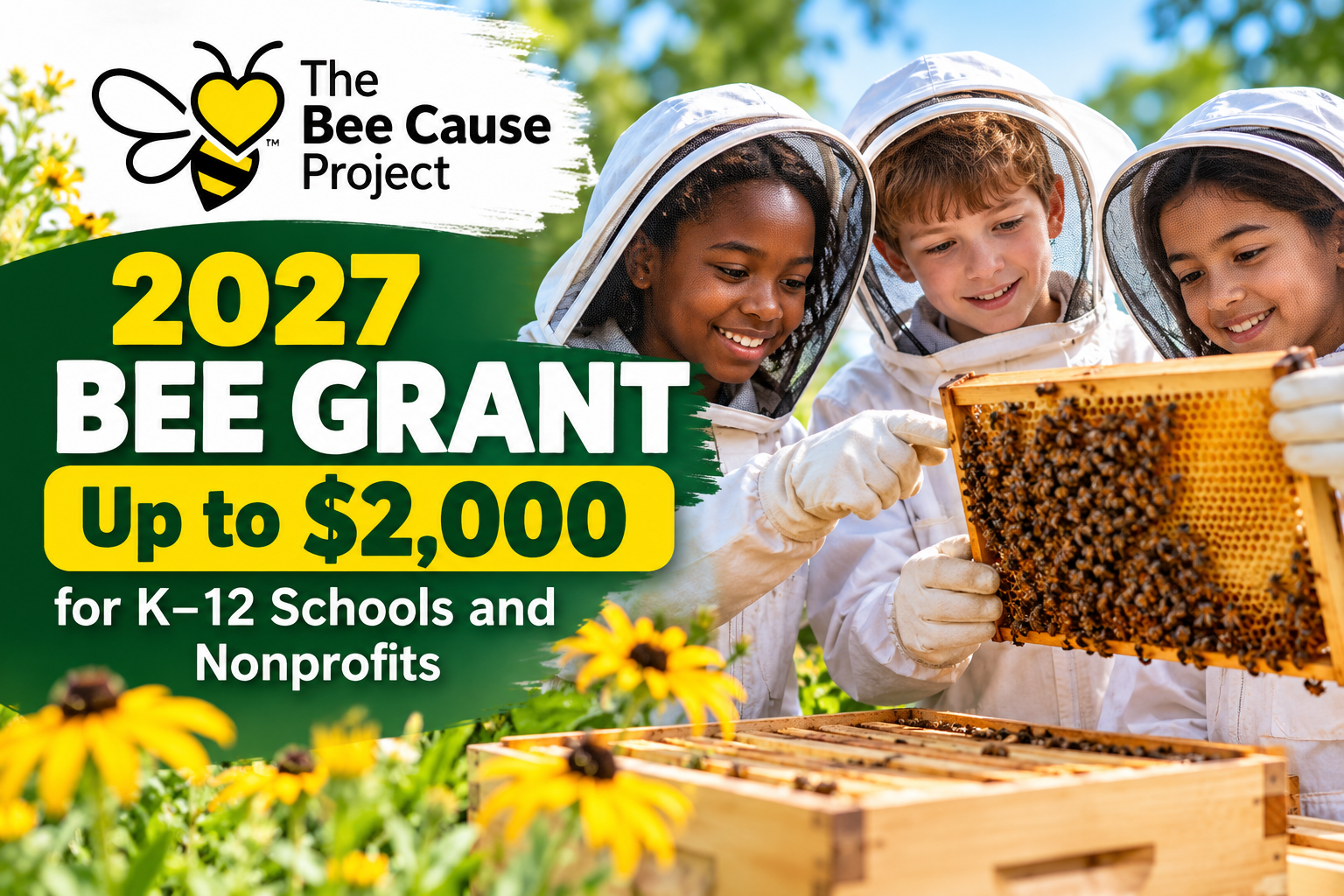
The Bee Cause Project 2027 Bee Grant: Up to $2,000 for K–12 Schools and Nonprofits
Schools and nonprofit organizations looking for practical ways to introduce students to environmental conservation, pollination, and science education can explore the Bee Cause Project 2027 Bee Grant. The program provides financial and educational support to eligible organizations interested in developing or improving educational honeybee programs.
Offered through The Bee Cause Project in partnership with Whole Kids Foundation, the initiative helps students learn about honeybees, pollinators, and their importance to the environment through hands-on educational experiences.
For the 2027 funding cycle, eligible applicants can apply for a traditional grant worth $2,000 or choose an equipment package that includes an indoor observation hive and a $1,000 stipend. Previous grant recipients may also qualify for a separate renewal grant worth $2,000.
Applications opened on September 1, 2026, and the published closing date is October 30, 2026, according to Whole Kids Foundation.
This article explains the grant options, eligibility requirements, application process, important dates, and practical steps organizations can take before submitting an application.
Overview of the Bee Cause Project 2027 Bee Grant
The Bee Grant is designed to help schools and nonprofit organizations make pollinator education a meaningful part of their educational activities.
Rather than providing unrestricted funding for general organizational expenses, the program focuses on educational honeybee projects that allow students to learn about bees, ecosystems, and environmental responsibility.
Here are the key details applicants should know.
- Grant name: The Bee Cause Project 2027 Bee Grant
- Organizing partners: The Bee Cause Project and Whole Kids Foundation
- Funding cycle: 2027
- Maximum traditional monetary grant: $2,000
- Alternative traditional award: Indoor observation hive plus a $1,000 stipend
- Renewal grant: $2,000 for eligible previous recipients
- Eligible applicants: Qualifying K–12 schools and nonprofit organizations in the United States and Canada
- Minimum student requirement: At least 10 students in kindergarten through Grade 12
- Application opening date: September 1, 2026
- Application closing date: October 30, 2026
- Expected notification date: December 16, 2026
- Expected grant package delivery: February 1, 2027
- Application method: Online through the official application platform
Applicants should review the official guidelines carefully because eligibility and award options differ between the traditional and renewal grants.
What Is the Bee Cause Project Bee Grant?
The Bee Cause Project Bee Grant is an educational funding initiative that supports organizations interested in teaching children about honeybees and pollinator conservation.
Honeybees play an important role in pollination, which helps many plants reproduce. Pollination also supports agricultural production and contributes to the health of ecosystems.
However, students do not always have opportunities to explore these processes through direct observation. The Bee Grant seeks to address this gap by helping eligible organizations establish educational bee programs and provide learning experiences that connect classroom lessons with the natural world.
Through the initiative, participating schools and nonprofits can introduce students to subjects such as biology, environmental science, ecology, and sustainability.
The program also offers educational resources to help educators develop meaningful lessons around pollinators and honeybees.
Organizations considering an application should understand that this is a specialized educational grant. The proposed project must focus on bee education rather than unrelated activities or general operating expenses.
Bee Grant Funding Options for 2027
The 2027 program includes different funding options depending on whether an organization is applying for a traditional grant or a renewal grant.
1. Traditional Bee Grant: $2,000
The Traditional Bee Grant is intended for eligible schools and nonprofit organizations that want to establish a new educational honeybee program or strengthen an existing program.
Applicants can choose a monetary award of $2,000 to support their bee education activities.
This option may be suitable for organizations that have identified the resources and local support needed to develop a sustainable educational program.
Before applying, organizations should prepare a realistic project budget explaining how the funding will contribute to their educational objectives.
The proposal should clearly explain what students will learn, how the activities will be delivered, and how the organization intends to maintain the program.
2. Traditional Equipment Grant: Observation Hive and $1,000 Stipend
Instead of the $2,000 monetary award, eligible traditional applicants can choose an equipment package consisting of an indoor observation hive and a $1,000 stipend.
An observation hive provides an opportunity for students to observe honeybee activity in a structured educational setting.
This option may be particularly useful for schools that want to make honeybee behavior a regular part of their science lessons.
Organizations should consider the practical requirements of hosting bees before selecting this option. These may include obtaining administrative approval, identifying a suitable location, arranging expert support, and establishing appropriate safety procedures.
The observation hive option should not be treated as a completely maintenance-free educational resource. A successful program requires planning and responsible management.
3. Renewal Bee Grant: $2,000
The Renewal Bee Grant is designed for eligible organizations that previously received support through the Bee Grant program.
It provides $2,000 to help recipients strengthen or expand their existing educational bee programs.
According to the published 2027 guidelines, applicants must have received a Traditional Bee Grant from Whole Kids Foundation in 2025 or earlier and completed the required progress report.
Renewal applicants do not need to have live bees to qualify.
The renewal package also includes program consultation and educational resources to help recipients improve their projects.
Previous recipients should review the renewal requirements carefully before applying, as this category is not intended for organizations that have never received a qualifying grant.
Who Can Apply for the Bee Cause Project 2027 Bee Grant?
The Bee Grant is open to qualifying schools and nonprofit organizations in the United States and Canada that serve students in kindergarten through Grade 12.
Applicants must meet the program’s requirements and demonstrate that the proposed bee program will serve an educational purpose.
1. K–12 Schools
Eligible educational institutions may include qualifying public schools and nonprofit private schools serving kindergarten through Grade 12 students.
Schools interested in applying should demonstrate how the proposed bee program will support student learning.
For example, a school might incorporate honeybee observation into science lessons, environmental clubs, or practical activities about pollination and biodiversity.
The school should also have the appropriate administrative support to host and manage the program.
2. Nonprofit Organizations
Qualifying nonprofit organizations that provide educational programming for children may also apply.
Examples can include eligible youth programs, museums, camps, and other nonprofit organizations that work directly with school-age children.
The organization must demonstrate that the bee program will serve at least 10 students in the K–12 age or grade range.
Applicants should confirm their organizational status and documentation requirements before beginning the application.
3. Homeschool Associations
Eligible homeschool associations may also be considered.
The published guidelines indicate that a homeschool association must serve at least 10 registered K–12 students and meet the applicable organizational requirements, including the specified nonprofit status and employer identification number requirements.
Individual homeschooling families should not assume they qualify simply because they educate children at home. They should confirm whether their association or organization meets the official criteria.
4. University Departments and Extension Programs
Certain university departments and extension programs may qualify if they directly provide educational programming for K–12 students.
For example, an extension program could propose honeybee education activities for children at local schools or through a structured community education initiative.
The important consideration is whether the applicant will directly support qualifying students and take responsibility for delivering the educational program.
Universities should review the official requirements before applying because a university’s general student population does not automatically establish eligibility.
Important Eligibility Requirements
Meeting the basic school or nonprofit criteria is only part of the application process.
Applicants should pay attention to the following requirements.
Minimum number of students: The program must serve at least 10 students in kindergarten through Grade 12.
Geographical eligibility: Applicants must be based in the United States or Canada and satisfy the program’s organizational requirements.
Educational purpose: The proposed project must use bee education as a learning tool.
Responsible program coordinator: The organization should identify a Bee Advocate who will oversee the educational activities and help ensure that the program operates effectively.
Bee mentor: Organizations planning to host live bees should arrange appropriate support from a knowledgeable beekeeper or suitable bee educator.
Administrative approval: The school’s principal, executive director, or relevant leadership should understand and support the proposed project.
Long-term planning: Applicants should consider how the program will be maintained beyond the initial funding period.
These requirements help ensure that funded projects are educationally useful, responsibly managed, and capable of continuing over time.
Applicants should consult the official guidelines for the complete requirements applicable to their chosen grant category.
What Can the Bee Grant Support?
The Bee Grant is intended to support educational honeybee programs.
Depending on the award category and applicable guidelines, funding and resources may help organizations establish or improve activities involving live honeybees, observation equipment, educational materials, and pollinator learning.
Potential educational activities include:
- Introducing students to honeybee biology and behavior.
- Teaching students about pollination and plant reproduction.
- Developing science lessons around ecosystems and biodiversity.
- Helping students understand the relationship between pollinators and food production.
- Creating structured opportunities to observe honeybee activity.
- Supporting educational projects focused on environmental conservation.
- Providing resources for teachers and program coordinators.
Organizations should ensure that every proposed expense is consistent with the official grant rules.
The $2,000 award should not be presented as unrestricted funding for any organizational purpose. Applicants should develop their budgets around the educational bee program and verify which costs are permitted.
The grant also should not be assumed to cover every future expense associated with keeping bees. Organizations need to consider ongoing maintenance, expert assistance, replacement equipment, and other responsibilities when planning their projects.
Why the Bee Grant Matters for Schools and Students
A well-planned bee education program can give students opportunities to connect classroom learning with real-world environmental questions.
Encourages Practical Science Learning
Students can learn about honeybee anatomy, colony behavior, pollination, and plant reproduction through lessons and structured observations.
These experiences can make scientific concepts easier to understand because students can connect what they learn in the classroom with the natural world.
Develops Environmental Awareness
Pollinators are an important part of many ecosystems.
Teaching children about bees can help them understand the relationships between insects, plants, food systems, and environmental health.
Students can also explore how habitat changes and other environmental factors affect pollinator populations.
Supports STEAM Education
The program can contribute to science, technology, engineering, arts, and mathematics education.
Depending on the curriculum, students might record observations, compare data, draw diagrams, study life cycles, or investigate how environmental conditions influence pollinator activity.
Teachers can adapt these activities to different grade levels and learning objectives.
Builds Responsibility and Collaboration
A successful educational bee program requires planning, communication, and cooperation.
Students may participate in supervised learning activities while teachers, program coordinators, and qualified bee mentors handle the responsibilities associated with the hive.
This structure can help learners appreciate the importance of teamwork and responsible environmental stewardship.
How to Apply for the Bee Cause Project 2027 Bee Grant
Applications are submitted online through the official application platform.
Organizations interested in applying should follow these steps.
Step 1: Visit the Official Bee Grant Website
Begin by reading the current grant announcement and reviewing the requirements for the 2027 funding cycle.
Official information is available on The Bee Cause Project website:
https://www.thebeecause.org/the-bee-grant/
Read the details for the Traditional Bee Grant or Renewal Bee Grant, depending on your organization’s eligibility.
Step 2: Confirm Your Eligibility
Determine whether your school or nonprofit organization meets the program’s requirements.
Confirm that the organization serves at least 10 K–12 students and satisfies the geographical and organizational criteria.
If you are applying for a renewal grant, verify that your previous award and progress report meet the published requirements.
Do not begin preparing a full proposal until you have checked the eligibility rules for your chosen category.
Step 3: Identify a Bee Advocate
The Bee Advocate is the individual responsible for helping implement the educational program.
This person should understand the proposed activities, coordinate relevant responsibilities, and work with the appropriate school or organizational leadership.
The applicant should be able to explain how the program will be integrated into educational activities and maintained over time.
Step 4: Arrange Appropriate Beekeeper Support
Organizations planning to host live honeybees should identify a knowledgeable beekeeper or suitable bee educator who can provide the necessary support.
Before submitting an application, consider how the hive will be managed and who will be responsible for its ongoing care.
Applicants should also review the project’s location, safety arrangements, and any local or institutional requirements.
Step 5: Develop a Clear Project Proposal
Prepare a proposal that explains what the organization intends to accomplish with the grant.
A strong proposal should address the educational needs of the students, the planned activities, the number of students expected to participate, and the expected learning outcomes.
For example, an applicant might explain how students will study pollination, maintain observation records, and explore the importance of honeybees to ecosystems.
Avoid vague statements that simply describe the project as beneficial.
Explain what students will actually do and how the proposed activities will support their learning.
Step 6: Prepare a Realistic Budget
Develop a budget that reflects the needs of the proposed bee program.
Identify the planned expenses and explain how they relate to the educational objectives.
Applicants should confirm that proposed costs are permitted under the official guidelines before including them in the budget.
The proposal should also consider how the organization will handle responsibilities that continue after the grant period.
Step 7: Complete the Online Application
The official program directs applicants to the SmartSimple platform to register their organization and submit an application.
The application portal is available here:
https://wholekidsfoundation.smartsimple.com/
Follow the instructions provided for the appropriate grant category.
The official website also provides sample application materials that applicants can use to prepare their responses. These documents are intended to help with preparation; the final application must be submitted online.
Step 8: Review and Submit Before the Deadline
Review the completed application before submitting it.
Check that the information is accurate, the project description is clear, and the proposed budget matches the intended activities.
Make sure all required information has been provided and that the application has been submitted successfully.
Applicants should keep any submission confirmation for their records.
Important: The published closing date for the 2027 Bee Grant is October 30, 2026. Applicants should confirm the deadline and any category-specific instructions on the official website before submitting.
Bee Grant 2027: Important Dates
The following dates are listed by Whole Kids Foundation for the 2027 funding cycle.
| Application milestone | Date |
|---|---|
| Applications open | September 1, 2026 |
| Applications close | October 30, 2026 |
| Application notifications | December 16, 2026 |
| Expected grant package delivery | February 1, 2027 |
As of October 11, 2026, the application period is open, and the published closing date is approaching.
Applicants should not wait until the final day to begin preparing their submissions. Confirming eligibility, obtaining administrative approval, arranging beekeeper support, and preparing a clear proposal may take time.
Dates can change, so check the official grant page for any updates before applying.
Tips for Preparing a Strong Bee Grant Application
Although meeting the eligibility requirements is essential, applicants should also demonstrate that their proposed program is practical and educationally valuable.
Here are several ways to prepare a stronger application.
Explain the Educational Need
Describe why bee education would be valuable to the students your organization serves.
Identify the subjects or learning objectives the program will address and explain how the proposed activities fit into the organization’s educational work.
Show How Students Will Participate
Explain how many students are expected to participate and what they will learn.
A proposal that describes actual lessons, observations, and learning activities gives reviewers a clearer understanding of the project’s educational purpose.
Demonstrate Readiness
For projects involving live bees, explain how the organization plans to manage the hive responsibly.
Identify the people who will coordinate the program and provide the required expertise.
Also consider how the project will obtain administrative approval and meet applicable safety requirements.
Prepare a Sustainable Plan
A successful bee program requires more than an initial purchase.
Applicants should consider how they will maintain the educational activities, support the hive where applicable, and keep the program useful for future students.
A realistic sustainability plan can help demonstrate that the project has been carefully considered.
Follow the Official Instructions
Read the application guidelines and required documents before submitting your proposal.
Answer the questions directly, provide accurate information, and avoid including expenses or activities that do not fit the grant’s purpose.
A clear, well-organized application is easier to assess than one containing vague explanations or unnecessary information.
Safety Considerations for Schools Hosting Live Bees
Schools and nonprofits considering a live honeybee program should plan for safety before applying.
The organization should identify a suitable hive location, arrange expert guidance, and develop procedures for supervising students.
It is also important to consider students and staff who may have bee-sting allergies and to consult appropriate school health personnel when developing a response plan.
The Bee Cause Project provides resources to help organizations prepare for the practical responsibilities of hosting bees.
Applicants should review these resources and follow the relevant guidance from their institution, beekeeper, and local authorities.
An observation hive or outdoor beehive should never be treated as an informal classroom activity without appropriate planning and supervision.
Frequently Asked Questions
1. How much funding does the Bee Cause Project 2027 Bee Grant provide?
Eligible traditional applicants can choose a $2,000 monetary grant or an equipment package consisting of an indoor observation hive and a $1,000 stipend.
Eligible previous recipients may apply for a separate $2,000 renewal grant if they meet the renewal requirements.
2. Can individuals apply for the Bee Grant?
The program is intended for qualifying schools and nonprofit organizations rather than individuals applying for personal funding.
Applicants should confirm that their organization meets the relevant requirements before registering.
3. Can schools outside the United States and Canada apply?
The published eligibility requirements specify schools and nonprofit organizations in the United States and Canada.
Organizations based in other countries should not assume they qualify unless the program publishes updated eligibility rules.
4. Can a nonprofit organization apply if it already has a beehive?
Potentially, yes.
An organization that has not previously received a qualifying Traditional Bee Grant may be able to apply through the traditional category to enhance an existing educational bee program.
Previous qualifying recipients should review the renewal category instead.
Eligibility depends on the organization’s circumstances and the current grant guidelines.
5. Do renewal applicants need to have live bees?
No. According to the published renewal guidelines, live bees are not required to apply for the Renewal Bee Grant.
Applicants must still satisfy the other renewal requirements, including the previous-award and progress-report conditions.
6. When is the application deadline?
The published closing date is October 30, 2026.
Applicants should check the official website for any changes and confirm that their submission is complete before the deadline.
7. How can applicants access the application form?
Applicants can visit The Bee Cause Project’s official Bee Grant page and follow the instructions to access the SmartSimple application platform.
Sample application documents are also available to help organizations prepare their responses.
8. Does the grant guarantee that a school will receive a beehive?
No. Submitting an application does not guarantee selection or funding.
Organizations must complete the application process and wait for the program’s decision. The final award depends on the program’s review and applicable requirements.
Final Thoughts
The Bee Cause Project 2027 Bee Grant offers eligible K–12 schools and nonprofit organizations an opportunity to develop educational honeybee programs and introduce students to pollination, science, and environmental conservation.
With a traditional monetary award of $2,000, an alternative observation hive package, and a renewal option for qualifying previous recipients, the program offers different forms of support for organizations at different stages of their bee education work.
However, the grant is not a general-purpose funding opportunity. Applicants should demonstrate a clear educational purpose, confirm their eligibility, prepare a realistic proposal, and plan responsibly for any ongoing requirements associated with hosting live bees.
Since the published deadline is October 30, 2026, eligible organizations interested in applying should review the official guidelines and begin preparing their applications as soon as possible.
Official application and further information:
The Bee Cause Project: https://www.thebeecause.org/the-bee-grant/
Whole Kids Foundation: https://www.wholekidsfoundation.org/our-work/childrens-nutrition/bee-grant
Application portal: https://wholekidsfoundation.smartsimple.com/
Disclaimer: Latest Scholarship News is an independent information platform and is not the grant administrator. Grant amounts, eligibility requirements, application dates, and award decisions are determined by the official program organizers. Applicants should verify all details through the official sources before submitting an application.
