
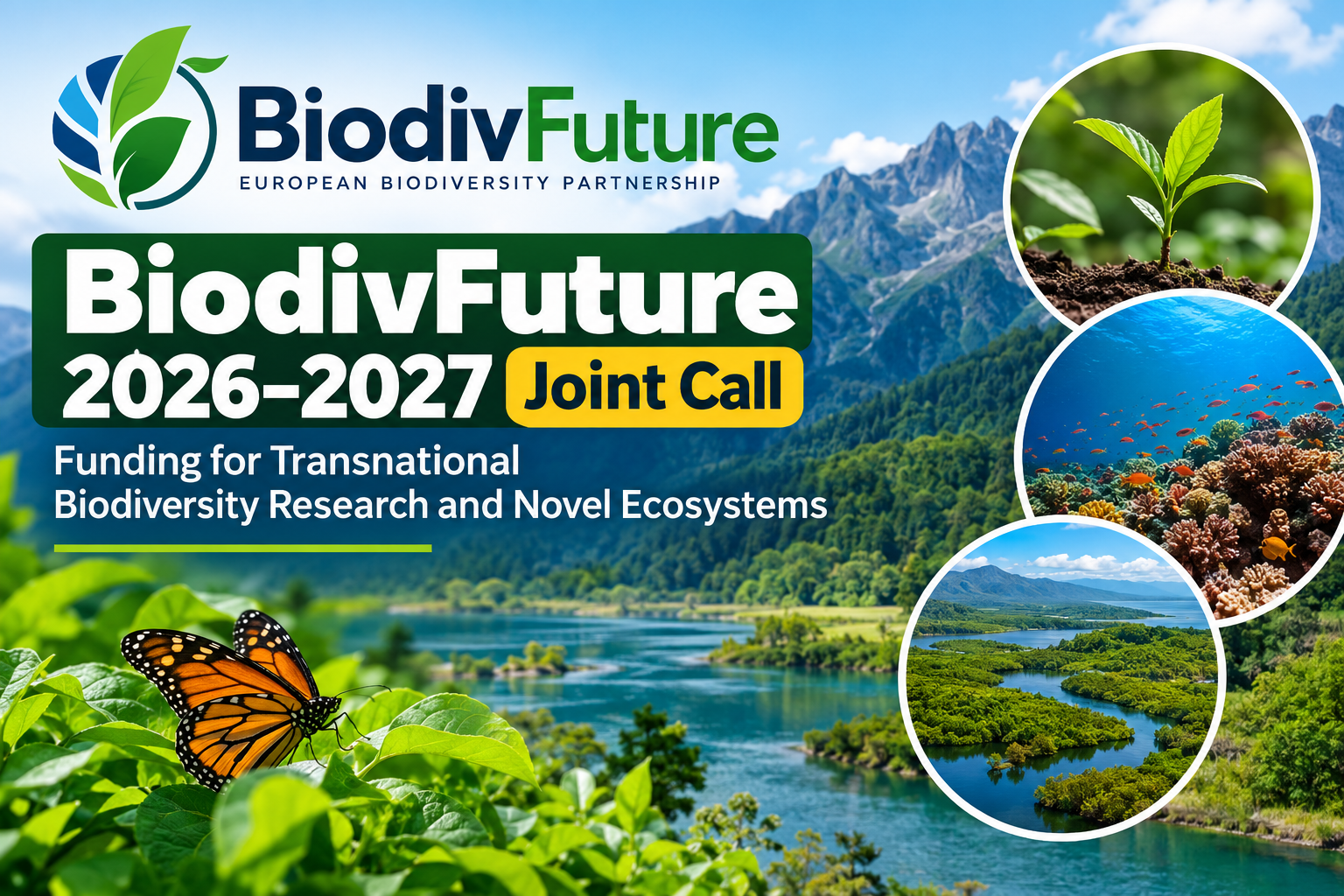
BiodivFuture 2026–2027 Joint Call: Funding for Transnational Biodiversity Research and Novel Ecosystems
Researchers working in biodiversity conservation, ecology, environmental science, and sustainability have an opportunity to seek funding through the BiodivFuture 2026–2027 Joint Call, an international research funding initiative supporting collaborative projects on biodiversity and changing ecosystems.
Launched by Biodiversa+, the European Biodiversity Partnership, this funding call focuses on understanding how ecosystems are changing, what these changes mean for biodiversity and society, and how research can help create more resilient and sustainable environments.
The call, titled Novel ecosystems: biodiversity, socio-ecological consequences and future trajectories, is co-funded by the European Commission and participating national and regional funding organisations. Approximately €40 million has been provisionally allocated to support research projects under the initiative.
The programme is particularly relevant to researchers who want to collaborate with international partners and develop practical solutions to environmental challenges. However, applicants must meet the international consortium requirements and the eligibility rules of the funding organisation responsible for their country or region.
The deadline for mandatory pre-proposals is 10 November 2026 at 12:00 CET. Interested researchers should begin preparing their proposals early and consult the official call documents before applying.
Overview of the BiodivFuture 2026–2027 Joint Call
Here are the key details researchers should know before considering an application.
- Funding programme: BiodivFuture 2026–2027 Joint Call
- Organising partnership: Biodiversa+
- Research focus: Novel ecosystems, biodiversity, socio-ecological consequences and future trajectories
- Provisional total budget: Approximately €40 million
- Funding type: Transnational collaborative research grants
- Application method: Electronic Proposal Submission System (EPSS)
- First application deadline: 10 November 2026, at 12:00 CET
- Full proposal deadline: 16 April 2027, at 12:00 CEST
- Expected funding recommendations: Late September to early October 2027
- Expected project start: Between 1 December 2027 and 1 April 2028
- Official call website: https://www.biodiversa.eu/2026/06/09/2026-2027-joint-call/
Please note that the €40 million figure represents the provisional overall budget for the international call. It is not an individual grant amount, and the funding available to each research partner depends on the applicable funding organisation’s rules.
What Is the BiodivFuture Joint Call About?
BiodivFuture is designed to support research that improves our understanding of ecosystems undergoing significant environmental change.
An ecosystem may become different from its historical condition because of human activities, climate change, invasive species, land-use changes, or other environmental pressures. Such an environment may develop new combinations of species, ecological processes, and interactions.
These are commonly described as novel ecosystems.
Understanding these environments is important because changes in ecosystem composition and functioning can create both opportunities and risks. Some changes may support new ecological relationships, while others may threaten native species, disrupt natural processes, or affect the communities that depend on local resources.
The BiodivFuture call seeks research that examines these changes in an integrated way. It encourages scientists to investigate not only ecological processes but also the economic, social, cultural, and political factors that influence environmental outcomes.
The broader objective is to produce useful knowledge that can inform environmental policies, biodiversity conservation, ecosystem management, and efforts to reverse biodiversity decline.
Research may cover terrestrial, freshwater, marine, and coastal environments in different regions of the world.
Main Research Themes Supported by BiodivFuture
Applicants can develop proposals around one or more of the call’s three main research themes.
1. Novel Ecosystem Functioning
The first theme focuses on understanding how novel ecosystems function and how their ecological processes interact with social, cultural, and economic conditions.
Researchers may investigate how changing species composition affects ecosystem services, how environmental transformations influence biodiversity, or which approaches could help improve ecological functioning.
Projects may also explore how communities, institutions, and economic activities influence the development and management of these ecosystems.
The aim is to improve scientific understanding and identify approaches that can contribute to biodiversity gains.
2. Pathways to Novel Ecosystems
The second theme examines how novel ecosystems emerge, develop, and change over time.
Research in this area may investigate the drivers of ecological transformation, the possible future trajectories of changing environments, and the uncertainties associated with environmental change.
Projects could also examine different management or policy pathways and assess their potential consequences for biodiversity and society.
Researchers should aim to develop credible, evidence-based scenarios that help decision-makers understand possible environmental futures and make informed choices.
3. Biodiversity Benefits and Equity in Novel Ecosystems
The third theme focuses on how the benefits, costs, and risks associated with biodiversity and novel ecosystems are distributed across different groups and communities.
Environmental changes do not affect everyone in the same way. Some communities may benefit from new economic opportunities, while others may experience reduced access to natural resources or increased environmental risks.
Research under this theme may examine environmental justice, inclusive ecosystem management, community participation, and the fair distribution of biodiversity-related benefits.
Projects can also explore how collaborative approaches and investment decisions can support more equitable environmental transformation.
Applicants do not necessarily have to address all three themes. They can focus on one or combine several, provided their research fits the overall objectives of the call.
How Much Funding Is Available?
BiodivFuture has a provisional overall budget of approximately €40 million.
The funding is intended to support eligible transnational research projects addressing the call’s scientific priorities.
However, there is no single universal grant amount that every successful project will receive. The budget available to an individual research team depends on the funding organisation participating from its country or region, the number of partners involved, the project’s requirements, and the applicable funding rules.
Each participating research partner will generally seek funding through the relevant national or regional funding organisation.
Applicants should therefore avoid preparing a budget based solely on the overall €40 million figure.
Before submitting a proposal, researchers should consult the official funding organisation rules to establish:
- The maximum amount available to their research team.
- Which research costs are eligible.
- Whether institutional or national co-funding is required.
- Any restrictions on equipment, travel, personnel, or other expenses.
- The specific conditions that apply to their organisation and country.
The official list of participating funding organisations and their rules is available here:
Who Can Apply for the BiodivFuture Research Funding?
The call is intended for research teams that can collaborate across national borders to address shared biodiversity and environmental challenges.
Applications must be submitted through eligible transnational research consortia rather than by an individual researcher applying independently.
International Consortium Requirements
A consortium must include research teams from at least three countries that are financially participating in the call.
At least two of those countries must be different EU Member States or Horizon Europe Associated Countries.
This requirement means that having collaborators in three countries is not sufficient by itself. The countries must participate financially in the call, and the relevant research partners must satisfy the applicable eligibility rules.
Applicants should consult the official list of participating funding organisations to confirm whether their proposed partners can receive funding.
Researchers and Research Institutions
Potential applicants may include eligible researchers and research organisations working in areas such as:
- Biodiversity conservation and ecological research.
- Environmental science and ecosystem management.
- Climate and environmental change.
- Freshwater, marine, coastal, and terrestrial ecosystems.
- Environmental economics and sustainability.
- Social sciences and environmental policy.
- Interdisciplinary research involving communities and environmental stakeholders.
These are examples of relevant research areas, not a guarantee of eligibility for every institution or researcher.
Each funding organisation establishes its own requirements concerning eligible applicants, institutions, research activities, and expenses.
Researchers should confirm these conditions before committing their institutions to a consortium.
Are International Collaborations Encouraged?
Yes. International collaboration is central to the programme.
The call is designed to support research that benefits from expertise, data, methods, and perspectives across different countries.
Applicants are encouraged to consider interdisciplinary approaches and involve relevant stakeholders outside academia where appropriate.
These may include environmental practitioners, policymakers, community organisations, and other groups whose knowledge or participation could strengthen the project’s research and impact.
Is the BiodivFuture Call Open to Applicants Worldwide?
The call examines environmental challenges across regions of the world, but this does not mean that every country is eligible to receive funding.
Eligibility depends on the countries and funding organisations participating in the call.
Researchers based outside the participating funding systems should carefully check whether their institution can receive funding or participate through an arrangement permitted by the relevant call rules.
For example, researchers based in Nigeria should not assume that they can obtain direct funding under this programme simply because the call addresses biodiversity challenges worldwide.
They should first check the current list of participating funding organisations and the applicable rules for international collaborators.
If direct funding is unavailable, a research team may explore whether an eligible consortium can involve its institution in another permitted capacity. Such participation must be confirmed with the relevant funders and consortium partners before it is included in a proposal.
Important Application Deadlines
Researchers interested in the BiodivFuture 2026–2027 Joint Call should pay close attention to the two-stage application process.
Stage One: Pre-Proposal Submission
Deadline: 10 November 2026, at 12:00 CET.
Submitting a pre-proposal is mandatory for teams wishing to proceed through this call.
Applicants should review the official instructions, coordinate with their international partners, and prepare the required information before submitting through the Electronic Proposal Submission System.
A late or incomplete submission may not be accepted under the call rules.
Stage Two: Full Proposal Submission
Deadline: 16 April 2027, at 12:00 CEST.
Research consortia that successfully pass the first evaluation stage will be invited to prepare and submit a full proposal.
The full proposal stage requires further development of the research plan and supporting information in line with the call’s instructions.
Researchers should not assume that submitting a pre-proposal automatically guarantees an invitation to the second stage.
Expected Results and Project Start
The call schedule indicates that first-stage evaluation results are expected around mid-February 2027.
Funding recommendations are expected between late September and early October 2027.
Successful projects are expected to start between 1 December 2027 and 1 April 2028.
These dates are planning expectations published for the call. Applicants should monitor the official website for any subsequent changes.
How to Apply for the BiodivFuture 2026–2027 Joint Call
The application process requires coordination among international research partners. The following steps can help interested teams prepare.
Step 1: Read the Official Call Announcement
Begin by reviewing the official Biodiversa+ call page.
Read the research scope, application schedule, consortium requirements, evaluation criteria, and supporting documents carefully.
Official call page:
Step 2: Identify Eligible International Partners
Build a consortium that satisfies the minimum three-country requirement.
At least two countries must be different EU Member States or Horizon Europe Associated Countries, and all countries counted towards the minimum must participate financially in the call.
Contact potential partners early to discuss research objectives, responsibilities, available expertise, and possible contributions.
Confirm each partner’s eligibility with the relevant funding organisation before finalising the consortium.
Step 3: Develop a Research Idea That Fits the Call
Your project should directly address one or more of the three research themes.
Explain the environmental problem, the research questions, the proposed methods, and the expected contribution to biodiversity knowledge.
A strong proposal should also demonstrate why international collaboration is necessary and how the findings could benefit environmental management, policy, or society.
Avoid relying on broad statements about protecting nature without explaining what the research will investigate and how the results could be used.
Step 4: Check National and Regional Funding Rules
Each consortium partner must follow the rules of its own funding organisation.
Review the eligible costs, funding limits, institutional requirements, and any national restrictions that may affect the proposed research.
The official funding organisations page provides access to the relevant rules:
This step is particularly important because the general international call requirements do not replace country-specific funding conditions.
Step 5: Prepare and Submit the Pre-Proposal
Use the Electronic Proposal Submission System (EPSS) specified by the call.
Follow the official instructions for completing and submitting the mandatory pre-proposal.
Allow enough time for the consortium to review the application and resolve any technical or administrative issues before the deadline.
The pre-proposal must be submitted by 10 November 2026 at 12:00 CET.
Step 6: Prepare a Full Proposal if Invited
Teams that pass the first evaluation stage can proceed to the full proposal stage.
Use the feedback and instructions provided through the official process to develop the research plan further.
Ensure that the scientific objectives, methods, partnership structure, budget, stakeholder engagement, and expected impact are clearly explained.
The full proposal deadline is 16 April 2027 at 12:00 CEST.
Step 7: Monitor Official Updates
After submitting, regularly check the official call website and communications from the relevant funding organisations.
Applicants should follow the published evaluation schedule and respond to any requests made through the official application process.
Do not treat an application as successful until the relevant authorities have communicated the outcome.
How Will Proposals Be Evaluated?
The call uses a two-stage evaluation process.
At the pre-proposal stage, the assessment considers factors including the proposal’s fit with the call’s scope, the novelty of the research, and its potential impact.
At the full proposal stage, the assessment considers scientific excellence, the quality and efficiency of the project plan, and the expected impact of the research.
Societal and policy impacts, along with approaches to engaging relevant stakeholders, are also important considerations.
Applicants should therefore explain both the scientific value of their work and its potential practical contribution.
A proposal that clearly connects research questions, methods, international collaboration, and expected outcomes may be better positioned to demonstrate its relevance to the call.
However, meeting the eligibility requirements does not guarantee funding. Proposals must also undergo the required evaluation and selection process.
Why Is the BiodivFuture Call Important?
Biodiversity loss and environmental transformation affect ecosystems, economies, and communities in many parts of the world.
Research can help explain why these changes occur, how species and ecological processes respond, and which management approaches may support more resilient environments.
The BiodivFuture call offers an opportunity for eligible research teams to investigate these questions through international collaboration.
Its emphasis on novel ecosystems is especially relevant because environmental change can produce conditions that differ substantially from historical ecosystems. Understanding these changes requires more than studying individual species in isolation.
By combining ecological research with social, economic, and policy perspectives, projects may help decision-makers better understand environmental trade-offs and identify approaches that protect biodiversity while accounting for the needs of people.
The programme’s international structure can also help researchers compare findings across different landscapes, environmental conditions, and social contexts.
Tips for Preparing a Competitive Application
Researchers considering this funding opportunity should take several practical steps before submitting their proposals.
Choose a clearly defined research problem. Explain the environmental issue the project will investigate and why it matters.
Demonstrate the need for international collaboration. Make clear how the participating teams complement one another and why the research benefits from a transnational approach.
Address the call’s research themes directly. Show how the proposed work fits one or more of the published priorities.
Build an appropriate interdisciplinary team. Where relevant, bring together expertise in ecology, biodiversity, environmental policy, economics, social sciences, or other disciplines that strengthen the project.
Develop a realistic research plan and budget. Ensure that the proposed activities, timeline, resources, and expected results are consistent with the funders’ requirements.
Engage relevant stakeholders. Consider how practitioners, communities, policymakers, or other stakeholders could contribute to the research or benefit from its findings.
Check every partner’s eligibility. A consortium must satisfy both the international call requirements and the applicable national or regional rules.
Start early. Coordinating a transnational proposal can take time, particularly when several institutions must agree on research responsibilities and budgets.
These recommendations can help teams prepare a clearer application, although funding decisions remain subject to the official evaluation process.
Frequently Asked Questions
1. What is the BiodivFuture 2026–2027 Joint Call?
It is a transnational research funding initiative coordinated by Biodiversa+ that supports research on novel ecosystems, biodiversity, socio-ecological consequences, and future environmental trajectories.
2. How much funding is available?
Approximately €40 million has been provisionally allocated to the overall call. This is the combined programme budget, not the amount available to each applicant.
Individual funding depends on the relevant funding organisation’s rules and the approved project budget.
3. What is the deadline for applications?
The mandatory pre-proposal deadline is 10 November 2026 at 12:00 CET.
The full proposal deadline is 16 April 2027 at 12:00 CEST for teams invited to proceed to the second stage.
4. Who is eligible to apply?
Applications must come from eligible transnational research consortia involving teams from at least three financially participating countries, including at least two different EU Member States or Horizon Europe Associated Countries.
Each partner must also satisfy the rules of its relevant funding organisation.
5. Can researchers from Nigeria apply?
Researchers based in Nigeria should first check the official list of participating funding organisations and the rules governing international collaboration.
Nigeria is not listed among the participating countries in the published funding organisation list. Therefore, Nigerian researchers should not assume they can receive direct funding under this call.
Any possible involvement through an eligible international consortium would need to be confirmed under the applicable rules.
6. What research areas are covered?
The call covers research on novel ecosystem functioning, pathways to novel ecosystems, and biodiversity benefits and equity.
Projects may investigate terrestrial, freshwater, marine, or coastal environments and their ecological, social, cultural, or economic dimensions.
7. How do I submit an application?
Applications are submitted through the Electronic Proposal Submission System (EPSS) using the procedures described in the official call documents.
A pre-proposal is mandatory before a team can proceed to the full proposal stage.
8. When are successful projects expected to begin?
The published schedule anticipates project starts between 1 December 2027 and 1 April 2028.
Applicants should check the official website for updates to the timetable.
9. Does submitting a proposal guarantee funding?
No. Applications must meet the eligibility requirements and pass the relevant evaluation and selection stages. Funding depends on the outcome of that process and the applicable funding conditions.
Official Application Links
Researchers should rely on official sources when checking deadlines, eligibility requirements, funding limits, and submission instructions.
- Official BiodivFuture call announcement: https://www.biodiversa.eu/2026/06/09/2026-2027-joint-call/
- Participating funding organisations and national rules: https://www.biodiversa.eu/biodivfuture-funding-organisations/
- European Commission overview of the funding opportunity: https://projects.research-and-innovation.ec.europa.eu/en/funding/funding-opportunities/funding-programmes-and-open-calls/horizon-europe/eu-missions-horizon-europe/restore-our-ocean-and-waters/horizon-europe-european-biodiversity-partnership-biodivfuture-novel-ecosystems-biodiversity-socio
Always consult the official call documents before submitting an application, as they provide the authoritative requirements for the funding process.
Final Thoughts
The BiodivFuture 2026–2027 Joint Call offers eligible research teams an opportunity to pursue international collaboration on some of the important questions facing biodiversity research today.
With approximately €40 million provisionally allocated to the programme, the initiative seeks projects that can improve understanding of novel ecosystems and contribute useful evidence for environmental management, policy, and society.
Researchers interested in applying should begin by checking their eligibility, identifying suitable international partners, and developing a research proposal that directly addresses the call’s priorities.
The first deadline to remember is 10 November 2026 at 12:00 CET, when mandatory pre-proposals must be submitted.
Careful preparation and close attention to the official funding rules will be essential for teams wishing to take part in this international research initiative.
