
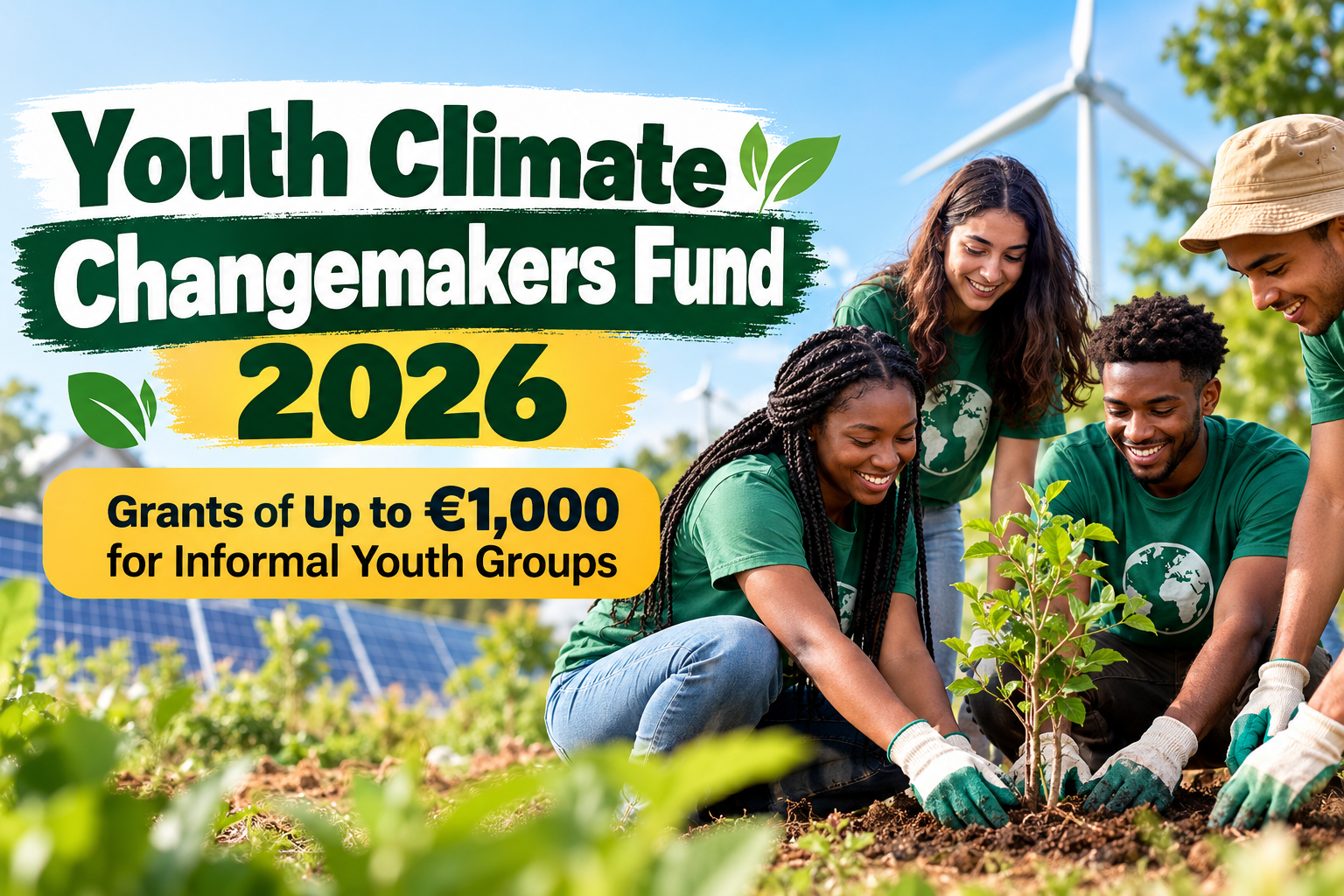
Youth Climate Changemakers Fund 2026: Grants of Up to €1,000 for Informal Youth Groups
Young people across Europe who are passionate about protecting the environment have an opportunity to seek financial support through the Youth Climate Changemakers Fund 2026. The initiative provides micro-grants of up to €1,000 to help informal youth groups develop and implement community-based climate action projects.
The fund is designed to support young people who want to make a difference but may not have access to the financial resources needed to turn their ideas into reality. Unlike many funding opportunities that require applicants to be formally registered organisations, this programme welcomes informal youth groups that meet its eligibility requirements.
Supported activities may include climate awareness campaigns, community mobilisation, environmental education, youth-led advocacy, and other initiatives that strengthen local climate movements.
For young people interested in environmental sustainability and grassroots activism, this funding opportunity could provide valuable support for developing practical solutions to climate-related challenges.
Important: The next reported application deadline is 25 October 2026. Applicants should confirm the deadline, eligibility requirements, and application instructions on the organiser’s official channels before submitting an application.
About the Youth Climate Changemakers Fund 2026
The Youth Climate Changemakers Fund is an initiative associated with Generation Climate Europe (GCE) under the Funding Fairer Futures initiative.
The programme aims to strengthen youth participation in climate action by supporting grassroots groups and young people working to create positive environmental change in their communities.
Many young activists have creative ideas for addressing climate change but struggle to secure funding because they do not have formal organisational structures or extensive project experience. This fund seeks to reduce some of those barriers by making small grants available to eligible informal groups.
Beyond financial assistance, the initiative is intended to help young climate activists strengthen their work, develop their skills, and connect with others working towards similar environmental goals.
The programme is particularly relevant to groups that want to organise practical activities, engage their communities, and contribute to a more inclusive climate movement.
Youth Climate Changemakers Fund 2026: Key Details
Here is a summary of the opportunity:
- Programme name: Youth Climate Changemakers Fund 2026
- Funding organisation: Generation Climate Europe
- Funding initiative: Funding Fairer Futures
- Maximum grant amount: €1,000 per selected group
- Target applicants: Eligible informal youth groups
- Geographical eligibility: European Union, subject to the official eligibility rules
- Leadership requirement: Primarily young people under 30
- Minimum group size: At least three young people
- Project duration: Approximately 6–12 months
- Eligible activities: Climate advocacy, environmental awareness, community mobilisation, and youth-led climate initiatives
- Reported next deadline: 25 October 2026
- Registration requirement: Formal registration is not necessarily required for informal groups
Applicants should consult the official programme information to verify these details and determine whether their proposed activities qualify for support.
What Is the Grant Amount?
The Youth Climate Changemakers Fund offers grants of up to €1,000 to eligible informal youth groups.
The funding is intended to help young people implement practical climate initiatives that contribute to stronger grassroots environmental movements.
Although €1,000 may not be sufficient for a large environmental programme, it can help a small group organise a local campaign, deliver educational activities, engage community members, or test a promising climate action idea.
For example, a youth group could use a carefully planned budget to produce educational materials, organise community workshops, develop an awareness campaign, or coordinate activities that encourage sustainable environmental practices.
The amount awarded to each successful applicant may depend on the programme’s assessment process and funding rules. Applicants should not assume that every selected group will automatically receive the maximum amount.
It is also important to understand that this is a small project grant, not a personal scholarship or salary. The funding is intended to support eligible project activities.
What Types of Projects Can Receive Funding?
The fund focuses on youth-led initiatives that strengthen climate action and encourage greater participation in environmental movements.
Applicants should develop a clear project idea that responds to a real need within their community.
Potential project areas include the following.
1. Climate Change Awareness Campaigns
Young people can organise campaigns that explain climate change, its causes, and its effects on local communities.
Activities might include school awareness sessions, community discussions, educational materials, and digital campaigns that share reliable information about environmental challenges.
A strong proposal should explain the audience the campaign intends to reach and how the group will measure its impact.
2. Community Environmental Education
Youth groups may consider educational activities that help community members understand environmental issues and identify practical ways to respond.
For example, a group could organise workshops on waste reduction, responsible consumption, energy conservation, or climate resilience.
The proposed activities should align with the fund’s official objectives and eligible expenditure rules.
3. Youth-Led Climate Advocacy
Climate advocacy can help young people communicate environmental concerns and encourage constructive action.
Eligible initiatives may include community meetings, youth consultations, public engagement activities, and campaigns that encourage decision-makers and local stakeholders to take climate issues seriously.
Applicants should describe the specific issue they want to address and explain how their proposed activities will contribute to meaningful change.
4. Community Mobilisation
Another potential area is mobilising young people and community members to participate in climate-related activities.
A group might organise a local climate action event, establish a youth environmental network, or coordinate community discussions about sustainable practices.
The proposal should demonstrate how the activity will encourage participation and contribute to the development of a stronger local climate movement.
5. Training and Capacity Building
Some youth groups may benefit from training that improves their ability to plan campaigns, communicate environmental messages, organise volunteers, or manage community projects.
A proposed training activity should have clear learning objectives and explain how the knowledge gained will strengthen the group’s future climate work.
Please note: These are illustrative project ideas, not a guarantee of funding. Applicants must check the official guidelines to confirm that their proposed activities and expenses are eligible.
Who Can Apply for the Youth Climate Changemakers Fund 2026?
The programme is intended for eligible youth groups working on climate-related initiatives in the European Union.
Based on the published opportunity information, applicants should pay particular attention to the following eligibility requirements.
1. Applicants Must Meet the Geographical Requirements
The fund targets eligible groups within the European Union.
Applicants should verify the programme’s rules concerning citizenship, country of residence, group location, and project implementation before applying.
Being interested in climate action does not automatically make a group eligible if it does not meet the geographical requirements.
2. The Group Should Have at Least Three Young People
The opportunity is intended for groups rather than individuals applying without a collective.
Published information indicates that applicants should represent a group consisting of at least three young people.
Groups should be able to explain who their members are, how they work together, and who will be responsible for coordinating the proposed project.
3. The Initiative Should Be Youth-Led
The programme focuses on youth leadership and meaningful participation by young people.
Published eligibility information indicates that the group should be primarily led by people under 30.
Applicants should demonstrate that young people are responsible for the project’s planning, management, and implementation rather than simply participating in activities designed and controlled by others.
4. Informal Groups Are Welcome
One of the programme’s notable features is its focus on informal youth groups.
A group may be able to apply without registering as a formal organisation, provided it satisfies the other eligibility conditions.
This can be helpful for young activists who have already started working together but have not established a registered association or nonprofit organisation.
However, applicants should confirm the official requirements for receiving and managing grant funds, including any arrangements needed for financial administration.
5. Applicants Must Respect the Programme’s Funding Restrictions
Published information indicates that groups already receiving support from another project funded under the European Union’s Development Education and Awareness Raising (DEAR) programme may be ineligible.
Applicants should check this restriction carefully and disclose any relevant funding or project involvement when required.
Meeting the basic age and group-size requirements does not guarantee selection. Applications must also comply with the programme’s other conditions.
Can Registered Organisations Apply?
The fund is specifically intended to make climate funding accessible to informal youth groups.
Published opportunity information indicates that registered organisations may also be eligible under the relevant application rules, but applicants should not assume that all types of organisations qualify.
Groups that are formally registered should check the official guidance to determine whether their organisational status and proposed project fit the call for informal groups.
The programme’s central purpose is to support youth-led climate action, particularly initiatives that may otherwise face difficulties accessing traditional funding.
How Long Can Funded Projects Last?
The Youth Climate Changemakers Fund is reported to support projects lasting approximately six to twelve months.
This period gives successful groups time to plan their activities, engage participants, implement their initiatives, and assess their results.
For example, a group planning a climate education campaign could spend the first month preparing materials and identifying partners, the following months delivering workshops and outreach activities, and the final stage evaluating participation and documenting results.
Applicants should prepare a realistic implementation schedule that matches their objectives and available resources.
The official call should be consulted to confirm the permitted project start date, completion date, and any reporting obligations.
How to Apply for the Youth Climate Changemakers Fund 2026
Interested groups should begin by reviewing the official funding announcement and checking whether their proposed project meets the programme’s requirements.
The following steps can help applicants prepare a stronger submission.
Step 1: Confirm Your Eligibility
Check the geographical requirements, age criteria, minimum group size, leadership conditions, and funding restrictions.
Make sure your group meets the requirements before spending significant time preparing an application.
Step 2: Develop a Clear Climate Project Idea
Identify a specific environmental issue that your group wants to address.
Rather than proposing a broad project such as raising awareness about climate change, explain the particular problem, the people affected, and the activities your group intends to carry out.
For instance, a proposal could focus on helping young people in a particular community understand local climate risks through educational workshops and public engagement.
A clear and focused project is generally easier to assess than a proposal with numerous unrelated objectives.
Step 3: Define Your Objectives and Expected Results
Explain what your group hopes to achieve during the project period.
Your objectives should be realistic and measurable.
For example, you might aim to deliver a defined number of workshops, engage a specific number of young people, or produce educational resources for community use.
Avoid promising results that cannot reasonably be achieved with the available funding and time.
Step 4: Prepare a Realistic Budget
Develop a budget that explains how the requested grant would be used.
Depending on the official rules, relevant expenses might include educational materials, workshop resources, communication costs, or other project-related items.
Each expense should be connected to a planned activity.
Check the fund’s eligible-cost rules before including equipment, travel, staff costs, or other expenses that may be subject to restrictions.
Step 5: Explain Why Your Group Is Suitable
Describe your group’s motivation, experience, community connections, and commitment to youth-led climate action.
Previous grant funding or formal registration should not be presented as a requirement unless the official guidelines specify otherwise.
If your group is new, explain what inspired the initiative and how members will organise themselves to deliver the proposed activities.
Step 6: Submit the Application Through the Official Channel
Use the application procedure specified by Generation Climate Europe or the programme’s authorised platform.
Complete the required sections, provide accurate information, and submit any requested supporting documents.
Before submission, review the application to ensure that the project description, budget, timeline, and expected results are consistent.
Important: The exact application form, submission procedure, and current call requirements should be confirmed through the organiser’s official website. Do not submit sensitive personal information or pay an unofficial intermediary claiming to guarantee a grant.
Application Deadline
The next reported deadline for the Youth Climate Changemakers Fund for Informal Groups is 25 October 2026.
Because application windows and funding rounds can change, interested groups should confirm the deadline directly with the organiser before preparing their final submission.
If the call is still accepting applications, groups should begin preparing their project descriptions, budgets, and supporting information as early as possible.
Applicants should also verify whether submissions are assessed on a rolling basis or against a specific deadline. They should not assume that an application submitted after the stated closing date will be considered.
Tips for Preparing a Competitive Application
Although no application can guarantee a grant award, careful preparation can help a group communicate its idea more effectively.
Consider the following recommendations.
Focus on a specific problem. Explain the environmental issue your group wants to address and why it matters to the intended community.
Demonstrate youth leadership. Make it clear how young people will make decisions and manage the proposed activities.
Keep the project realistic. Design activities that can be delivered within the available budget and project period.
Show community involvement. Explain how local young people, residents, schools, or other relevant stakeholders will participate, where appropriate.
Use a clear budget. Connect each proposed expense to a specific project activity and follow the fund’s financial rules.
Explain how success will be measured. Identify practical indicators, such as the number of participants reached, workshops delivered, or educational resources produced.
Check the rules before submitting. Ensure that your group satisfies the eligibility requirements and that the requested funding will be used for permitted activities.
These steps can help reviewers understand the purpose, feasibility, and potential value of your proposal.
Why the Youth Climate Changemakers Fund Matters
Young people are increasingly involved in conversations about climate change, environmental protection, and sustainable communities.
However, having an idea is not always enough to make a project happen. Community initiatives often require money for basic materials, communications, training, and coordination.
Small grants can help bridge this gap by giving grassroots groups an opportunity to test ideas, engage more participants, and develop practical experience.
The Youth Climate Changemakers Fund also recognises that meaningful climate action does not always begin with a large organisation. Informal groups can contribute to environmental awareness and community mobilisation when they have a clear objective and the support needed to act.
For eligible applicants, the programme could provide a starting point for building a stronger and more organised youth climate initiative.
Frequently Asked Questions
1. How much funding does the Youth Climate Changemakers Fund offer?
The fund offers micro-grants of up to €1,000 to eligible groups. The amount awarded may depend on the programme’s selection process and funding rules.
2. Can an informal youth group apply without registering as an organisation?
Yes, informal groups are specifically encouraged under the published opportunity information. However, applicants must still satisfy the eligibility requirements and any financial administration conditions.
3. Can an individual apply alone?
The published criteria indicate that the fund is intended for groups of at least three young people. An individual without a qualifying group should not assume they are eligible.
4. Who is eligible to apply?
The opportunity targets eligible youth-led groups in the European Union. Published information indicates that groups should be primarily led by people under 30 and meet the programme’s other requirements.
5. What projects can the grant support?
Potential activities include climate awareness campaigns, environmental education, advocacy, community mobilisation, and capacity-building initiatives, subject to the official funding rules.
6. How long should a project last?
Published information indicates a project duration of approximately six to twelve months. Applicants should confirm the exact implementation requirements in the official call.
7. What is the application deadline?
The next reported deadline is 25 October 2026. Applicants should verify the date on the organiser’s official channels before submitting.
8. Is the grant available to youth groups in Nigeria?
The published opportunity information identifies the European Union as the target geographical area. Youth groups based in Nigeria should not assume they are eligible unless the organiser’s official rules explicitly confirm otherwise.
9. Does the grant guarantee funding for every applicant?
No. Meeting the eligibility criteria does not guarantee selection. Applications are subject to the programme’s assessment and available funding.
Final Thoughts
The Youth Climate Changemakers Fund 2026 offers a potential source of small-scale financial support for young people seeking to strengthen climate action in their communities.
With grants of up to €1,000, the programme could help eligible informal youth groups organise awareness campaigns, deliver educational activities, mobilise communities, and develop practical environmental initiatives.
The opportunity may be particularly useful for groups that have a clear project idea but lack the resources or formal organisational structure often associated with traditional funding programmes.
Interested applicants should carefully review the eligibility requirements, prepare a realistic project plan, and confirm the current deadline and application procedure through the official organiser.
Before applying, verify the latest details directly with Generation Climate Europe to ensure that the opportunity remains open and that your group meets all the requirements.
