
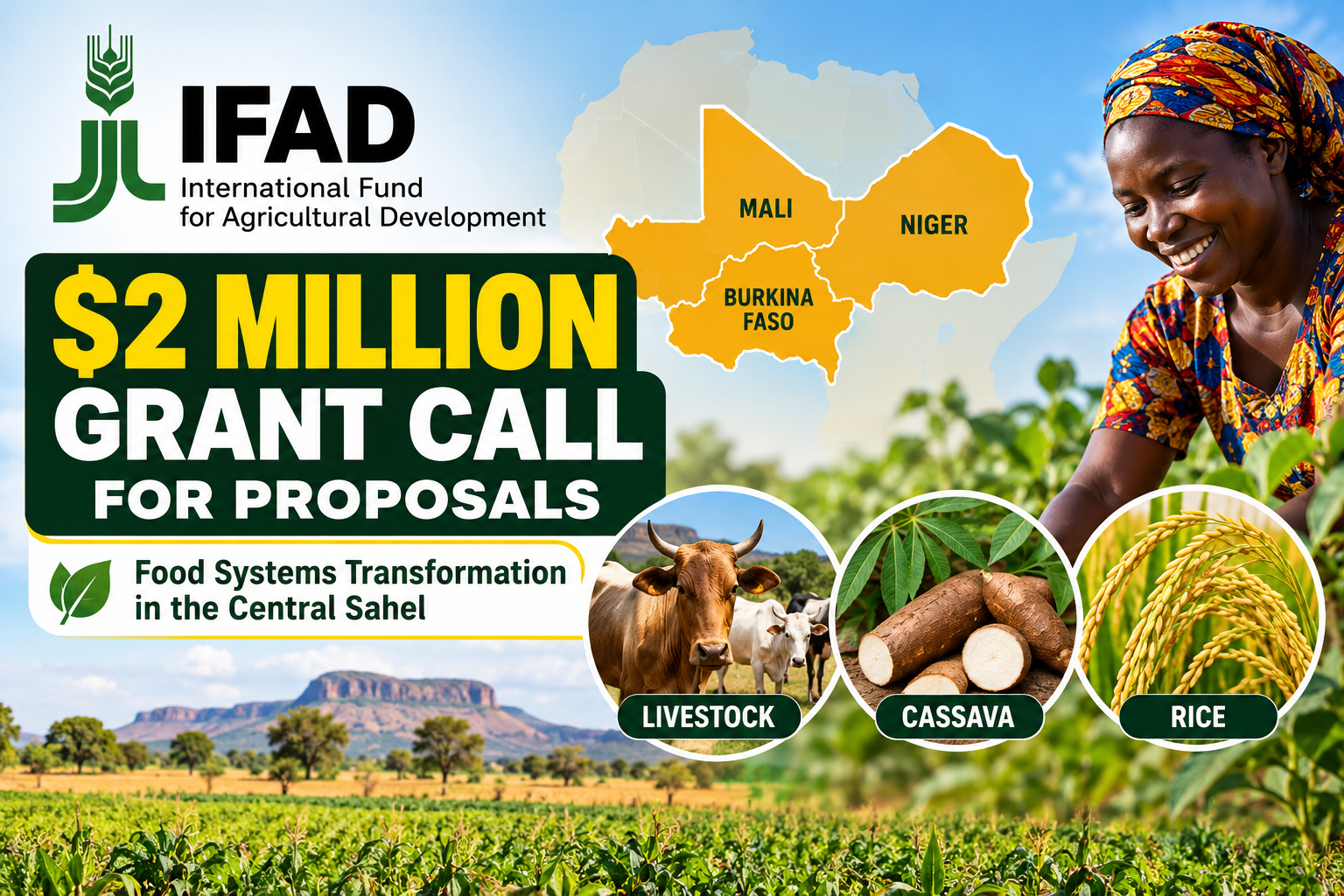
IFAD $2 Million Grant Call for Proposals 2026: Food Systems Transformation in the Central Sahel
Organizations working to improve agriculture, food security, and rural livelihoods in West Africa have an opportunity to apply for a major regional funding initiative from the International Fund for Agricultural Development (IFAD).
Through its Support for Food Systems Transformation in the Central Sahel initiative, IFAD is inviting eligible organizations and institutions to submit proposals for a regional project supported by a grant of US$2 million. The initiative focuses on strengthening agricultural value chains, promoting climate resilience, creating economic opportunities, and improving food systems in Burkina Faso, Mali, and Niger.
The funding is intended to support innovative and scalable interventions that address challenges across three priority value chains: livestock, cassava, and rice. Applicants are expected to demonstrate how their proposed activities can contribute to sustainable economic development while creating opportunities for women and young people.
Importantly, this is an institutional grant opportunity rather than an individual scholarship or personal cash award. Eligible organizations, government agencies, private-sector entities, research institutions, and qualifying consortia should review the official requirements before preparing their applications.
The application deadline is 16 October 2026 at 23:59 GMT, according to the official IFAD announcement. Interested applicants should begin reviewing the documentation as soon as possible.
IFAD Central Sahel $2 Million Grant: Overview
Here are the key details of the funding opportunity.
| Opportunity Detail | Information |
|---|---|
| Grant provider | International Fund for Agricultural Development (IFAD) |
| Grant programme | Support for Food Systems Transformation in the Central Sahel |
| Funding amount | US$2 million |
| Opportunity type | Institutional and project grant |
| Geographic focus | Burkina Faso, Mali, and Niger |
| Priority sectors | Livestock, cassava, and rice value chains |
| Target applicants | Eligible organizations, government agencies, private-sector entities, research institutions, and consortia |
| Application language | English or French |
| Submission format | Electronic PDF documents |
| Application method | Email submission |
| Application deadline | 16 October 2026, at 23:59 GMT |
| Official application information | Visit the IFAD call for proposals |
Applicants should consult the official call documentation for the complete eligibility conditions, evaluation criteria, required forms, and grant provisions.
About the IFAD Food Systems Transformation Grant
The International Fund for Agricultural Development is a United Nations specialized agency that works to reduce rural poverty and improve food security by supporting rural people, agricultural development, and inclusive economic opportunities.
The Central Sahel initiative responds to several interconnected challenges affecting communities and businesses in Burkina Faso, Mali, and Niger. These include food insecurity, climate change, land degradation, conflict, and limited economic opportunities.
Addressing these challenges requires more than increasing agricultural production. Farmers and other businesses also need opportunities to process products, reach markets, attract investment, and develop sustainable commercial activities.
The IFAD grant is designed to support interventions that address these wider challenges across agricultural value chains.
Rather than focusing exclusively on isolated activities, the initiative seeks proposals with the potential to produce meaningful results, strengthen commercial opportunities, and generate benefits that can be expanded across the region.
What Does the $2 Million Grant Aim to Achieve?
The main objective is to support the transformation of food systems across the Central Sahel by addressing important constraints and unlocking opportunities in selected agricultural value chains.
The funding is intended to provide catalytic seed financing for innovative initiatives that can demonstrate regional relevance and the potential for sustainable impact.
Depending on the proposed project and its eligibility, relevant interventions may address areas such as:
- Improving agricultural production systems.
- Strengthening livestock-related businesses and value chains.
- Supporting cassava and rice production, processing, and marketing.
- Improving access to agricultural markets.
- Encouraging private-sector investment in food systems.
- Developing commercially viable agricultural initiatives.
- Creating economic opportunities for women and young people.
- Promoting climate-resilient agricultural practices.
- Strengthening connections between producers, processors, and buyers.
- Developing solutions that can be expanded or replicated across the region.
These are examples of areas that may be relevant to the call, not a guarantee that every type of project will qualify. Applicants must demonstrate how their proposed activities meet the official programme objectives and evaluation criteria.
Three Priority Value Chains Supported by the Initiative
The call identifies livestock, cassava, and rice as priority value chains. Organizations considering an application should understand the challenges and opportunities within their proposed area of intervention.
1. Livestock Value Chain
Livestock plays an important role in agricultural livelihoods and economic activity across parts of the Sahel.
However, the development of a strong livestock value chain involves more than raising animals. It can also require improvements in animal health, feed availability, processing, transportation, marketing, and access to buyers.
Projects in this area could explore practical ways to address these constraints while improving commercial opportunities and resilience.
For example, an eligible organization might develop an intervention that strengthens links between livestock producers and markets, supports more efficient processing, or helps agricultural businesses overcome a specific barrier to growth.
A competitive proposal should clearly identify the problem being addressed, explain why the intervention is needed, and demonstrate how the proposed activities could generate sustainable results.
2. Cassava Value Chain
Cassava is another priority area under the IFAD initiative.
Its value chain includes production, harvesting, processing, product development, distribution, and marketing. Opportunities may therefore exist beyond cultivation alone.
Organizations working in this area could consider interventions that improve processing capacity, strengthen market connections, support value-added products, or address other constraints affecting commercial development.
Proposals should explain how the intended activities could improve the performance of the cassava value chain and contribute to the broader objectives of the grant.
Applicants should also consider whether their proposed approach can create opportunities for women and young people and whether the results could be expanded beyond a single project location.
3. Rice Value Chain
Rice is the third priority value chain identified in the call.
Interventions may address challenges affecting production, processing, market access, and other stages of the rice value chain.
For instance, a proposal could focus on an identified constraint affecting agricultural businesses or on an innovative approach to improving commercial connections between producers and buyers.
However, applicants should avoid presenting a general agricultural activity without explaining its wider value.
The strongest proposals are likely to be those that clearly connect a specific problem with a practical intervention, measurable outcomes, commercial viability, and the potential for broader impact.
Applicants must use the official evaluation criteria to determine how their proposals will be assessed.
Who Is Eligible to Apply for the IFAD Grant?
According to the official announcement, IFAD is seeking proposals from eligible organizations and institutions capable of implementing a regional initiative supporting food systems transformation.
Potential applicant categories include:
1. Eligible organizations
Organizations with relevant experience in agricultural development, food systems, rural livelihoods, or related thematic areas may consider applying, provided they satisfy IFAD’s eligibility requirements.
2. Government agencies
Eligible governmental agencies with relevant mandates and the capacity to contribute to the proposed initiative may be considered under the call.
3. Private-sector entities
Businesses and other eligible private-sector entities with relevant experience may explore the opportunity, particularly where their proposed interventions address value-chain constraints and demonstrate commercial viability.
4. Research institutions
Research institutions with relevant regional expertise may consider projects that translate research, technical knowledge, or innovation into practical improvements across the priority value chains.
5. Consortia
Organizations may also explore submitting proposals as part of a consortium, subject to the official eligibility conditions and applicable requirements for partners.
Important Eligibility Consideration
Belonging to one of these categories does not automatically make an applicant eligible.
Organizations must meet the applicable IFAD grant-financing requirements and demonstrate relevant experience in the priority areas and themes of the initiative.
The official call documentation should be treated as the final authority on eligibility.
Individuals seeking personal financial assistance should note that this opportunity is designed for institutional project implementation, not individual tuition fees, personal living expenses, or unrestricted cash support.
What Are the Main Requirements for a Strong Proposal?
The official announcement highlights several characteristics that proposals should demonstrate.
Regional relevance
The proposed intervention should be relevant to food systems transformation in Burkina Faso, Mali, and Niger.
Applicants should explain how their activities relate to the needs of the region and the selected priority value chain.
Commercial viability
IFAD is looking for initiatives that can support sustainable economic opportunities.
Applicants should explain how their proposed intervention can address a genuine constraint and support a viable approach to agricultural or food-system development.
Climate resilience
Proposals should demonstrate how the intervention can contribute to resilience in the face of climate-related challenges.
Applicants should identify the relevant risks and explain how their approach will address them.
Inclusion of women and young people
The initiative emphasizes the importance of including women and youth in food systems transformation.
Applicants should explain how these groups will participate in or benefit from the proposed activities, using realistic and measurable objectives where appropriate.
Potential for scaling up
The programme seeks transformative interventions with the potential to be expanded.
Organizations should explain whether their proposed approach could be replicated in additional locations, adopted by other actors, or expanded to reach more participants.
A clear implementation plan
A strong proposal should identify the problem, intended beneficiaries, proposed activities, expected results, implementation arrangements, and the resources needed to carry out the project.
These practical recommendations can help applicants prepare a coherent proposal, but they do not replace the official evaluation methodology.
Required Documents for the IFAD Grant Application
IFAD has identified specific documents that applicants must submit as part of the proposal process.
1. Grant Concept Note Template
Applicants must prepare their proposal using the prescribed grant concept note template.
The concept note should follow the template’s instructions and present the proposed intervention clearly.
Organizations should ensure that the information provided explains the project’s relevance to the initiative and addresses the requirements specified in the application documents.
2. Self-Certification of Eligibility for IFAD Grant Financing
Applicants must submit the applicable self-certification form.
The official announcement identifies a standard form and a separate form for UN entities, as applicable.
Applicants should download and complete the form appropriate to their organization rather than submitting an unrelated eligibility document.
3. Brief Institutional Profile
Applicants must provide a brief institutional profile describing their experience in the relevant priority areas and grant themes in the region.
The official call specifies a limit of one page or less for the recipient’s institutional profile. For consortium applications, an additional page is allowed to describe the institutional experience of partners.
The profile should focus on relevant experience and expertise rather than lengthy general descriptions of the organization.
4. Review of the Grant Provisions
The call also provides the General Provisions Applicable to IFAD Grant Agreements for reference.
Applicants should review these provisions to understand the conditions associated with IFAD grant financing.
The official page also lists the detailed activity-based budget template as a reference document that is not considered at this stage. Applicants should follow the instructions in the current call rather than submitting additional documents simply because they are available for reference.
Important: Check the latest official instructions to confirm the precise submission requirements before sending your application.
How to Apply for the IFAD $2 Million Grant
Eligible organizations interested in the opportunity should follow the official application process carefully.
Step 1: Visit the official IFAD announcement
Start by opening the official call for proposals:
https://www.ifad.org/en/w/calls-for-proposal/call-for-proposals-ifad-support-for-food-systems-transformation-in-the-central-sahel
Read the announcement and review all available application documents.
Do not rely exclusively on summaries published on third-party websites.
Step 2: Confirm your organization’s eligibility
Review the applicable eligibility requirements before investing time in preparing a proposal.
Confirm that your organization meets the conditions for IFAD grant financing and has relevant experience in the priority areas and themes.
If you intend to apply through a consortium, check the requirements applicable to consortium members and the proposed recipient.
Step 3: Select a suitable priority value chain
Determine whether your proposed intervention relates to livestock, cassava, or rice.
Identify a specific challenge within the chosen value chain and explain how addressing it would contribute to food systems transformation.
The proposal should have a clear connection to the objectives of the call.
Step 4: Prepare the grant concept note
Download and complete the official concept note template.
Explain the problem your project will address, the proposed solution, the intended beneficiaries, the expected results, and the potential for sustainable impact.
Make sure your proposal demonstrates regional relevance, commercial viability, climate resilience, inclusion of women and youth, and potential for scaling up.
Step 5: Complete the eligibility documentation
Prepare the applicable self-certification form and the required institutional profile.
Check all information carefully before submission.
Ensure that the institutional profile respects the specified page limit and describes experience relevant to the proposed intervention.
Step 6: Review and convert your documents to PDF
IFAD requires the application documents to be submitted electronically in PDF format.
Before submission, verify that the documents are complete, readable, correctly named, and consistent with the information in your concept note.
Follow any additional instructions contained in the official application documentation.
Step 7: Submit your application by email
The official IFAD announcement provides the following submission address:
Email: sahelfoodsystems@ifad.org
Deadline: 16 October 2026 at 23:59 GMT.
Applicants should submit their documents well before the deadline to allow time to address any technical problems.
The period for submitting questions about this call closed on 2 October 2026 at 23:59 GMT. Applicants should consult the official FAQ and published responses for clarification of questions already addressed.
Step 8: Keep a record of your submission
After sending your application, retain a copy of the submitted documents and the email used to submit them.
If you receive an acknowledgment or further communication from IFAD, keep it with your application records.
Submission does not guarantee selection or funding. Proposals will be assessed according to the applicable process and criteria.
Application Deadline and Important Dates
Applicants should pay close attention to the dates associated with this funding opportunity.
| Important Information | Date |
|---|---|
| Official call announcement | 21 September 2026 |
| Deadline for submitting questions | 2 October 2026, at 23:59 GMT |
| Proposal submission deadline | 16 October 2026, at 23:59 GMT |
| Application language | English or French |
| Submission format | Electronic PDF documents |
As of 10 October 2026, the application deadline is approaching. Organizations that have not yet reviewed the requirements should prioritize checking their eligibility and preparing the necessary documentation.
Applicants should consult the official IFAD webpage for any updates or additional clarification.
Practical Tips for Preparing a Competitive Application
A well-prepared application should do more than describe a good idea. It should explain why the project matters, how it will work, and what results it is expected to deliver.
Here are some practical steps organizations can take.
Identify a specific problem
Avoid describing the challenges of the entire agricultural sector without identifying a clear issue your project can realistically address.
Explain the problem within the chosen value chain and provide relevant evidence where available.
Explain what makes the intervention useful
Describe how the proposed activities will address the identified problem.
Show how the intervention differs from existing approaches and why it could offer a practical improvement.
Set measurable objectives
Where possible, include clear indicators that can be used to assess progress.
For example, depending on the project, indicators could relate to market access, business participation, processing capacity, or the involvement of women and young people.
Any targets should be realistic and supported by the proposed implementation plan.
Demonstrate institutional experience
Use the institutional profile to show that your organization has the relevant experience and expertise to carry out the proposed work.
Focus on previous activities and capabilities that directly relate to the proposed intervention.
Address sustainability
Explain how the intervention could continue delivering value beyond the initial period of grant support.
Consider the commercial, institutional, and operational factors that could influence its long-term viability.
Follow the official instructions
Even a promising proposal may face difficulties if it does not meet the call’s formal requirements.
Use the prescribed templates, submit the required documentation, observe the page limits, and follow the specified deadline and submission method.
Frequently Asked Questions
1. What is the IFAD Central Sahel grant?
It is a US$2 million grant-financed initiative intended to support food systems transformation in Burkina Faso, Mali, and Niger.
The funding will support an eligible organization or implementing arrangement selected through the call for proposals.
2. How much funding is available?
The initiative is financed through a grant of US$2 million.
Applicants should read the official grant documentation to understand the funding arrangements and any applicable conditions. The headline amount should not be interpreted as an automatic award to every applicant or as a guaranteed payment to an individual organization.
3. Which countries are covered by the initiative?
The initiative focuses on three Central Sahel countries: Burkina Faso, Mali, and Niger.
Proposals should demonstrate the regional relevance required by the official call.
4. Which sectors are eligible under the call?
The three priority value chains are livestock, cassava, and rice.
Applicants should review the official evaluation criteria to understand how their proposed activities must relate to these priorities.
5. Can individuals apply for this grant?
The opportunity is intended for eligible institutions, government agencies, private-sector entities, research institutions, and consortia.
It is not presented as an individual scholarship or personal grant for tuition, living expenses, or general personal use.
6. Can organizations from other countries apply?
The geographic focus is Burkina Faso, Mali, and Niger. However, applicants should not assume that being based inside or outside these countries automatically establishes eligibility.
Organizations must review the official eligibility requirements and determine whether their proposed role and institutional status satisfy the conditions of the call.
7. Can a consortium submit a proposal?
Yes. The official announcement identifies consortia among the potential applicants.
Consortium members should review the eligibility and documentation requirements and ensure that the proposed recipient and partners satisfy the applicable conditions.
8. In which languages can applications be submitted?
Applications may be prepared in English or French.
All documents must be submitted electronically in PDF format.
9. What is the application deadline?
The deadline is 16 October 2026 at 23:59 GMT.
Applicants should verify the official announcement before submission and avoid waiting until the final hours to send their documents.
10. How can applicants access the official application documents?
Applicants can find the announcement, concept note template, eligibility forms, evaluation methodology, and related grant documentation on the official IFAD website.
Visit the IFAD Central Sahel call for proposals page.
11. Does submitting a proposal guarantee funding?
No. Submission does not guarantee selection.
Applicants must satisfy the applicable eligibility conditions, submit the required documents, and undergo the relevant assessment process.
Final Thoughts
The IFAD $2 million grant call presents an opportunity for eligible organizations to contribute to food systems transformation in the Central Sahel.
By focusing on livestock, cassava, and rice value chains, the initiative aims to support interventions that strengthen commercial opportunities, improve resilience, encourage inclusive development, and address constraints affecting agricultural systems in Burkina Faso, Mali, and Niger.
For organizations with relevant expertise, the most important next step is to review the official eligibility requirements and develop a proposal that responds directly to the objectives of the call.
With the 16 October 2026 deadline approaching, eligible applicants should prioritize their concept notes, eligibility forms, institutional profiles, and final submission checks.
Official application page: IFAD Support for Food Systems Transformation in the Central Sahel
Application email: sahelfoodsystems@ifad.org
Application deadline: 16 October 2026 at 23:59 GMT.
Disclaimer
Latest Scholarship News shares information about grants, scholarships, jobs, and other opportunities to help readers identify relevant programmes. We are not the grant provider and do not make funding decisions on behalf of IFAD.
Applicants should confirm all eligibility requirements, application instructions, deadlines, and updates through the official IFAD website before submitting a proposal. Funding is not guaranteed, and readers should be cautious of anyone requesting unofficial payments or promising guaranteed selection.
