
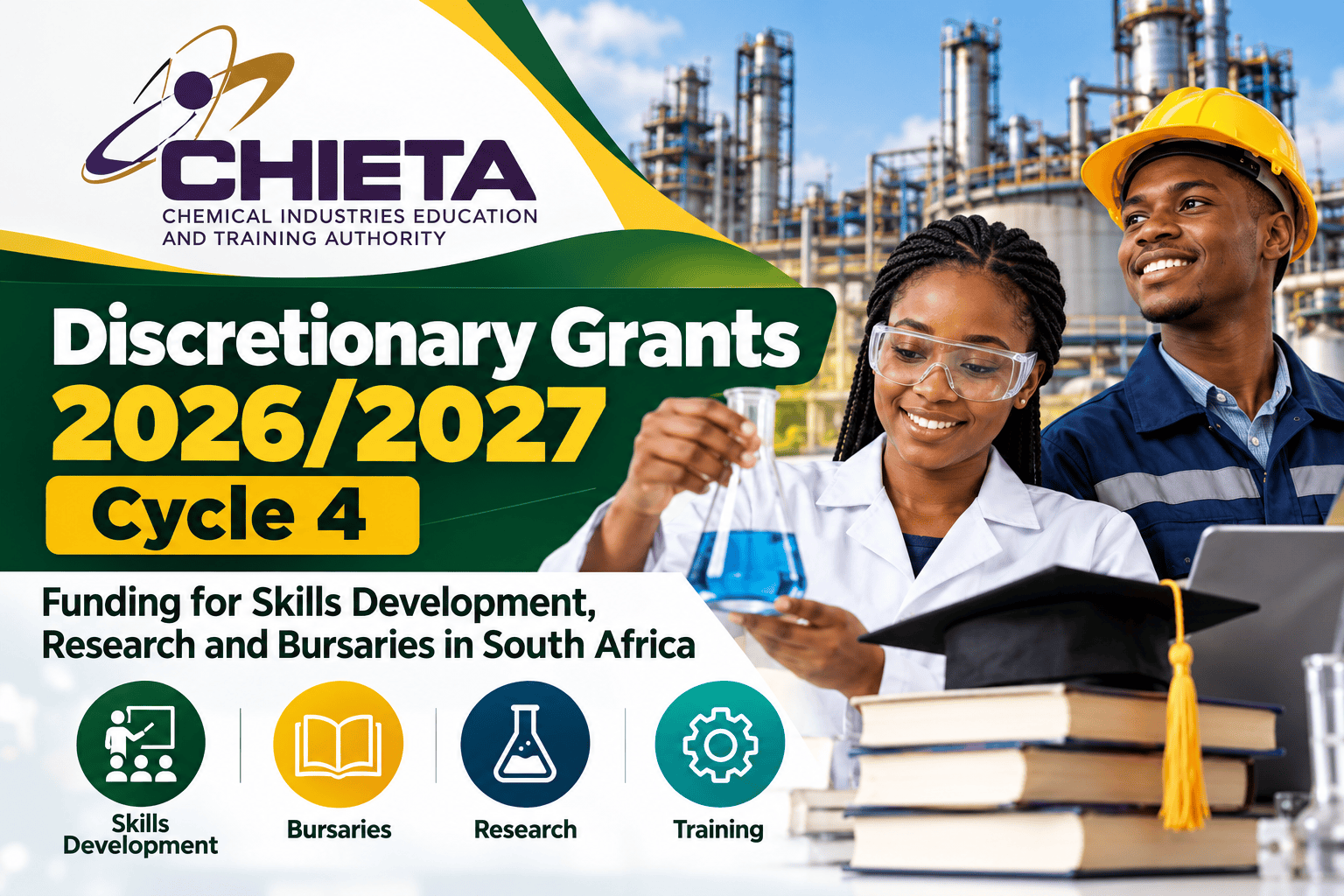
CHIETA Discretionary Grants 2026/2027 Cycle 4 – Funding for Skills Development, Research and Bursaries in South Africa
Organisations, educational institutions, training providers, and other eligible stakeholders in South Africa’s chemical sector have an opportunity to apply for the CHIETA Discretionary Grants 2026/2027 Cycle 4. The funding programme supports skills development, research, workplace learning, specialised training, and strategic projects designed to address skills shortages in the chemical and related industries.
The Chemical Industries Education and Training Authority (CHIETA) has opened this funding window to support selected training initiatives and projects that contribute to workforce development and innovation. The opportunities include research and skills planning, support for Technical and Vocational Education and Training (TVET) colleges, Community Education and Training (CET) initiatives, postgraduate bursaries under relevant funding categories, and work-integrated learning.
Applications opened on 6 October 2026 and are scheduled to close on 16 October 2026. However, applicants should urgently verify the supporting-document upload deadline because the published information also references an earlier date for document submission.
This article explains the funding opportunity, available programmes, eligibility requirements, supporting documents, and how interested applicants can submit an application.
Overview of the CHIETA Discretionary Grants 2026/2027
Here are the key details of the funding opportunity:
- Funding provider: Chemical Industries Education and Training Authority (CHIETA)
- Funding programme: Discretionary Grants 2026/2027 Cycle 4
- Country: South Africa
- Application opening date: 6 October 2026
- Advertised closing date: 16 October 2026
- Funding focus: Skills development, research, education, training, workplace learning, and strategic projects
- Eligible applicants: Qualifying organisations, educational institutions, employers, training providers, and other eligible stakeholders
- Application method: Online application through the CHIETA Integrated Management System (IMS)
- Funding amount: Depends on the applicable programme and CHIETA approval; a single award amount has not been established for the entire funding window.
- Official website: CHIETA
Applicants should consult the official funding advertisement and the requirements for their selected funding category before proceeding.
What Is the CHIETA Discretionary Grant Programme?
The Chemical Industries Education and Training Authority is a South African sector education and training authority responsible for supporting skills development within the chemical industries and related sectors.
Its work includes promoting relevant training, improving workforce capabilities, and helping address skills gaps that affect businesses and the wider economy.
Through its discretionary grant programme, CHIETA supports selected initiatives that align with its skills development priorities and sector requirements.
The 2026/2027 Cycle 4 funding window focuses on continuing learners and strategic projects. These initiatives are intended to strengthen institutional capacity, improve access to relevant training, support research, and prepare learners for opportunities in the chemical industry.
The programme is particularly relevant to organisations and institutions that can demonstrate how their proposed activities will contribute to skills development and the priorities identified by CHIETA.
Important: This is an organisational and institutional funding opportunity in several categories, not a general cash grant available to every individual. People interested in bursaries should check the specific bursary provisions and eligibility requirements associated with the relevant funding category.
Funding Opportunities Available Under CHIETA Cycle 4
The 2026/2027 Cycle 4 funding window covers several areas of skills development, research, and institutional support.
1. Institutional–Industry Partnerships
CHIETA is encouraging partnerships between higher education institutions and relevant industry stakeholders to support innovation and strengthen the relationship between education and the workplace.
Two highlighted areas are artificial intelligence-powered skills forecasting and data science.
AI-powered skills forecasting
This strategic project focuses on developing a tool that can support predictive analysis, risk management, and improved operational efficiency across CHIETA programmes.
Such a tool could help stakeholders better understand skills requirements and make informed decisions about training priorities.
Data Lab and Data Science
Another focus area involves establishing a Data Lab through collaboration with higher education institutions.
The proposed initiative aims to encourage data experimentation, analysis, innovation, and evidence-based decision-making.
Higher education institutions interested in these opportunities should review the relevant project specifications to understand the expected outcomes, partnership arrangements, and application requirements.
2. Centres of Specialisation
The funding window also includes support for Centres of Specialisation associated with apprenticeship programmes.
Apprenticeships provide practical training that helps learners develop occupation-specific skills. Specialised training initiatives can help bridge the gap between theoretical learning and the practical requirements of the workplace.
Eligible organisations should examine the official funding information to determine which apprenticeship-related activities qualify for support.
Applications should explain the skills gaps being addressed, the intended training outcomes, and how the proposed activities relate to the chemical sector.
3. Community Education and Training Support
Community Education and Training institutions can play an important role in expanding access to learning and improving employment prospects.
Under this funding window, eligible initiatives may include skills programmes for CET lecturers and Adult Education and Training opportunities for learners.
These activities can help strengthen teaching capacity and support learners who need additional education or occupational skills.
Interested institutions should confirm the specific programme requirements before preparing an application.
4. Technical and Vocational Education and Training Support
Technical and Vocational Education and Training colleges are important for developing practical skills that employers need.
CHIETA Cycle 4 includes support for TVET-related initiatives, particularly lecturer development through bursaries and skills programmes.
The objective is to strengthen professional development and improve the capacity of lecturers to deliver relevant training.
Eligible institutions should identify the skills development needs their proposed projects will address and explain how the activities could improve teaching quality or training outcomes.
5. Research and Skills Planning
Research is another important component of the CHIETA Discretionary Grants programme.
Evidence-based research can help identify skills shortages, understand employment trends, and improve the design of training interventions.
The 2026/2027 Cycle 4 funding window identifies several research topics relevant to the chemical sector.
These include:
- Exploring the extent and nature of job losses in the chemical industry.
- Evaluating the career pathways, retention, and progression of TVET chemical programme graduates.
- Assessing the impact and effectiveness of support provided to small, medium, and micro enterprises (SMMEs) in the chemical sector.
- Investigating the demand for and supply of chemical engineers in South Africa.
- Evaluating the impact of CHIETA Smart Skills Centres.
Applicants interested in research funding should examine the official research and skills planning document for the relevant scope of work and submission requirements.
A strong proposal should clearly explain the research problem, proposed methodology, expected outputs, and potential value to the chemical sector.
6. Master’s and PhD Bursaries
Postgraduate education is important for developing advanced technical knowledge, research expertise, and specialised professional skills.
The funding window includes master’s and PhD bursaries as part of its broader research and skills development priorities.
These opportunities are intended to support advanced skills development relevant to the sector.
However, applicants should not assume that every postgraduate student automatically qualifies. The applicable funding category may have specific academic, institutional, research, and administrative requirements.
Students and institutions should consult the official Cycle 4 funding documents to confirm who may apply, which qualifications are covered, what supporting documents are required, and whether applications must be submitted through an eligible institution or organisation.
The funding window should also be distinguished from separate CHIETA bursary programmes that may have their own application periods and eligibility criteria.
7. Work-Integrated Learning Opportunities
Work-integrated learning (WIL) combines academic or occupational learning with practical workplace experience.
The Cycle 4 funding window includes support for workplace learning opportunities for eligible learners holding qualifications at National Qualifications Framework (NQF) Level 6 or above.
These opportunities aim to help qualifying learners gain practical experience and improve their readiness for employment.
Organisations interested in WIL funding should review the official requirements to establish which qualifications, placements, and workplace arrangements are eligible.
Applicants should also ensure that their proposed activities have clear learning objectives and appropriate arrangements for workplace supervision.
8. QCTO-Registered Occupational Certificates
The funding window also covers qualifying learners undertaking non-artisan occupational certificate programmes registered with the Quality Council for Trades and Occupations (QCTO).
This category includes support for eligible new and continuing learners.
Occupational qualifications are designed to develop skills for specific roles and areas of work. They can provide structured pathways into employment or help existing workers improve their professional capabilities.
Applicants should verify that their proposed programmes meet the applicable registration and funding requirements.
9. Support for Continuing Learners
CHIETA also provides for applications involving learners who need continued support to complete previously funded qualifications.
This category is important for learners who have not yet completed their programmes and require further assistance.
Applications for continuing learners must include the relevant previous Memorandum of Agreement (MOA), a list of the learners concerned, and proof of enrolment, as specified in the funding requirements.
Support is subject to the availability of funds and the applicable approval process. Previous funding does not automatically guarantee further assistance.
Who Can Apply for CHIETA Discretionary Grants 2026/2027?
The funding window is intended for eligible organisations and institutions involved in the chemical sector, education, training, research, and related development activities.
Depending on the funding category, eligible applicants may include:
- Chemical-sector companies that meet the relevant requirements, including applicable Annual Training Report and Workplace Skills Plan submission requirements.
- Non-levy-paying companies operating within the chemical sector.
- CHIETA-accredited training providers.
- Small, medium, and micro enterprises.
- Community-based organisations.
- Community-based cooperatives.
- Non-profit organisations.
- Non-governmental organisations.
- Eligible cooperatives.
- Government institutions and municipalities.
- Technical and Vocational Education and Training colleges.
- Community Education and Training colleges.
- Higher education institutions.
Eligibility varies by funding category. An organisation that qualifies for one programme may not necessarily qualify for another.
For example, a higher education institution interested in a research partnership should review the requirements for that project rather than relying solely on the general eligibility list.
Similarly, an employer applying for support for continuing learners must provide the relevant learner records and documentation.
Before preparing an application, applicants should confirm that their organisation is eligible for the specific funding category they intend to pursue.
Required Documents for the Application
Applicants should prepare the documents required by the relevant funding category and the CHIETA online application system.
The general compliance requirements identified for this funding window include the following:
1. Proof of Registration
Applicants may need to provide official registration documents confirming the legal status of their organisation.
For example, companies may be required to provide relevant Companies and Intellectual Property Commission (CIPC) documentation, while eligible non-profit organisations may need to submit their applicable registration evidence.
2. Tax Compliance Documents
Applicants should prepare valid tax compliance documentation, such as an applicable Tax Compliance Status PIN.
Other documents may be required depending on the applicant’s status and the instructions in the application system.
3. B-BBEE Documentation
A valid Broad-Based Black Economic Empowerment (B-BBEE) certificate or other applicable proof should be prepared where required.
Applicants should follow the official instructions concerning acceptable documentation.
4. Declaration of Interest
The funding requirements identify a declaration of interest concerning potential relationships between an applicant’s directors and CHIETA board members or management.
Where required, this declaration must be completed and signed in accordance with the official instructions.
5. Proof of Banking Details
Applicants should prepare acceptable banking documentation to support the verification of their organisation’s banking details.
6. Appointment Letter for New Applicants
New discretionary grant applicants and Sector Development Facilitators may be required to provide a signed appointment letter on the letterhead of the company they represent before linking themselves to that company in the online system.
Applicants should confirm the exact requirements before completing the linking process.
7. Documents for Continuing Learners
Applications involving continuing learners should include the applicable previous MOA, a list of learners, and proof of enrolment.
Other supporting documents may be required depending on the funding category.
Applicants should review the application system’s document-upload section carefully. Missing mandatory documents may result in an application being rejected.
How to Apply for CHIETA Discretionary Grants 2026/2027
Applications are submitted online through the CHIETA Integrated Management System.
Follow these steps to prepare your application.
Step 1: Visit the official CHIETA website
Start by visiting the official CHIETA website and locating the 2026/2027 Cycle 4 Discretionary Grants advertisement.
Official website: https://chieta.org.za/
Step 2: Read the funding advertisement
Review the complete advertisement and identify the funding category that matches your organisation, institution, or proposed project.
Pay attention to the eligibility criteria, required activities, supporting documents, and applicable deadlines.
Step 3: Select the appropriate funding category
Choose the relevant programme, such as research and skills planning, TVET support, institutional–industry partnerships, work-integrated learning, occupational certificates, or continuing learners.
Make sure the proposed activities match the selected category.
Step 4: Prepare the required documents
Gather the necessary registration, tax, banking, declaration, learner, and project-specific documents.
Check that the documents are valid, complete, and consistent with the information entered in the application system.
Step 5: Access the CHIETA application portal
Use the official online application system:
https://core-ims.chieta.org.za/
Follow the instructions for registration, account access, organisation linking, and the relevant funding application.
Step 6: Complete the application
Enter the requested information accurately and provide the supporting documents required for your selected category.
Where a project proposal is required, explain the problem being addressed, the activities to be undertaken, the intended beneficiaries, the expected results, and the project’s relevance to the chemical sector.
Step 7: Review and submit
Before submitting, check all the information and uploaded documents.
Ensure that the application has been signed by the appropriate individuals and submitted through the required online process.
Keep a copy of the application and any available submission confirmation for your records.
Manual and emailed applications are not accepted under the published application instructions. Applicants should therefore use the official online system.
Application Deadline
The advertised closing date for the CHIETA Discretionary Grants 2026/2027 Cycle 4 is 16 October 2026.
Applications opened on 6 October 2026, leaving a limited period for interested organisations to prepare and submit their applications.
There is an important detail to check before applying: published information about this funding window also references 9 October 2026 as a deadline for uploading supporting documents.
Because this date is earlier than the advertised application closing date, applicants should immediately confirm the applicable document-upload deadline with CHIETA. Do not assume that the later closing date automatically extends every supporting-document requirement.
As of 10 October 2026, the advertised application deadline is approaching. Applicants should check the official portal for the current status of the relevant funding category and any additional instructions.
Tips for Preparing a Strong Application
Submitting an application does not guarantee that funding will be awarded. Applicants should take time to prepare a complete and well-supported submission.
The following practices can help:
Understand the programme requirements. Read the relevant funding documents and make sure your proposal addresses the specific objectives of the selected category.
Explain the skills gap. Describe the training, research, or workforce development problem your project is intended to address.
Set clear objectives. Identify what the project aims to achieve and how progress or results will be assessed.
Prepare a realistic project plan. Explain the proposed activities, expected timeline, responsibilities, and intended outcomes.
Check all supporting documents. Ensure that required compliance documents are valid and correctly uploaded.
Demonstrate sector relevance. Explain how the project contributes to skills development, research, innovation, or workforce needs in the chemical sector.
Submit through the correct channel. Use the official CHIETA application system and retain evidence of submission.
Applicants should provide accurate information throughout the process and avoid making claims about project outcomes that cannot be supported.
Important Things Applicants Should Know
Before applying for the CHIETA Discretionary Grants 2026/2027 Cycle 4, keep the following points in mind:
- The programme is intended for eligible applicants under the relevant funding categories.
- Not every funding category is open to every organisation or individual.
- Funding amounts may differ between programmes and approved projects.
- Submission of an application does not guarantee funding.
- Awards are subject to CHIETA’s assessment, available funding, and applicable approval procedures.
- Continuing learners may need to provide evidence of previous funding and current enrolment.
- Applications must follow the official online submission process.
- Applicants should confirm the discrepancy between the advertised application deadline and the supporting-document upload deadline.
For the most accurate information, consult the official funding advertisement and the applicable programme documents before submitting an application.
Frequently Asked Questions
1. What is the CHIETA Discretionary Grants 2026/2027 Cycle 4?
It is a funding opportunity administered by the Chemical Industries Education and Training Authority to support eligible skills development, research, training, and strategic projects related to the chemical sector in South Africa.
2. What is the application deadline?
The advertised closing date is 16 October 2026. However, applicants should urgently verify the separate supporting-document upload deadline referenced in the published information.
3. Who is eligible to apply?
Depending on the funding category, eligible applicants may include qualifying chemical-sector companies, training providers, SMMEs, non-profit organisations, government institutions, TVET colleges, CET colleges, and higher education institutions.
4. Can individual students apply for funding?
The Cycle 4 funding window includes bursary-related and continuing-learner provisions, but eligibility depends on the specific category. Students should check the official requirements to determine whether applications must be submitted through an institution or another eligible organisation.
5. Does the programme provide funding for master’s and PhD studies?
Postgraduate bursaries are included among the funding priorities. Applicants should consult the relevant funding information to confirm eligibility, covered qualifications, application procedures, and supporting-document requirements.
6. How much funding can applicants receive?
There is no single funding amount established for the entire Cycle 4 programme. The amount available depends on the applicable funding category, project requirements, and CHIETA’s approval.
7. How do applicants submit their applications?
Applications must be submitted online through the CHIETA Integrated Management System at https://core-ims.chieta.org.za/.
Applicants should follow the official instructions and ensure that all required documents are provided.
8. Does submitting an application guarantee funding?
No. Applications are subject to the applicable assessment and approval process, and funding depends on eligibility, available resources, and the relevant programme requirements.
Final Thoughts
The CHIETA Discretionary Grants 2026/2027 Cycle 4 provide an opportunity for eligible organisations and institutions to pursue projects that strengthen skills development, research, and workforce training in South Africa’s chemical sector.
The funding window covers a range of priorities, from institutional–industry partnerships and specialised training to postgraduate bursaries, research, and workplace learning.
For interested applicants, the most important steps are to identify the correct funding category, understand its requirements, prepare the necessary documents, and verify the applicable submission deadlines.
Because the application period is short and the supporting-document deadline requires clarification, applicants should consult the official CHIETA website and online application system as soon as possible.
Official application portal: https://core-ims.chieta.org.za/
Official website: https://chieta.org.za/
Disclaimer: This article is intended for informational purposes only. Funding availability, eligibility, deadlines, and award decisions are determined by CHIETA and may be subject to official updates. Applicants should verify all requirements through official CHIETA channels before submitting an application.
