
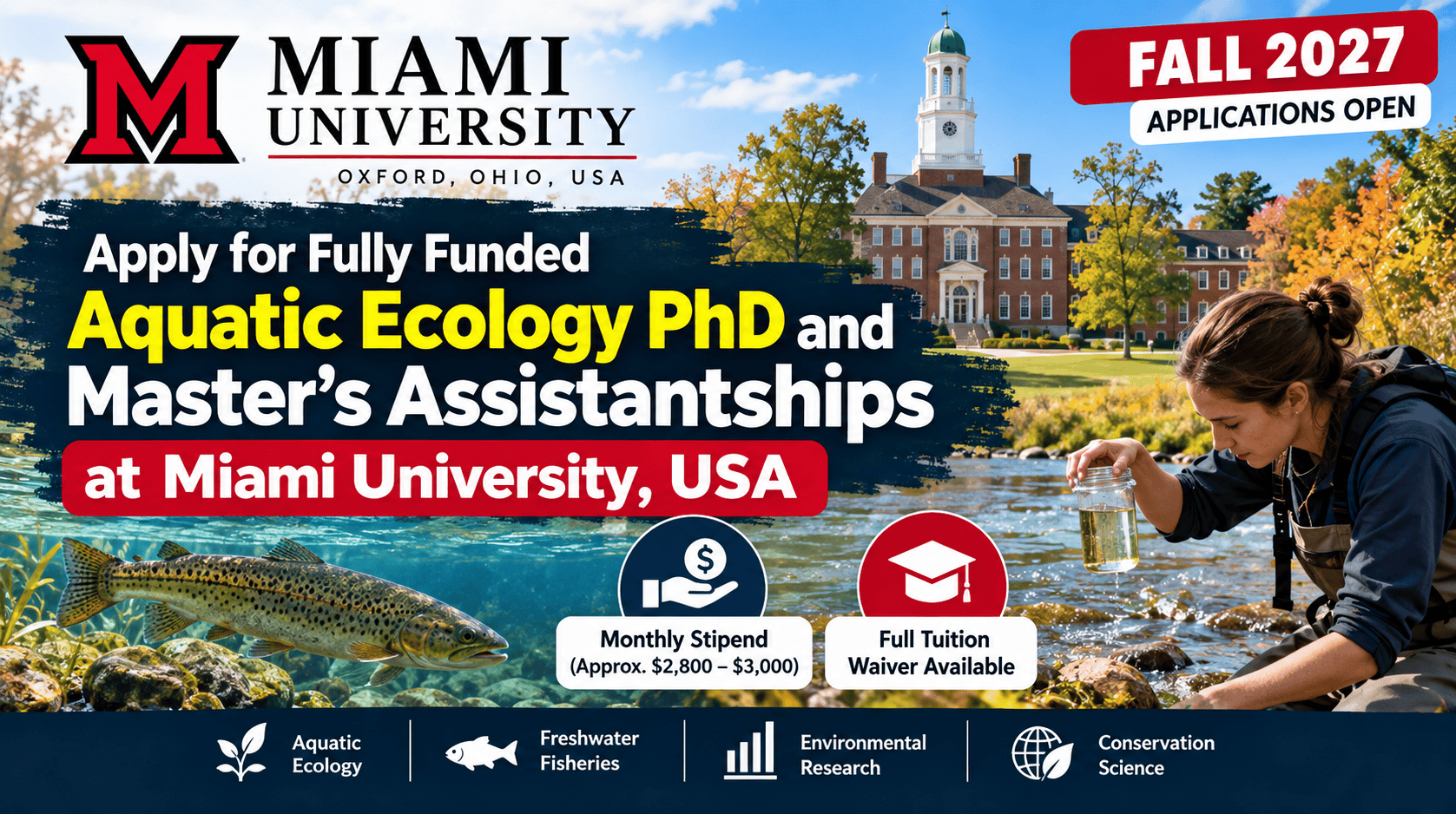
Apply for Fully Funded Aquatic Ecology PhD and Master’s Assistantships at Miami University, USA — Fall 2027
Graduate students interested in aquatic ecology, freshwater fisheries, and environmental conservation have an opportunity to pursue advanced research at Miami University in Oxford, Ohio, USA. The university’s Wagner Lab is seeking motivated PhD and master’s students to join its research team for the Fall 2027 intake.
The advertised graduate assistantships offer financial support through a stipend and a full tuition waiver. The research focuses on understanding how environmental changes and human activities affect freshwater ecosystems and fish populations.
These opportunities may be particularly attractive to students with backgrounds in ecology, fisheries science, environmental biology, or ecological statistics who want to develop their research careers in the United States.
In this guide, we explain the available opportunities, funding benefits, eligibility requirements, application documents, and steps for submitting an application.
Scholarship Overview
- Host Institution: Miami University
- Location: Oxford, Ohio, United States
- Research Laboratory: Wagner Lab
- Academic Opportunities: PhD and master’s assistantships
- Preferred PhD Programme: Ecology, Evolution, and Environmental Biology
- Master’s Programme: Biology
- Research Area: Aquatic ecology and freshwater fisheries
- Study Level: Postgraduate
- Programme Start: Fall 2027
- Funding: Stipend and full tuition waiver, as advertised
- Application Deadline: Contact the laboratory to confirm the correct deadline
- Application Method: Email application to the principal investigator
Official Opportunity Page: https://wagneraqualab.weebly.com/opportunities.html
About the Miami University Aquatic Ecology Assistantships
The opportunities are offered through the Wagner Lab in the Department of Biology at Miami University.
The laboratory conducts research into aquatic ecosystems, freshwater fisheries, and the environmental pressures affecting them. Students joining the research team may have opportunities to develop research questions, analyse ecological data, and collaborate with researchers from academic institutions and government agencies.
The positions are intended for students who want to investigate environmental challenges through scientific research and quantitative methods.
The advertised assistantships are scheduled to begin in Fall 2027, with support provided through research and teaching assistantships.
The laboratory particularly encourages applications from prospective PhD students in Ecology, Evolution, and Environmental Biology. Qualified applicants interested in pursuing a master’s degree in Biology may also be considered.
Prospective students should review the official laboratory announcement to confirm the available positions, funding arrangements, and current application requirements.
Benefits of the Miami University Graduate Assistantships
One of the main attractions of these opportunities is the financial support available to selected graduate students.
1. Monthly Stipend
Successful applicants will receive a stipend through their graduate assistantship.
The opportunity listing reports an advertised salary of approximately $2,800 to $3,000 per month. Applicants should confirm the applicable stipend, payment arrangements, and appointment terms directly with the laboratory before making financial plans.
The stipend can help students manage living expenses while undertaking graduate research and teaching responsibilities.
However, students should remember that the stipend is intended to provide financial support during the assistantship. It should not automatically be interpreted as covering every expense associated with living and studying in the United States.
2. Full Tuition Waiver
The advertised positions include a full tuition waiver.
This benefit can substantially reduce the cost of postgraduate education, particularly for students who would otherwise pay international tuition rates.
However, a tuition waiver does not necessarily cover every university charge. Students should confirm whether mandatory fees, health insurance, accommodation, travel, and other personal expenses are included in their particular funding package.
For further information, visit Miami University’s official graduate assistantship funding page:
https://miamioh.edu/graduate-school/funding-awards/grad-assistantships.html
3. Research and Teaching Experience
Graduate assistants will have opportunities to participate in research and teaching activities.
These responsibilities can help students develop practical skills in scientific investigation, academic communication, and collaboration.
Depending on their assigned duties and research projects, students may gain experience in collecting and interpreting ecological information, developing research questions, and communicating scientific findings.
4. Opportunities to Publish Research
The advertised opportunity identifies conference presentations and contributions to academic journal publications as expectations for successful candidates.
This experience can help graduate students strengthen their academic profiles and prepare for careers in research, higher education, environmental consulting, and conservation.
Publication opportunities depend on the research conducted, the quality of the work, and the relevant academic processes. Publication is not guaranteed.
5. Collaboration With Researchers
Students may have opportunities to work with interdisciplinary teams involving federal, state, and academic scientists.
Such collaborations can expose graduate researchers to different approaches to environmental research and help them develop professional connections within the scientific community.
Research Areas and Academic Opportunities
The Wagner Lab focuses on understanding how environmental changes and human activities affect aquatic ecosystems and freshwater fisheries.
Prospective students should be interested in one or more of the following research areas.
Climate Change and Aquatic Ecosystems
Climate change can affect water temperature, freshwater habitats, species distribution, and the ecological processes that sustain aquatic life.
Students may investigate how these changes influence freshwater ecosystems and fish populations.
Land Use and Land Management
Agriculture, urban development, and other land-use activities can affect water quality and freshwater habitats.
Research in this area can help explain how changes across a landscape influence aquatic environments.
Invasive Species
Aquatic invasive species can alter food webs, compete with native organisms, and change the structure of freshwater ecosystems.
Understanding their effects can support better conservation and fisheries management strategies.
Eutrophication and Water Quality
Eutrophication occurs when excessive nutrients enter aquatic environments, potentially causing algal blooms, reduced oxygen levels, and other ecological problems.
Research into these processes can help scientists understand the relationship between nutrient pollution and aquatic ecosystem health.
Persistent Chemical Pollutants
The research programme also identifies persistent chemical pollutants, including per- and polyfluoroalkyl substances (PFAS), as areas of interest.
These substances are studied because of concerns about their persistence in the environment and potential effects on ecosystems.
Freshwater Fisheries Conservation
Students may also investigate the environmental factors that affect freshwater fish populations and fisheries management.
This research can contribute to a better understanding of aquatic biodiversity and the sustainable management of freshwater resources.
Specific research projects and responsibilities should be discussed with the principal investigator before applying.
Eligibility Requirements
The assistantships are intended for applicants with relevant academic preparation and a strong interest in aquatic ecology, fisheries, or related environmental research.
Although the final selection will depend on the laboratory’s assessment of each applicant, the advertised qualifications provide a useful guide.
1. Relevant Academic Background
Applicants should have completed a bachelor’s or master’s degree in one of the following areas or a related discipline:
- Ecology
- Fisheries science
- Ecological statistics
- Environmental biology
- Biological sciences
- Related environmental science fields
Applicants should explain how their academic background prepares them for the proposed graduate research.
2. Quantitative and Statistical Skills
A strong quantitative background is desirable.
The laboratory is particularly interested in candidates who can apply statistical methods to ecological questions or who are willing to develop these skills.
The advertisement specifically mentions Bayesian hierarchical statistical models.
Applicants with experience in statistical analysis, ecological modelling, data interpretation, or quantitative research should highlight that experience in their application.
Candidates without extensive experience in Bayesian modelling should explain their willingness to learn and apply advanced statistical methods.
3. Research Interest
Applicants should demonstrate a genuine interest in aquatic ecosystems, freshwater fisheries, environmental change, or conservation.
A strong application should explain the research questions the candidate hopes to explore and how those interests relate to the laboratory’s work.
4. Communication Skills
Successful candidates are expected to communicate their research findings clearly.
Applicants should demonstrate strong written and oral communication skills and the ability to explain scientific ideas in an organised manner.
5. Ability to Work Independently and Collaboratively
Graduate research often requires students to manage their own tasks while working with supervisors and other researchers.
Candidates should demonstrate initiative, organisation, reliability, and the ability to contribute positively to a research team.
Important: Meeting the general qualifications does not guarantee admission or funding. The laboratory will assess each application based on its academic and research requirements.
Can International Students Apply?
The advertised opportunity is based at Miami University in the United States and invites prospective PhD and master’s students to apply.
The published advertisement does not clearly state a nationality restriction. However, international applicants should confirm their eligibility with the principal investigator before submitting their applications.
Students applying from Nigeria, Ghana, South Africa, India, Pakistan, and other countries should pay particular attention to the academic admission requirements and any additional documentation required for international students.
If selected, international applicants will also need to satisfy the applicable US student immigration requirements.
Receiving a graduate assistantship does not automatically guarantee visa approval. Immigration decisions are handled by the relevant US authorities.
For programme information, visit Miami University’s graduate admission page:
https://miamioh.edu/admission-aid/apply/graduate-students/
Required Application Documents
Applicants should prepare the following documents for consideration.
1. Cover Letter
Your cover letter should describe your academic background, research experience, and interest in aquatic ecology or freshwater fisheries.
Explain why you want to join the Wagner Lab and how your research interests connect with its work.
Where possible, identify the statistical, laboratory, fieldwork, or data-analysis skills you could contribute to the research team.
2. Curriculum Vitae
Prepare an up-to-date academic CV containing relevant information such as:
- Educational qualifications
- Research experience
- Relevant technical and statistical skills
- Publications, if applicable
- Conference presentations, if applicable
- Research projects
- Academic awards or honours
Keep the document clear and easy to read.
3. Contact Information for Three Professional References
Provide the names and contact information of three professional references.
Choose individuals who can discuss your academic ability, research experience, work ethic, and suitability for postgraduate study.
Where possible, inform your referees before submitting their details.
4. Academic Transcripts
Include your academic transcripts.
The advertisement states that unofficial transcripts are acceptable for the initial application.
If you studied outside the United States, make sure your academic records clearly identify your qualifications, courses, and grades.
The university may request additional documentation during the admission process.
5. Relevant Publication, If Available
Applicants are encouraged to include a relevant publication if they have one.
This requirement is optional according to the advertisement.
If you have not published academic research, do not assume that you are automatically ineligible. Instead, focus on presenting your research experience, academic preparation, and potential to contribute to the laboratory.
Important Document Submission Instruction
The advertised instructions request that all application materials be combined into one PDF file and emailed to the principal investigator.
Before sending your application, check that the file opens correctly, the pages are readable, and every required document is included.
How to Apply for the Miami University Aquatic Ecology Assistantships
Interested candidates can follow these steps to prepare their applications.
Step 1: Review the Research Opportunity
Visit the Wagner Lab opportunities page and read the original advertisement carefully.
Official website: https://wagneraqualab.weebly.com/opportunities.html
Make sure the research areas and degree options match your academic goals.
Step 2: Identify Your Preferred Degree
Determine whether you intend to pursue a PhD in Ecology, Evolution, and Environmental Biology or a master’s degree in Biology.
The advertisement indicates a preference for prospective PhD students while also considering strong master’s applicants.
Step 3: Prepare Your Application Documents
Write your cover letter, update your CV, obtain your academic transcripts, and collect the contact information for three professional references.
Include a relevant publication if you have one.
Step 4: Combine the Documents Into One PDF
Arrange the documents in a logical order and merge them into a single PDF file, as instructed in the advertisement.
Use a professional filename, such as:
YourName_Aquatic_Ecology_Graduate_Application.pdf
Step 5: Email Your Application
Send your completed application to the principal investigator using the contact details below.
Contact Person: Dr. Tyler Wagner
Department: Department of Biology, Miami University
Email: wagne263@miamioh.edu
Use a clear subject line, such as:
Fall 2027 Graduate Assistantship Application – Aquatic Ecology – [PhD or MS]
In the email, briefly introduce yourself, identify your preferred degree programme, and explain your interest in the research opportunity.
Step 6: Confirm the Deadline and Funding Details
Before submitting, contact the laboratory if you need clarification about the deadline, stipend, tuition waiver, or degree-specific admission requirements.
The laboratory’s official opportunity page should be your primary reference for the application process.
Application Deadline for Fall 2027
The opportunity listing identifies Fall 2027 as the intended start period.
However, applicants should carefully verify the deadline before relying on dates reproduced elsewhere.
The advertisement syndicated through graduate research opportunity listings contains inconsistent deadline information. One section reports a priority date of 15 November 2027, while another listing identifies 30 December 2026 as the application deadline.
A November 2027 priority date would also fall after the advertised Fall 2027 start.
Because of this discrepancy, it would be misleading to present either date as definitively confirmed.
Our recommendation is to contact Dr. Tyler Wagner as soon as possible at wagne263@miamioh.edu to confirm the correct application deadline and whether the positions remain open.
Applications may be reviewed as they arrive, so prospective students should not delay while waiting for clarification.
For updates, visit the official Wagner Lab opportunities page:
https://wagneraqualab.weebly.com/opportunities.html
Tips for Preparing a Competitive Application
Graduate assistantships can attract applicants with different academic and research backgrounds. A carefully prepared application can help the selection team understand your strengths.
Explain Your Research Interests Clearly
Avoid writing a cover letter that simply repeats your CV.
Explain the environmental questions you want to investigate and how they connect with the laboratory’s research.
For example, you might discuss your interest in how land-use changes affect freshwater fish populations or how climate change influences aquatic ecosystems.
Your proposed interests should reflect your genuine academic goals.
Highlight Quantitative Experience
If you have experience using statistical software, analysing ecological data, conducting surveys, or completing quantitative research projects, explain what you did and what you learned.
If your experience is limited, describe relevant coursework and your willingness to develop more advanced statistical skills.
Demonstrate Research Potential
Include specific examples of research projects, dissertations, fieldwork, laboratory work, or academic assignments that demonstrate your ability to investigate scientific questions.
Explain your role and the skills you developed.
Choose Suitable References
Select referees who know your academic or research work well.
A detailed recommendation from someone familiar with your abilities may provide more useful information than a reference from someone who knows little about your experience.
Proofread Every Document
Check your application for spelling errors, inconsistent dates, missing pages, and incorrect contact information.
A clear, well-organised application makes it easier for the selection team to assess your qualifications.
Frequently Asked Questions
1. Is the Miami University Aquatic Ecology Assistantship Fully Funded?
The advertised opportunity states that successful students will receive a stipend and a full tuition waiver.
However, applicants should confirm the complete funding package, including mandatory fees and other expenses, directly with the laboratory.
2. Can I Apply for a Master’s Degree?
Yes. The advertisement indicates that strong candidates interested in pursuing a master’s degree in Biology will be considered, although preference is given to applicants seeking a PhD in Ecology, Evolution, and Environmental Biology.
3. Do I Need a Publication to Apply?
A relevant publication is requested only if available. Applicants who have not published research should still submit the other required documents and demonstrate their academic and research potential.
4. Can Students From Nigeria Apply?
The published advertisement does not clearly specify nationality restrictions. Prospective applicants from Nigeria should contact the principal investigator to confirm eligibility and ask about the relevant international admission requirements.
5. Does the Tuition Waiver Cover Living Expenses?
Not necessarily. A tuition waiver reduces eligible tuition charges, while the stipend provides financial support during the assistantship.
Accommodation, travel, insurance, mandatory fees, and other expenses may not be fully covered. Applicants should request a written breakdown of the funding package.
6. What Is the Application Deadline?
The available listings contain conflicting dates. Contact Dr. Tyler Wagner directly to verify the correct deadline before submitting your application.
7. When Does the Assistantship Begin?
The advertised starting period is Fall 2027.
8. Where Can I Submit My Application?
The advertisement instructs applicants to send a single PDF containing the required documents to Dr. Tyler Wagner at wagne263@miamioh.edu.
Always verify the latest instructions on the laboratory’s official opportunities page before submitting your materials.
Final Thoughts
The Aquatic Ecology PhD and Master’s Assistantships at Miami University offer a research-focused opportunity for graduates interested in freshwater ecosystems, fisheries conservation, and environmental change.
The advertised funding package includes a stipend and a full tuition waiver, while the research experience may help students strengthen their quantitative, scientific communication, and academic research skills.
Applicants with relevant qualifications, an interest in ecological research, and a willingness to develop advanced statistical skills may find the opportunity worth exploring.
Before applying, carefully review the research requirements, prepare all requested documents, and contact the principal investigator to confirm the funding terms and application deadline.
Official Application Contact: Dr. Tyler Wagner
Email: wagne263@miamioh.edu
Official Opportunity Page: https://wagneraqualab.weebly.com/opportunities.html
