
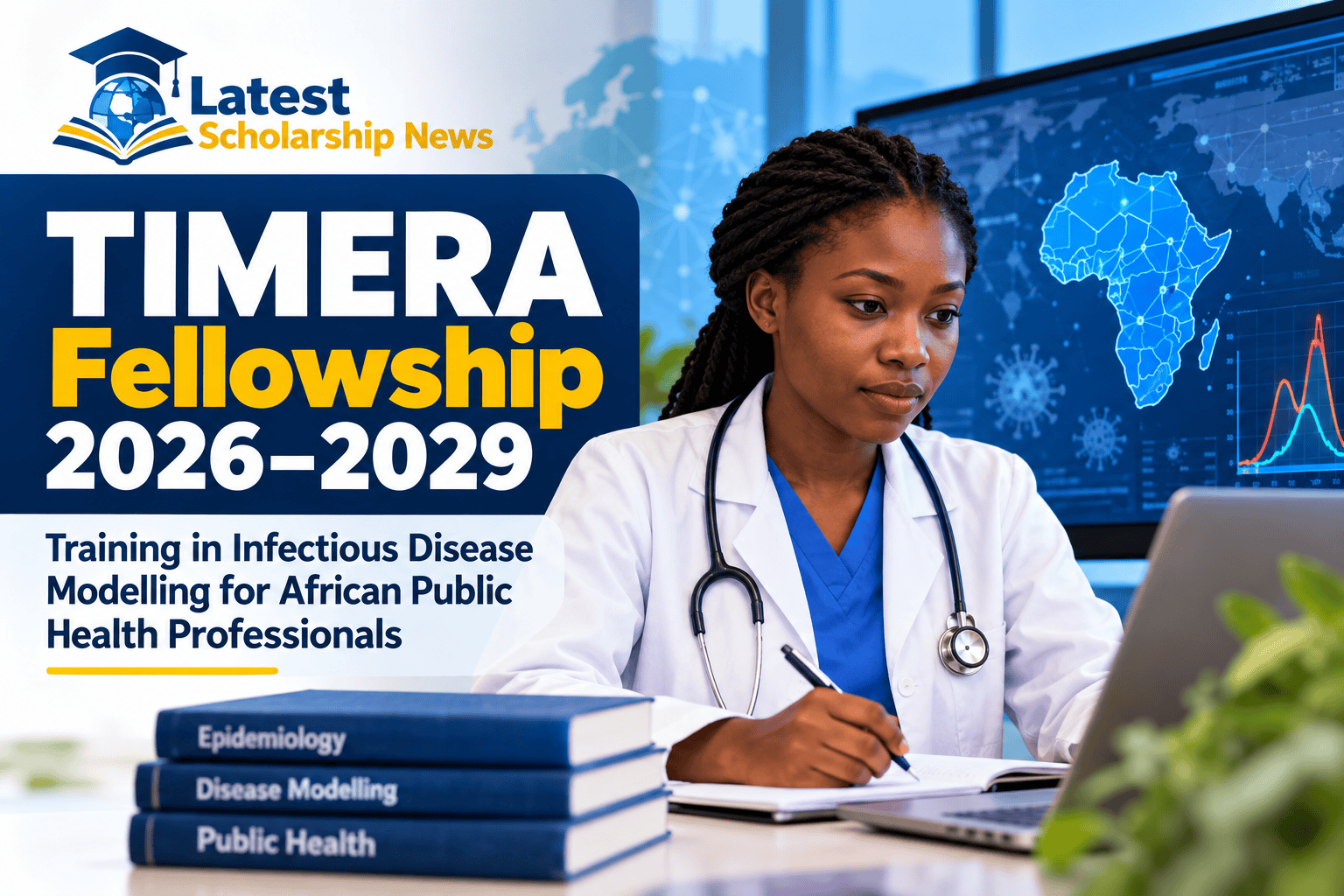
TIMERA Fellowship 2026–2029: Training in Infectious Disease Modelling for African Public Health Professionals
African public health professionals and researchers interested in infectious disease modelling have an opportunity to strengthen their technical skills through the TIMERA Fellowship 2026–2029. The programme is designed to improve Africa’s capacity to predict, understand and respond to infectious disease outbreaks through mathematical modelling, epidemiological research and evidence-based public health decision-making.
Funded through the European and Developing Countries Clinical Trials Partnership (EDCTP3) under the Global Health EDCTP3 programme, TIMERA aims to train approximately 50 African fellows during its three-year project period.
The initiative focuses on developing local expertise in infectious disease modelling, an important area of public health research that helps professionals understand how diseases spread, assess possible outbreak scenarios and evaluate the potential effects of public health interventions.
The fellowship combines online learning, intensive face-to-face training, expert mentoring, collaborative research and practical projects. It is particularly relevant to professionals who want to apply modelling techniques to real public health challenges in their institutions and communities.
Interested applicants should review the eligibility requirements and application information below before submitting their applications.
TIMERA Fellowship 2026–2029: Overview
Here are the key details of the TIMERA Fellowship programme.
- Programme Name: Training Initiative for Modelling Epidemic Response in Africa (TIMERA)
- Project Period: 1 July 2026 – 30 June 2029
- Programme Duration: A structured training programme delivered over approximately 12 months per cohort
- Funding Organisation: Global Health EDCTP3
- Target Participants: African public health professionals and early- to mid-career researchers who meet the programme’s eligibility requirements
- Number of Fellows: Approximately 50 across the project
- Training Format: Online learning and face-to-face training
- Training Location: Includes in-person training in Addis Ababa, Ethiopia
- Main Focus: Infectious disease modelling, epidemiology, outbreak preparedness and evidence-based public health policy
- Application Deadline: 15 October 2026, according to published application announcements. Applicants should confirm the deadline through the programme’s official application information.
- Application Method: Online application
The project runs from July 2026 to June 2029. These dates describe the overall project period, rather than the duration of an individual fellowship.
What Is the TIMERA Fellowship?
The Training Initiative for Modelling Epidemic Response in Africa, commonly known as TIMERA, is a capacity-building initiative designed to strengthen infectious disease modelling expertise across sub-Saharan Africa.
Infectious diseases remain an important public health challenge across the continent. Effective responses require reliable surveillance systems, skilled epidemiologists, researchers and public health professionals who can analyse available information and help decision-makers understand the possible development of an outbreak.
Mathematical and statistical modelling can support these efforts by helping researchers estimate disease transmission, explore potential future scenarios and assess how different interventions might affect an outbreak.
However, specialised modelling expertise is not equally available across all regions. TIMERA seeks to address this gap by equipping African professionals with the knowledge and practical experience needed to apply modelling methods within their own public health systems.
The initiative is being implemented through collaboration between African and European institutions, with Addis Ababa University serving as the scientific project lead.
By investing in local expertise, TIMERA aims to strengthen Africa’s ability to generate and interpret evidence that supports infectious disease prevention, surveillance and control.
What Does the TIMERA Fellowship Offer?
The TIMERA Fellowship provides structured professional training rather than simply offering a short academic course.
Selected participants will take part in a combination of learning activities designed to help them develop technical knowledge and apply it to practical public health problems.
1. Training in Infectious Disease Modelling
Fellows will develop knowledge of mathematical and statistical approaches used to study infectious diseases.
These methods can help public health professionals examine patterns of disease transmission, estimate possible outbreak developments and explore the potential effects of different control measures.
The programme is intended to strengthen participants’ ability to use modelling as part of public health research, surveillance and decision-making.
2. Online Learning and Face-to-Face Training
The programme combines remote learning with intensive in-person training.
According to the project description, fellows will participate in two intensive, two-week face-to-face training blocks, supported by online modules and thematic workshops.
This blended approach gives participants opportunities to build foundational knowledge, interact with other professionals and develop their technical skills through structured instruction.
The published programme information identifies Addis Ababa, Ethiopia, as a location for in-person training.
Applicants should consult the official call for information about the schedule, travel arrangements and participation requirements.
3. Expert Mentoring
Participants will benefit from specialised mentoring throughout the programme.
The training model includes guidance from experienced professionals in infectious disease modelling and infectious disease research.
This support is intended to help fellows understand technical concepts, strengthen their research abilities and apply modelling approaches to relevant public health questions.
Mentoring can also help participants identify suitable research questions and improve the quality of their work.
4. Practical Research and Applied Projects
The fellowship places an emphasis on applying newly acquired knowledge to real-world problems.
Participants will work on applied projects that connect modelling techniques with public health challenges.
Where feasible, fellows may also undertake supervised internships at their home institutions, national public health institutes or ministries of health.
These practical activities are designed to help participants connect theoretical knowledge with the needs of the communities and health systems they serve.
The precise arrangements for individual projects and internships should be confirmed through the programme’s official application materials.
5. Exposure to AI-Supported Modelling
The programme also includes exposure to artificial intelligence-supported approaches to epidemiological modelling.
AI and machine learning tools can assist researchers in analysing complex datasets and exploring patterns that may be relevant to disease surveillance and outbreak preparedness.
However, their usefulness depends on data quality, appropriate methods and careful interpretation.
Through this component, TIMERA aims to familiarise participants with developing technical approaches that may support infectious disease research and public health planning.
6. Policy Communication and Collaborative Learning
Technical research is most useful when its findings can be understood and applied by the people responsible for public health decisions.
TIMERA therefore places emphasis on helping fellows communicate scientific findings effectively to policymakers.
Participants will also take part in group work and collaborative activities, including a period of joint work following the final face-to-face training module.
These activities are intended to help fellows develop outputs that communicate research findings in formats suitable for policy discussions and public health planning.
Financial Benefits and Support
The TIMERA Fellowship is supported through the Global Health EDCTP3 programme.
Published descriptions of the opportunity indicate that support is available for eligible fellows participating in the programme’s training activities.
Reported forms of support include:
- Travel support: Assistance with eligible travel associated with in-person training.
- Accommodation: Accommodation support during designated face-to-face training periods.
- Meals: Meal support during the relevant residential training sessions.
- Subsistence support: Support associated with eligible in-person training periods.
- Research or internship support: Published opportunity announcements also refer to a stipend associated with research or internship activities.
Applicants should read the official call carefully to establish the precise amounts, eligibility conditions, payment arrangements and covered expenses.
Important: The publicly available project description does not establish a guaranteed monthly salary for every fellow. Applicants should not assume that the programme provides a fixed monthly stipend unless this is explicitly confirmed in the official fellowship terms.
The opportunity should primarily be understood as a specialised training and professional development programme with associated support, subject to the official conditions.
Who Can Apply for the TIMERA Fellowship 2026–2029?
The programme is designed for African public health professionals and researchers who want to strengthen their ability to use infectious disease modelling in public health research and practice.
Published application announcements identify relevant postgraduate qualifications, professional experience and institutional support as important considerations.
Prospective applicants should pay particular attention to the following areas.
1. Relevant Academic Background
Applicants should have an academic background relevant to the fellowship’s focus.
Fields that may be relevant include:
- Public health
- Epidemiology
- Biostatistics
- Statistics
- Mathematics
- Infectious disease research
- Related health or quantitative research disciplines
Published descriptions of the current call indicate a relevant master’s degree requirement. Applicants should verify the accepted qualifications and any additional academic conditions in the official call before applying.
2. Professional Experience
The programme targets early- to mid-career researchers and public health professionals who can apply the training in a professional setting.
Published announcements identify at least two years of post-master’s work experience in a sub-Saharan African organisation as a requirement.
Candidates should confirm the precise definition of eligible experience and the types of organisations accepted by the programme.
3. Connection to Public Health or Research
The fellowship is particularly relevant to professionals working in areas such as infectious disease epidemiology, public health surveillance, health research and outbreak preparedness.
Applicants should be able to explain how the skills gained through the programme could support their work and contribute to stronger public health research or decision-making.
4. Institutional Support
Published information about the opportunity indicates that employer support is an important consideration.
Applicants should review the official call to determine whether they need a letter from their employer or another form of institutional confirmation.
Where required, this support may need to demonstrate that the applicant can participate in the training while maintaining the relevant professional arrangements.
5. Commitment to Apply the Training
TIMERA is intended to build modelling capacity within African institutions.
Applicants should therefore be prepared to explain how they intend to use the knowledge and practical skills gained through the fellowship to address infectious disease challenges.
A clear connection between the proposed training and the applicant’s professional responsibilities may help demonstrate the relevance of the application.
Eligibility reminder: These points summarise the published description of the opportunity. They are not a substitute for the complete official eligibility criteria. Applicants must meet all mandatory requirements stated in the current call.
How Long Does the TIMERA Fellowship Last?
The TIMERA project runs from 1 July 2026 to 30 June 2029.
The programme is designed to train approximately 50 fellows through three sequential cohorts during this period.
Individual participants are expected to follow a structured training pathway lasting approximately 12 months, according to published descriptions of the fellowship.
The training combines online activities, intensive in-person sessions, mentoring, workshops and applied work.
Applicants should distinguish between the three-year project period and the duration of their individual participation.
The exact cohort allocation, training calendar and participation schedule should be confirmed through the official application information.
How to Apply for the TIMERA Fellowship 2026–2029
Interested candidates should follow the steps below to prepare their applications.
Step 1: Review the Official Application Information
Before completing the form, read the official TIMERA project information and the available call for applications.
Check the academic qualifications, professional experience, institutional requirements and other eligibility conditions carefully.
Step 2: Confirm Your Eligibility
Make sure that your qualifications and professional background match the requirements of the current call.
If any requirement is unclear, contact the programme team before submitting your application.
Step 3: Prepare the Required Information and Documents
Review the application form to identify all required fields and supporting documents.
Depending on the official instructions, you may need to provide academic information, employment details and other supporting evidence.
Do not assume that a particular document is mandatory unless the application instructions specify it.
Step 4: Complete the Online Application Form
Enter your details accurately and answer the questions using the information requested by the programme.
Check that your contact information is correct and that any required attachments meet the stated format and submission requirements.
Step 5: Submit Before the Deadline
Published announcements list 15 October 2026 as the application deadline for the current call.
As application information can change, confirm the closing date and submission arrangements through the official programme channels.
Avoid waiting until the final hours to submit your application.
Step 6: Monitor Your Email
After applying, check your email regularly for acknowledgements, requests for additional information or updates from the programme team.
Keep a copy of your submitted application and any confirmation you receive.
TIMERA Fellowship Application Link
Eligible African public health professionals and researchers can access the application form through the link below.
Apply online: Official TIMERA Fellowship Application Form
Official project information: Global Health EDCTP3 TIMERA Project Page
Application enquiries: timera@aau.edu.et
Applicants are encouraged to consult the official project page and contact the programme team if they need clarification about eligibility, required documents, funding arrangements or the application deadline.
Why the TIMERA Fellowship Matters for African Public Health
Infectious disease outbreaks can place considerable pressure on health systems, particularly when timely data and specialised analytical expertise are limited.
Modelling can help public health teams investigate how an outbreak might develop, identify areas requiring additional attention and assess possible intervention strategies.
However, these methods are most useful when professionals understand both the technical approaches and the local context in which the results will be applied.
By developing modelling expertise among African researchers and public health professionals, TIMERA aims to strengthen the ability of local institutions to generate evidence and make informed decisions.
The programme also encourages collaboration between professionals and institutions across different countries, creating opportunities for knowledge exchange and continued professional development.
For participants who meet the eligibility requirements, the fellowship may provide a valuable opportunity to develop specialised skills that complement their existing public health or research experience.
Frequently Asked Questions About the TIMERA Fellowship
1. Is the TIMERA Fellowship open to African applicants?
The programme is designed to strengthen infectious disease modelling capacity in sub-Saharan Africa. Applicants should check the official call for the precise nationality, residence, employment and other eligibility conditions.
2. Is the TIMERA Fellowship fully funded?
Published announcements describe support for eligible travel, accommodation, meals and subsistence during relevant training periods. Some announcements also refer to research or internship stipends.
Applicants should consult the official call for the complete funding terms. A fixed monthly salary or an unrestricted cash award should not be assumed.
3. How many fellows will be selected?
The TIMERA project aims to train approximately 50 African fellows across three cohorts during the 2026–2029 project period.
4. How long is the training programme?
Published descriptions indicate a training programme lasting approximately 12 months per cohort. It combines online learning, face-to-face training, mentoring and practical activities.
5. Where will the in-person training take place?
The project information identifies Addis Ababa, Ethiopia, as a training location. Applicants should consult the official call for the confirmed schedule and arrangements for their cohort.
6. What is the application deadline?
Published announcements identify 15 October 2026 as the deadline for the current call. Applicants should verify the date through the official application information before submitting their forms.
7. Where can I apply?
Applications can be accessed through the official online form:
TIMERA Fellowship Application Form
Conclusion
The TIMERA Fellowship 2026–2029 is a specialised training opportunity designed to strengthen infectious disease modelling expertise among African public health professionals and researchers.
Through online learning, face-to-face instruction, expert mentoring, practical projects and collaborative activities, the initiative aims to equip participants with skills that can support outbreak preparedness, disease surveillance and evidence-based public health decisions.
The project expects to train approximately 50 fellows across three cohorts, with individual participants following a structured programme lasting approximately 12 months.
For professionals with relevant qualifications and experience, the fellowship may offer a useful pathway to develop advanced analytical skills and contribute to public health research in Africa.
Interested candidates should review the official eligibility criteria, confirm the funding arrangements and application deadline, and submit their applications through the official form if they qualify.
